Lawsuit: Pending Stoned Enterprise Corp v. Ministry of Development, Case 1 (Mag Ct., 2026)

SrICEKING

New member
SrICEKING
SrICEKING
Property Inspector
Joined
May 7, 2025
Messages
27
Claimant: Stoned Enterprise Corp

Defendant: Ministry of Development (MOD)

I. Introduction

  1. This action arises from the Ministry of Development’s (MOD) unlawful and frivolous enforcement of zoning regulations against the Claimant’s property located at c-4-victoria-ln.
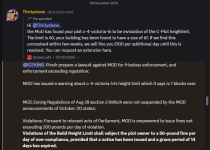
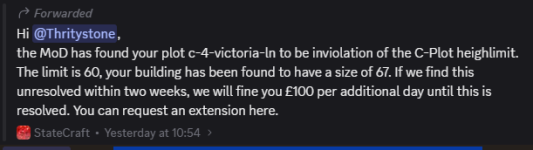
  2. MOD has issued a warning alleging that the property exceeds the build height limit by seven blocks.
  3. MOD has further threatened fines of £100 per day, despite its own regulations limiting such fines to £50 per day for build height violations.
II. Jurisdiction

  1. This Court has jurisdiction pursuant to the relevant Acts of Parliament governing zoning enforcement and administrative review.
III. Statement of Facts

  1. , MOD issued a warning to the Claimant regarding alleged violations of the build height limit.
  2. MOD claimed the property exceeded the permitted height by seven blocks.
  3. MOD threatened to impose fines of £100 per day of non-compliance.
  4. The applicable regulations, MOD Zoning Regulations of August 28, Section 2, expressly state:
    • Violations of the Build Height Limit shall subject the plot owner to a £50 fine per day, provided that notice has been issued and a grace period of 14 days has expired.
    • No provision authorizes MOD to impose fines exceeding £50 per day for build height violations.
  5. MOD’s announcements of October 31 did not suspend or amend Section 2 of the August 28 regulations.
IV. Causes of Action

Count 1 – Frivolous Enforcement


  1. MOD’s enforcement action is frivolous in nature, as it seeks to impose penalties beyond those authorized by its own regulations.
  2. Such conduct constitutes an abuse of administrative discretion and undermines the principles of fair enforcement.
Count 2 – Exceeding Regulatory Authority

  1. MOD’s threatened fines of £100 per day exceed the statutory and regulatory limits of £50 per day for build height violations.
  2. MOD is empowered to issue fines not exceeding £200 per day in general, but Section 2 specifically caps build height violations at £50 per day.
  3. By threatening fines in excess of this cap, MOD has acted ultra vires (beyond its legal authority).
V. Relief Requested

The Claimant respectfully requests that this Court:

· Declare MOD’s threatened enforcement action unlawful and void.

· Enjoin MOD from imposing fines exceeding £50 per day for build height violations.

· Order MOD to reimburse the Claimant’s legal expenses in the amount of £1500, representing the fees incurred in retaining legal services (SrICEKING) to contest MOD’s frivolous and excessive enforcement.

· Award any further relief this Court deems just and proper, including costs associated with defending against MOD’s extravagenting of fines beyond the regulatory limit.

VI. Conclusion

MOD’s actions represent both frivolous enforcement and enforcement exceeding regulation. The Claimant seeks judicial intervention to restrain MOD from continuing such unlawful practices.


Reference

Picture A
 

Attachments

  • A.PNG
    A.PNG
    21.5 KB · Views: 10
This appears to be something that the Magistrates' court is capable of handling and is within their original jurisdiction of handling civil matters - K.A Const. §III Art. 16

As such this case will be remanded down to the Magistrates' Court for their review.​
 
okay. but this is delaying so long
 
here is the proof
 

Attachments

  • aaa.PNG
    aaa.PNG
    71.2 KB · Views: 8
1759242443248.png
IN THE MAGISTRATES COURT OF ALEXANDRIA
WRIT OF SUMMONS
The Ministry of Development is required to appear before the Magistrates' Court In the case of
Stoned Enterprise Corp v. Ministry of Development, Case 1 (Mag Ct., 2026)
.

Failure to appear within 72 hours of this summons may result in a default judgment based on the known facts of the case.

All parties will make themselves aware of the Court Rules and Procedures (General and Magistrates).​
 
Soggeh T. Oast for the Ministry of Development, your honor.
 
IN THE MAGISTRATES COURT OF THE KINGDOM OF ALEXANDRIA
RESPONSE TO COMPLAINT

Stoned Enterprise Corp

Applicant/Plaintiff
v.

Ministry of Development
Respondent/Defendant

I. ANSWER TO COMPLAINT
1. The Crown AFFIRMS the MOD issued a warning to the Claimant regarding alleged violations of the build height limit.
2. The Crown AFFIRMS the MOD claimed the property exceeded the permitted height by seven blocks.
3. The Crown AFFIRMS that the MOD advised that non-compliance would result in fines of £150 per day.
4. The Crown AFFIRMS that MOD Zoning Regulations of August 28, Section 2, expressly state:
  • Violations of the Build Height Limit shall subject the plot owner to a £50 fine per day, provided that notice has been issued and a grace period of 14 days has expired.
However, the Crown DENIES the MOD Zoning Regulations of August 28 expressly state that no provision authorizes MOD to impose fines exceeding £50 per day for build height violations; however, the Crown acknowledges that MOD Zoning Regulations of August 28, Section 2 contain no provision that expressly authorizes MOD to impose fines exceeding £50 per day specifically for build height violations.
5. The Crown AFFIRMS the MOD’s announcements of October 31 did not suspend or amend Section 2 of the August 28 regulations.

II. DEFENSES
The Applicant simply has not articulated a coherent legal theory which establishes the necessity for any form of relief whatsoever. It is true that a warning was issued by the Ministry of Development, which advised that non-compliance would result in fines which succeed regulations imposed by their own internal ministry policy; however, these fines were never executed, the claimant never suffered financial loss, and the Applicant has failed to demonstrate any entitlement to relief. The Applicant has also argued the Ministry acted ultra vires, which is incorrect. The Ministry did not exceed its statutory authority granted by Parliament, and any departure from its own internal procedures, while problematic, does not constitute ultra vires conduct.

Respectfully submitted,

Soggeh T. Oast
Minister of Justice
Kingdom of Alexandria
 
Discovery shall now begin and last for seventy-two hours. Discovery may be abridged at the request of both parties, or extended if just cause is given.
 
Discovery has ended. Claimant has seventy-two hours to file their opening statement.
 
IN THE MAGISTRATES COURT OF THE KINGDOM OF ALEXANDRIA

Lux Group, Applicant/Plaintiff
v.
Ministry of Development, Respondent/Defendant

APPLICANT’S OPENING STATEMENT


Your Honor,

The Applicant, Lux Group LLC, respectfully submits this Opening Statement to clarify the core legal issues at stake and to demonstrate why the Respondent’s Answer is insufficient as a matter of law and fact.

I. The Central Issue: A Threat of Unlawful Action
This case does not concern whether a fine was collected, but whether a government ministry threatened to impose a fine it had no legal authority to impose. The Respondent’s Defense erroneously frames this as a mere internal procedural error with no consequence. This is a fundamental mischaracterization.

The Ministry of Development’s own promulgated Zoning Regulations of August 28 create a specific, limited penalty for build height violations: £50 per day, following notice and a 14-day grace period (Section 2). The Ministry’s warning to the Applicant explicitly threatened a fine of £150 per day—a penalty three times the lawful maximum.

A government agency’s formal threat to enforce a penalty that exceeds its statutory or regulatory authority is a quintessential example of ultra vires conduct. It is an assertion of a power not granted by law. The threat itself creates a tangible injury: it coerces compliance under an unlawful penalty scheme, distorts the legal relationship between the state and the citizen, and undermines the rule of law by placing the ministry above its own regulations.

II. The Respondent’s Admission and Flawed Defense
The Respondent’s Answer effectively concedes the pivotal fact. It AFFIRMS the warning threatened a £150/day fine. It AFFIRMS the August 28 regulations set a £50/day fine. It AFFIRMS no subsequent regulation amended this penalty. Its only hedge is a denial that the regulations “expressly state that no provision authorizes” a higher fine—a lawyerly distinction without a difference. The principle of delegated authority is clear: a ministry possesses only the powers expressly or necessarily granted. There is no grant of authority for a 300% penalty increase.

The Defense that “no fine was ever executed” and “no financial loss was suffered” is irrelevant and dangerously flawed. It suggests a ministry may threaten any unlawful action with impunity, so long as it does not finally execute it. This would eviscerate judicial review and allow the state to bully citizens with baseless threats. The injury is the threat of unlawful action, not merely its culmination.

Furthermore, the Defense’s claim that departing from “internal procedures… does not constitute ultra vires conduct” is incorrect. When those “internal procedures” are in fact the publicly promulgated regulations that define the scope of the ministry’s enforcement powers, a violation is a direct act beyond its legal authority.

III. The Need for Relief
The Applicant seeks a declaratory judgment from this Court. We require a clear ruling that:

  1. The Ministry of Development’s threatened fine of £150 per day for a build height violation exceeded its authority under the Zoning Regulations of August 28.
  2. The Ministry is bound by the penalties set forth in its own regulations.
Such a declaration is necessary and proper. It will prevent the Ministry from applying this unlawful penalty against the Applicant or any other citizen in the future. It reaffirms that the government and its citizens are equally bound by the law as written.

The Respondent’s position—that it can threaten penalties it cannot lawfully impose—is unsustainable. The Court should reject it, clarify the law, and grant the requested relief.

Respectfully submitted,

SrICEKING
legal Representive
 
Defendant now has seventy-two hours to file their opening statement.
 
Please note I have resigned from magistrate and am no longer on this case :giggle:
 
IN THE MAGISTRATES COURT OF THE KINGDOM OF ALEXANDRIA
ENTREATY FOR CONTINUANCE


Your Honor,

Web servers have suffered outages over the last few days, which has made it difficult to write and submit our opening statement. The Crown respectfully requests a 48-hour entreaty for continuance.

Respectfully submitted,

Soggeh T. Oast
Minister of Justice
Kingdom of Alexandria
 
IN THE MAGISTRATES COURT OF THE KINGDOM OF ALEXANDRIA
OPENING STATEMENT

Stoned Enterprise Corp

Applicant/Plaintiff
v.

Ministry of Development
Respondent/Defendant

I. NO ULTRA VIRES ACTION OR COGNIZABLE INJURY
The Ministry's regulations impose limits on what the Ministry can do, not what it may say in its communications.

The Applicant has claimed the Ministry acted beyond its authority by citing penalties of an amount which they were not explicitly authorized to impose. Ministry regulations clearly limit which fines may be imposed, but are silent on the content of Ministry notifications. The Applicant has repeatedly claimed ultra vires conduct but has failed to cite any regulation that legally prohibits the Ministry’s communications from containing inaccuracies. Relief requires a concrete injury. Here, the Ministry did not impose fines or take any enforcement action. Their alleged "uncertainty" is self-inflicted. They do not claim to have ever contacted the Ministry to clarify the notification of non-compliance.

The Ministry has already acknowledged that an incorrect penalty amount was cited. The Applicant has not identified any prejudice resulting from this mistake, nor have they implied a particular outcome would have occurred absent this error. The fines in question were never imposed, the claimant never suffered financial loss, and has not even alleged any change in business operations. Granting a declaratory judgment for self-inflicted injury is inappropriate. The Applicant purports to desire the resolution of a real dispute, but is instead seeking an advisory opinion which the court should not provide.

II. FAILURE TO EXHAUST EXISTING REMEDIES.
The Applicant does not allege that they contacted the Ministry to seek clarification or informal resolution. Channels through which the Applicant may have contacted the Ministry of Development directly for clarification or informal resolution already existed. Instead of notifying the Ministry to clarify alleged uncertainty, the Applicant has manufactured standing through deliberate inaction.

III. CONCLUSION
Moreover, the Applicant has asked this Court to create new law or regulation where none presently exists. How to regulate the accuracy of administrative notifications is a legislative or regulatory question, not a matter for judicial intervention. The Constitution vests the judiciary with the authority to interpret the law, not to create standards for government communications.

The Ministry's regulations bind its enforcement actions, not its correspondents. No enforcement action was taken, and no financial loss was incurred; where the Applicant had administrative resolutions available, they failed to pursue them. The Applicant has not so much as claimed any change in conduct occurred, and any losses incurred by the deliberate choice to seek judicial remedy where a process for administrative remedy already existed are self-inflicted.

IN SUMMARY:
  • The Ministry’s regulations govern enforcement actions, not the content of its communications.
  • No enforcement occurred, no financial loss was suffered, and the Applicant failed to pursue available administrative remedies.
  • The Applicant’s claimed uncertainty is self-inflicted, and the request for declaratory relief amounts to an advisory opinion beyond the judiciary’s constitutional authority.
Respectfully submitted,

Soggeh T. Oast
Ministry of Justice
Kingdom of Alexandria
 
IN THE MAGISTRATES COURT OF THE KINGDOM OF ALEXANDRIA
CLOSING STATEMENT

Stoned Enterprise Corp

Applicant/Plaintiff
v.

Ministry of Development
Respondent/Defendant

Your Honor,

I. REQUEST FOR ADVISORY OPINION
The Applicant seeks an advisory opinion which is in violation of the principle of justiciability. They have asked the Court to rule on a question regarding Ministry communications that has no legal or statutory basis. They have argued for "entitlement" based on moral or ethical considerations rather than on established law. Because no statute or regulation governs the content or accuracy of such communications, no declaratory judgment is possible, as there is no law for the Court to declare or interpret.

More fundamentally, they seek a ruling on a matter that remains premature and unnecessary. This is a hypothetical grievance not directly connected to any concrete injury which requires judicial remedy. The Applicant accuses the Crown of being "sophistic" while simultaneously arguing that declaratory judgment is necessary as "a correction of a state actor's misstatement of the law." Yet they have produced no statute, regulation, or legal standard that governs alleged miscommunications about the law. Without any legal foundation, this Court should not issue the declaratory relief they have asked for.

II. NO JUSTICIABLE CONTROVERSY
Courts must rule only on issues which they must necessarily adjudicate to establish factual premises pursuant to relief for some concrete, articulated injury. The Applicant has identified no such injury, and consequently no factual premise requiring this Court's determination. The Court has therefore been asked to provide a ruling on a question that does not actually arise from the facts before it — which is by definition an advisory opinion.

The Crown has already demonstrated, without meaningful rebuttal from the Applicant, that adequate relief exists through established channels. The Applicant received notice of a minor fine contingent upon their failure to lower their build plot height. Rather than engage with available administrative processes, the Applicant bypassed existing remedies and immediately initiated litigation.

This Court should grant relief only to those who have suffered direct injury through statutory or administrative error, not to those who manufacture controversy through their own decisions. Litigation may constitute a legitimate expense when necessary to secure relief to which a party is entitled. But litigation expenses cannot themselves be the sole basis for relief, particularly where the party voluntarily chose litigation over readily available alternatives. The Applicant has, entirely of their own accord and without procedural compulsion, sidestepped existing communication channels through which they could have sought clarification or correction.

II. NO CONCRETE INJURY WHICH DEMANDS REMEDY
While the Applicant has suggested that notice of the build-height violation constituted an ultra vires injury, they have failed to cite any statute which was violated, or justify any claim for relief that would actually remedy such an injury. An unjustifiable allegation without a corresponding request for meaningful relief must not be entertained. Their legal argument is, essentially, that being put on notice of a fine is practically equivalent to suffering the execution of that fine, which is absurd.

The Applicant asks this Court to expand on questions of legal authority while articulating no concrete injury beyond self-imposed litigation costs. This clearly constitutes an advisory opinion, and this Court should decline to rule on matters which are not necessary in the adjudication of facts pursuant to some concrete claim for relief. Providing the declaratory judgement which the Applicant has demanded would amount to unnecessary policy-making, exceeding what this Court is constitutionally empowered to do. The proper recourse for this miscommunication error lies in Parliament, not in the courts.

IN SUMMARY:
  • No statute or regulation governs Ministry communications, making declaratory judgment impossible.
  • No fine was executed and no concrete injury was suffered.
  • The Applicant bypassed available administrative remedies and proceeded directly to litigation.
  • The only concrete basis for relief is self-imposed and unnecessary litigation costs.
  • The requested relief constitutes an advisory opinion on hypothetical questions of authority.​
Respectfully Submitted,

Soggeh T. Oast
Minister of Justice
Kingdom of Alexandria
 
Greetings to all parties.
The Honorable Magistrate AmityBlamity has kindly allowed me to preside over this case.

Court is now in recess pending verdict.
 
  • Love
Reactions: Nim
Back
Top