Lawsuit: Adjourned Ameslap v. Crown, Case 12 (Ch. 2025)

Status
Not open for further replies.
IN THE CHANCERY OF THE KINGDOM OF ALEXANDRIA
CLOSING STATEMENT

INTRODUCTION

Throughout these proceedings, the Crown has demonstrated that the playtime requirement constitutes a constitutional, reasonable, and justified limitation on the constitutional right to run for office. The evidence establishes three key propositions:

  1. The requirement serves a legitimate purpose;
  2. It is based on objective, independently verifiable criteria;
  3. It was uniformly enforced across all candidates, without exception
WITNESS TESTIMONY

1. UNIQUELY SERVED A LEGITIMATE PURPOSE

Minister Thritystone testified that the playtime requirement clearly measures specific elements of competency that neither the waiting period nor the citizenship exam addresses. As he stated, playtime is a condition for participation in the administrative process. The Crown has repeatedly argued that without the playtime requirement, unqualified and uninformed individuals could become members of Parliament and jeopardize its efficacy and integrity. As a Minister and Member of Parliament, the witness's testimony clearly evidences a legitimate connection between playtime and legislative competency.

2. USE OF VERIFIABLE DATA
The Witness confirmed that the Ministry used data obtained through the /about command, which is accessible to all citizens. Additionally, he stated that violations of the playtime requirement were well documented with timestamped screenshots, creating an independently verifiable record.

3. NO PERSONAL OR DISCRETIONARY JUDGEMENT
Minister Thritystone confirmed unequivocally that no personal or discretionary judgment was exercised, and all decisions were made with strict adherence to the law.

4. UNIFORM APPLICATION ACROSS ALL CANDIDATES
The witness confirmed the playtime requirement was enforced across all candidates, without exception.

THE CITIZENSHIP EXAM AND JUDICIARY PRECEDENT
Ministry Thritystone’s testimony demonstrates that the playtime requirement clearly serves a distinct purpose that neither the citizenship exam nor the waiting period fulfills. The Minister, when asked what specific competency the playtime requirement measures that other requirements do not, explained that, unlike other qualification mechanisms, the playtime requirement measures candidates' knowledge of the effects of implemented policy.

The Crown reiterates that the playtime requirement uniquely serves a legitimate purpose. It argues, however, that whether or not the citizenship exam could theoretically serve a similar purpose to the playtime requirement is not at issue in this case. According to previous judicial precedent,
"Parliament may choose from a range of reasonable solutions for a given problem, even when one solution may obviously impact rights and liberties more than another." See ColonelKai v. Crown, Case 8 (Ch. 2025). In this case, the Chancery clearly stated that Parliament does not need to find some objective "minimum rights infringed." It was stated that "it is unreasonable to believe that Parliament must always find some objective 'minimum rights infringed' point along the spectrum of possible solutions to a given issue."

ON THE "TWO CLASSES OF CITIZENS" ARGUMENT
Plaintiff's claim that this law creates two classes of citizenship, wherein one has separate rights from the other, is patently false. Every citizen has equal protection under the law, under which they are free to exercise their right to run for office as they please, so long as they meet this reasonable standard imposed by Parliament. "Two classes of citizens" would imply some citizens have the right to run for office, while others do not, based on some immutable individual characteristic. The same reasonable standard has been imposed on all candidates across the board, regardless of any party affiliation or personal characteristics. The playtime requirement is a neutral, objective qualification that any citizen can satisfy.

SUMMARY:

  • Witness testimony has established that the playtime requirement is a reasonable, objective, and uniformly applied law that uniquely serves its legitimate purpose.
  • Previous precedent confirms that Parliament does not need to find some 'objective "minimum rights infringed" point along the spectrum.'
  • The playtime requirement clearly does not create "two classes of citizenship."
Respectfully submitted,

Soggeh T. Oast
Minister of Justice
Kingdom of Alexandria
 
The Crown shall have seventy-two hours to submit its closing statement.

IN THE CHANCERY OF THE KINGDOM OF ALEXANDRIA
CLOSING STATEMENT

INTRODUCTION

Throughout these proceedings, the Crown has demonstrated that the playtime requirement constitutes a constitutional, reasonable, and justified limitation on the constitutional right to run for office. The evidence establishes three key propositions:

  1. The requirement serves a legitimate purpose;
  2. It is based on objective, independently verifiable criteria;
  3. It was uniformly enforced across all candidates, without exception
WITNESS TESTIMONY

1. UNIQUELY SERVED A LEGITIMATE PURPOSE

Minister Thritystone testified that the playtime requirement clearly measures specific elements of competency that neither the waiting period nor the citizenship exam addresses. As he stated, playtime is a condition for participation in the administrative process. The Crown has repeatedly argued that without the playtime requirement, unqualified and uninformed individuals could become members of Parliament and jeopardize its efficacy and integrity. As a Minister and Member of Parliament, the witness's testimony clearly evidences a legitimate connection between playtime and legislative competency.

2. USE OF VERIFIABLE DATA
The Witness confirmed that the Ministry used data obtained through the /about command, which is accessible to all citizens. Additionally, he stated that violations of the playtime requirement were well documented with timestamped screenshots, creating an independently verifiable record.

3. NO PERSONAL OR DISCRETIONARY JUDGEMENT
Minister Thritystone confirmed unequivocally that no personal or discretionary judgment was exercised, and all decisions were made with strict adherence to the law.

4. UNIFORM APPLICATION ACROSS ALL CANDIDATES
The witness confirmed the playtime requirement was enforced across all candidates, without exception.

THE CITIZENSHIP EXAM AND JUDICIARY PRECEDENT
Ministry Thritystone’s testimony demonstrates that the playtime requirement clearly serves a distinct purpose that neither the citizenship exam nor the waiting period fulfills. The Minister, when asked what specific competency the playtime requirement measures that other requirements do not, explained that, unlike other qualification mechanisms, the playtime requirement measures candidates' knowledge of the effects of implemented policy.

The Crown reiterates that the playtime requirement uniquely serves a legitimate purpose. It argues, however, that whether or not the citizenship exam could theoretically serve a similar purpose to the playtime requirement is not at issue in this case. According to previous judicial precedent,
"Parliament may choose from a range of reasonable solutions for a given problem, even when one solution may obviously impact rights and liberties more than another." See ColonelKai v. Crown, Case 8 (Ch. 2025). In this case, the Chancery clearly stated that Parliament does not need to find some objective "minimum rights infringed." It was stated that "it is unreasonable to believe that Parliament must always find some objective 'minimum rights infringed' point along the spectrum of possible solutions to a given issue."

ON THE "TWO CLASSES OF CITIZENS" ARGUMENT
Plaintiff's claim that this law creates two classes of citizenship, wherein one has separate rights from the other, is patently false. Every citizen has equal protection under the law, under which they are free to exercise their right to run for office as they please, so long as they meet this reasonable standard imposed by Parliament. "Two classes of citizens" would imply some citizens have the right to run for office, while others do not, based on some immutable individual characteristic. The same reasonable standard has been imposed on all candidates across the board, regardless of any party affiliation or personal characteristics. The playtime requirement is a neutral, objective qualification that any citizen can satisfy.

SUMMARY:

  • Witness testimony has established that the playtime requirement is a reasonable, objective, and uniformly applied law that uniquely serves its legitimate purpose.
  • Previous precedent confirms that Parliament does not need to find some 'objective "minimum rights infringed" point along the spectrum.'
  • The playtime requirement clearly does not create "two classes of citizenship."
Respectfully submitted,

Soggeh T. Oast
Minister of Justice
Kingdom of Alexandria
OBJECTION - Procedural Breach

The Crown was late to post their closing remarks and I ask that they be struck from the record and have sanctions brought against them.

Time to Post started at 9:31 PM on October 9.

Posted at 12:33 AM on October 13.
All times in MDT

Time to Post In Hours: 75.033. This is more than the 72 permitted. Note that the Crown did not request an extension or give any reason for their delay when posting them.

Thank you,
Ameslap
 
RESPONSE TO OBJECTION - PROCEDURAL BREACH

The Crown's closing statement was indeed made a few hours after the 72-hour mark. Various factors caused this, but it was due primarily to a timezone issue on my side of the forums, resulting in the displayed time of the Chancery's instruction for closing statements being several hours off. This delay was the result of an unintended timezone discrepancy on my side of the forums, which caused the deadline to appear later than it in fact was. This issue has been addressed by changing my forum's timezone settings. It will not occur again, and I personally take full responsibility.

Moreover, the Ministry has been suffering from manpower issues. The Kingdom's recent political chaos, including the dissolution of Parliament and the resignation of our Solicitor General last night, has further temporarily burdened the functions of the Ministry and contributed to this delayed explanation.

This mistake has no bearing on the merits of this case, and the three-hour delay constitutes only an immaterial procedural irregularity at most. It certainly does not warrant the striking of the Crown's closing statements on a case of such significance.

Respectfully submitted,

Soggeh T. Oast
Minister of Justice
Kingdom of Alexandria
 
OBJECTION - Procedural Breach

The Crown was late to post their closing remarks and I ask that they be struck from the record and have sanctions brought against them.

Time to Post started at 9:31 PM on October 9.

Posted at 12:33 AM on October 13.
All times in MDT

Time to Post In Hours: 75.033. This is more than the 72 permitted. Note that the Crown did not request an extension or give any reason for their delay when posting them.

Thank you,
Ameslap
RESPONSE TO OBJECTION - PROCEDURAL BREACH

The Crown's closing statement was indeed made a few hours after the 72-hour mark. Various factors caused this, but it was due primarily to a timezone issue on my side of the forums, resulting in the displayed time of the Chancery's instruction for closing statements being several hours off. This delay was the result of an unintended timezone discrepancy on my side of the forums, which caused the deadline to appear later than it in fact was. This issue has been addressed by changing my forum's timezone settings. It will not occur again, and I personally take full responsibility.

Moreover, the Ministry has been suffering from manpower issues. The Kingdom's recent political chaos, including the dissolution of Parliament and the resignation of our Solicitor General last night, has further temporarily burdened the functions of the Ministry and contributed to this delayed explanation.

This mistake has no bearing on the merits of this case, and the three-hour delay constitutes only an immaterial procedural irregularity at most. It certainly does not warrant the striking of the Crown's closing statements on a case of such significance.

Respectfully submitted,

Soggeh T. Oast
Minister of Justice
Kingdom of Alexandria
This objection is sustained in part. The Crown is clearly late in their response, and did not ask for an extension. While the Court understands very clearly the manpower issues and is sympathetic, it is necessary to hold the Crown in contempt, and fine them £100. However, it would be ridiculous to remove the Crown's ability to respond, especially for a mere few hours. We will not strike their filing.

This Court shall now stand in recess until a verdict is rendered.
 
it is necessary to hold the Crown in contempt, and fine them £100
ENTREATY OF PROMPTING
Your Honor, I request some information on this.

Is the Crown, as an entity, in contempt and fined, or is the individual counsel found in contempt and fined.

Materially, this makes a big difference.

  • If the Crown as an entity is found in contempt, I request that the fine be paid either to the opposing counsel or put in a reserve fund for Parliament to designate at a later point. While accounts may be seperate, the Government as a whole holds all of the funds for itself. For the Crown to fine themselves would be akin to giving myself £100, which is to say that nothing happened.
  • If the counsel is held in contempt, I request that that be clarified so the Crown knows to fine the individual.

Thank you,
Ameslap
 
ENTREATY OF PROMPTING
Your Honor, I request some information on this.

Is the Crown, as an entity, in contempt and fined, or is the individual counsel found in contempt and fined.

Materially, this makes a big difference.

  • If the Crown as an entity is found in contempt, I request that the fine be paid either to the opposing counsel or put in a reserve fund for Parliament to designate at a later point. While accounts may be seperate, the Government as a whole holds all of the funds for itself. For the Crown to fine themselves would be akin to giving myself £100, which is to say that nothing happened.
  • If the counsel is held in contempt, I request that that be clarified so the Crown knows to fine the individual.

Thank you,
Ameslap
I'm sorry, but as a private citizen suing in a private matter, you do not have standing to ask for clarification on this subject. It is a matter wholly unrelated to you and your issues here.
 
ENTREATY OF AMENDMENT
Your honor,

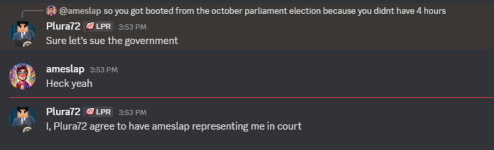
Since this case first began, another instance of harm on the same basis and methodology has occurred.

Given the request and ruling in Plura72 v Crown. The Plaintiff requests to amend their complaint, both to add Plura as an additional Plaintiff, to amend the facts to show when Plura72 was harmed, as this happened during a different time than the initial set of facts presented here, and to finally amend the claims for relief to include relief that satisfies the new Plaintiff.

1761923791820.png
 
ENTREATY OF AMENDMENT
Your honor,

Since this case first began, another instance of harm on the same basis and methodology has occurred.

Given the request and ruling in Plura72 v Crown. The Plaintiff requests to amend their complaint, both to add Plura as an additional Plaintiff, to amend the facts to show when Plura72 was harmed, as this happened during a different time than the initial set of facts presented here, and to finally amend the claims for relief to include relief that satisfies the new Plaintiff.

This case is in recess. This is denied.
 

CCA.png
IN THE CHANCERY OF
THE KINGDOM OF ALEXANDRIA
VERDICT


Written by High Chancellor AsexualDinosaur, joined by Chancellor Juniperfig.

Summary of parties positions

The only fact in dispute in this case is whether or not the removal of Ameslap as a candidate was unconstitutional.

It is the applicant's position that the restrictions applied onto candidates within A.P.018 are unconstitutional specifically because of the constitutional right K. A. Const. § V Art. 22.1 ‘Every citizen has the right to participate in and run for office’ and in support of this further suggests id. at § V Art. 22 is meant to target only some rights and freedoms - not all.
Applicant also argues that the restrictions themselves were not justified, and that the Crown’s argument that it would prevent ‘uninformed and unqualified’ candidates from participating would be a ‘slippery slope’.

The Crown’s position is that the constitution doesn’t prohibit the government from regulating rights and freedoms, citing id. and suggests that the right to run for office is subject to reasonable restrictions by Parliament.
The Crown also defends their position by reiterating that the limitations outlined are reasonable and justified because the requirements serve the legitimate purpose of ensuring that every member of Parliament maintains the requisite knowledge of the Kingdom’s affairs necessary.


Limitations of Rights and Freedoms

The argument to prevent Parliament from being able to limit specific rights that were not given outlines, we find to be incorrect. id. very specifically says ‘The following rights and freedoms are guaranteed as stated, subject only to such reasonable limits prescribed by law that are justified in a free and democratic society.’

The former honourable High Chancellor Smallfries notes specifically on this right in the case of ColonelKai v. Crown [Case 8 ch. 2025] - II.a - ‘Rights granted by the Constitution—including to run for office—are subject only to reasonable limits justified in a free and democratic society.’


Two-Tiered Citizenship

The Crown correctly notes that imposing limitations onto a right does not on its own, create a secondary ‘class.’ In this case they are still citizens and have the same types of rights afforded to them. They are still able to run for Parliament provided they meet the requirements to run. This contrasts with Tourists who strictly do not have the right to vote or run in elections even if they were to meet the requirements to run.
This does not mean that citizens who are unable to meet playtime requirements or other potential requirements are ‘less equal than others.’ All citizens have the same ability to meet this metric and as such are equally equal.


Slippery Slope

The applicant cites many hypothetical scenarios in which Parliament could attempt to restrict a candidate's right to run that may or may not be unjustified or reasonable.
While we avoid addressing each hypothetical, we will address the broad concept.

Should this court allow the restrictions on candidates, that does not give Parliament a free pass to apply restrictions without a care. Rights and freedoms may be limited if the limitations themselves are reasonable and justified. The way in which to challenge these, is through the courts - and the courts would make that determination.
We do not find this argument of a ‘slippery slope’ compelling for this reason.


Limits of limits

K. A. Const. § V Art. 22.2 - This particular right granted towards citizens is given a unique stipulation.
'Every citizen has the right to vote in elections and referendums provided the player meets the citizenship requirements set by law.'
The applicant makes the argument that this line singularly limits the rights afforded to citizens and that no other rights may be limited without enumerated limitations.

This segment actually reads as it’s intended to limit the limitations allowed towards this right.
That is to say that if Parliament were to attempt to limit a citizen's right to vote in elections and referendums outside of citizenship requirements, then it would be in violation of this section.


Reasonable and Justified

We’re left with the question of whether or not creating playtime requirements for candidates, either in the form of total playtime or active playtime - Is a reasonable limitation applied towards the right to participate and run for office.

We find that a limitation of playtime is a reasonable metric to apply towards the running of office. While playtime alone cannot ensure that a citizen would be qualified or informed, it does create a higher potential for being qualified and or informed of the conditions that our Kingdom is in.

Parliament wanting to ensure that those who sit within its chambers are active members of our community is a justifiable goal.


Conclusion

It is not an unreasonable limitation of rights for Parliament to limit the rights of citizens to participate in an election using playtime requirements either via ‘Active Playtime’ or ‘Total Playtime’.
Particularly it was not unconstitutional for the applicant to be removed as a candidate in the election, and further that the playtime requirements outlined for candidates within A.P.018 are constitutional limitations.
As such, the removal of Ameslap was not unconstitutional.

As an implication of the interpretation surrounding limits of limits, this court finds that id. at § 15.1.a is an unconstitutional limitation onto citizens in reference to K. A. Const. § V Art. 22.2
Should Parliament choose to have a limitation such as this, it should be made as part of the citizenship requirements.


Thanks to all parties for their time and patience.
 
Status
Not open for further replies.
Back
Top