Lawsuit: Pending The Crown v. Thritystone & 12700k, Case 3 (Mag. Ct., 2026)

12700k has failed to present their plea. As they had previously made themselves known to this court, and they are currently an active player on Statecraft, they will be subject to default judgement, to be ruled on at the conclusion of the case.

@ColonelKai @Capt11543 @SoggehToast You have 72 hours to present opening arguments.
 
12700k has failed to present their plea. As they had previously made themselves known to this court, and they are currently an active player on Statecraft, they will be subject to default judgement, to be ruled on at the conclusion of the case.

@ColonelKai @Capt11543 @SoggehToast You have 72 hours to present opening arguments.
Your honor, if I’m not mistaken, I still have approximately 30 minutes to plea?
 
And I would like to notify the court of ongoing negotiations to reach a plea agreement with the Plaintiff.
 
Your Honor. 12700k/FTLCEO has no representation in this court. As of this moment, he has not been assigned a public defender, nor does he have private counsel to advocate on his behalf. Under A.P. 01-006 § 14(1), all players have the right to legal representation at all critical stages of the legal process.
 
OFFICIAL STATEMENT FROM THE LEGAL REPRESENTATIVE OF 12700K

My client, 12700K, hereby formally enters a plea of NOT GUILTY to each and every charge enumerated in the indictment, specifically:

a. Conspiracy to violate CCPA Sec. 21(3)(b);
b. One count of violating CCPA Sec. 21(3)(b) - Bribery;
c.Conspiracy to violate CCPA Sec. 20(6)(d) - Election Fraud;
d.Attempt to violate CCPA Sec. 20(6)(d) - Election Fraud.

MEMORANDUM OF DEFENSE FOR THE ACCUSED, 12700K

The defense respectfully submits the following grounds for the dismissal of all four (4) charges, based on fundamental deficiencies in the prosecution’s case.

I. FAILURE TO MEET THE BURDEN OF PROOF & INSUFFICIENT EVIDENCE

Pursuant to the Rules of Evidence Act and legal framework omnibus Act, the prosecution bears the affirmative burden of proving each element of the alleged offenses beyond a reasonable doubt. The proffered evidence—specifically Exhibits P-013, P-014, P-015, and P-016 is manifestly insufficient to sustain this burden, particularly concerning the essential elements of bribery and election fraud.

Critical Absence of a Quid Pro Quo (Money Transfer) Nexus: The core of a bribery charge under CCPA Sec. 21(3)(b) requires evidence of a corrupt exchange. The prosecution’s exhibits are wholly devoid of any documentation, record, or credible testimony demonstrating a financial transaction or transfer of valuables from the accused to any voter or election official. No “quid pro quo”(Money Transfer) has been established, thereby vitiating the very foundation of the bribery and related conspiracy charges.

II. IMPERMISSIBLE AND EXTRA-JURISDICTIONAL EVIDENCE

The defense objects to the admission of evidence sourced from outside the jurisdiction of this Court, as its consideration constitutes a reversible error.

Violation of the Rules of Evidence Act: As stipulated in Section EVO-1(support evidence attached) of the aforementioned Act, evidence submitted in proceedings before this Magistrate Court must be solely drawn from StateCraft (Alexandria). This is not a mere procedural formality but a jurisdictional prerequisite ensuring the integrity and applicability of evidence. Any material originating from DemocracyCraft (Redmont) is, by statutory definition, inadmissible as it falls outside the competent jurisdiction of this tribunal. To rely on such extrinsic evidence would be prejudicial and contrary to established legal procedure as established by The Rules of Evidence ACT , Civil Procedure ACT and the Judiciary ACT.

CONCLUSION

Based on the insufficiency of evidence to meet the statutory burden of proof and the improper submission of extra-jurisdictional evidence, the prosecution has failed to establish a prima facie case against 12700K. The charges are legally unsupported and must be dismissed in the interests of justice.

Respectfully submitted,

SrICEKING
Legal Representative for 12700K

Reference
 

Attachments

  • P-013.png
    P-013.png
    1.3 MB · Views: 2
  • P-014.png
    P-014.png
    1.3 MB · Views: 2
  • P-015.png
    P-015.png
    1.1 MB · Views: 1
  • P-016.png
    P-016.png
    1.9 MB · Views: 2
OFFICIAL STATEMENT FROM THE LEGAL REPRESENTATIVE OF 12700K

My client, 12700K, hereby formally enters a plea of NOT GUILTY to each and every charge enumerated in the indictment, specifically:

a. Conspiracy to violate CCPA Sec. 21(3)(b);
b. One count of violating CCPA Sec. 21(3)(b) - Bribery;
c.Conspiracy to violate CCPA Sec. 20(6)(d) - Election Fraud;
d.Attempt to violate CCPA Sec. 20(6)(d) - Election Fraud.

MEMORANDUM OF DEFENSE FOR THE ACCUSED, 12700K

The defense respectfully submits the following grounds for the dismissal of all four (4) charges, based on fundamental deficiencies in the prosecution’s case.

I. FAILURE TO MEET THE BURDEN OF PROOF & INSUFFICIENT EVIDENCE

Pursuant to the Rules of Evidence Act and legal framework omnibus Act, the prosecution bears the affirmative burden of proving each element of the alleged offenses beyond a reasonable doubt. The proffered evidence—specifically Exhibits P-013, P-014, P-015, and P-016 is manifestly insufficient to sustain this burden, particularly concerning the essential elements of bribery and election fraud.

Critical Absence of a Quid Pro Quo (Money Transfer) Nexus: The core of a bribery charge under CCPA Sec. 21(3)(b) requires evidence of a corrupt exchange. The prosecution’s exhibits are wholly devoid of any documentation, record, or credible testimony demonstrating a financial transaction or transfer of valuables from the accused to any voter or election official. No “quid pro quo”(Money Transfer) has been established, thereby vitiating the very foundation of the bribery and related conspiracy charges.

II. IMPERMISSIBLE AND EXTRA-JURISDICTIONAL EVIDENCE

The defense objects to the admission of evidence sourced from outside the jurisdiction of this Court, as its consideration constitutes a reversible error.

Violation of the Rules of Evidence Act: As stipulated in Section EVO-1(support evidence attached) of the aforementioned Act, evidence submitted in proceedings before this Magistrate Court must be solely drawn from StateCraft (Alexandria). This is not a mere procedural formality but a jurisdictional prerequisite ensuring the integrity and applicability of evidence. Any material originating from DemocracyCraft (Redmont) is, by statutory definition, inadmissible as it falls outside the competent jurisdiction of this tribunal. To rely on such extrinsic evidence would be prejudicial and contrary to established legal procedure as established by The Rules of Evidence ACT , Civil Procedure ACT and the Judiciary ACT.

CONCLUSION

Based on the insufficiency of evidence to meet the statutory burden of proof and the improper submission of extra-jurisdictional evidence, the prosecution has failed to establish a prima facie case against 12700K. The charges are legally unsupported and must be dismissed in the interests of justice.

Respectfully submitted,

SrICEKING
Legal Representative for 12700K

Reference
Is your client retracting their previous plea of "no contest"?
 
Alright. Your client will still face a fine for Contempt of Court for missing the initial deadline (100 SC pounds).

We'll reopen Discovery for 72 hours, or we can end it sooner if both parties agree.

@ColonelKai @SrICEKING
 
IN THE MAGISTRATE'S COURT OF THE KINGDOM OF ALEXANDRIA
ENTREATY OF PROMPTING


Your Honor,

The Crown respectfully seeks clarification as to whether the Court in fact anticipates the filing of the Crown’s opening statement tomorrow in accordance with (#41), given that such a requirement at this stage would be procedurally unusual in light of the reopening of Discovery.

Respectfully Submitted,

Soggeh T. Oast
MInister of Justice
KIngdom of Alexandria
 
IN THE MAGISTRATE COURT OF ALEXANDRIA

ENTREATY FOR DISMISS

Your Honor,

Counsel for the Defendant, 12700K, respectfully submits this entreaty for the dismissal of all charges presently before this Court. My client reaffirms his plea of NOT GUILTY to each count in the indictment.

The grounds for this motion are rooted in a fatal legal and evidentiary deficiency that voids the prosecution’s case in its entirety.

I. THE PROSECUTION’S CASE IS LEGALLY INSUSTAINABLE

The charges hinge upon evidence which this Court is statutorily barred from considering. Section 1(a) of the Criminal Code and Procedure Act explicitly mandates that “The Minister of Justice shall enforce all criminal law within the jurisdiction of Alexandria.”

A principled interpretation of this statute establishes a clear jurisdictional boundary: the enforcement authority—and by necessary extension, the adjudicative authority of this Court—is confined to criminal matters arising from and substantiated by evidence within the sovereign jurisdiction of StateCraft (Alexandria). Consequently, evidence procured from the foreign jurisdiction of DemocracyCraft (Redmont) is inadmissible perses.

The prosecution’s reliance on such extra-jurisdictional material constitutes a fundamental legal error. To permit its use would contravene the express territorial limits of this Court’s authority and the enforcement framework established by Parliament.

II. RESULTANT ABSENCE OF PRIMA FACIE EVIDENCE

With the extra-jurisdictional evidence deemed void and inadmissible, the prosecution’s case collapses. No competent or admissible evidence remains to establish a prima facie case against the accused for the alleged violations of CCPA Sec. 21(3)(b) and Sec. 20(6)(d). The prosecution cannot meet its burden of proof where the foundational evidence is legally null.

PRAYER FOR RELIEF

Wherefore, for the reasons stated herein, the Defense respectfully PRAYS that this Honorable Court:
1. Sustain our objection to all evidence originating from DemocracyCraft (Redmont).
2. Find that the prosecution has failed to present a legally sufficient, admissible case.
3. Dismiss all charges against the Defendant, 12700K, with prejudice.

Respectfully submitted,

SrICEKING
Legal Representative for Defendant 12700K


Support Material
1770316021744.png


Below is the legal evidence provided by the prosecution. in support of the present charges against my client
P-016.png

P-015.png


P-014.png

p-013-png.1265
 

Attachments

  • P-014.png
    P-014.png
    1.3 MB · Views: 0
  • P-013.png
    P-013.png
    1.3 MB · Views: 24
IN THE MAGISTRATE COURT OF ALEXANDRIA

ENTREATY FOR DISMISS

Your Honor,

Counsel for the Defendant, 12700K, respectfully submits this entreaty for the dismissal of all charges presently before this Court. My client reaffirms his plea of NOT GUILTY to each count in the indictment.

The grounds for this motion are rooted in a fatal legal and evidentiary deficiency that voids the prosecution’s case in its entirety.

I. THE PROSECUTION’S CASE IS LEGALLY INSUSTAINABLE

The charges hinge upon evidence which this Court is statutorily barred from considering. Section 1(a) of the Criminal Code and Procedure Act explicitly mandates that “The Minister of Justice shall enforce all criminal law within the jurisdiction of Alexandria.”

A principled interpretation of this statute establishes a clear jurisdictional boundary: the enforcement authority—and by necessary extension, the adjudicative authority of this Court—is confined to criminal matters arising from and substantiated by evidence within the sovereign jurisdiction of StateCraft (Alexandria). Consequently, evidence procured from the foreign jurisdiction of DemocracyCraft (Redmont) is inadmissible perses.

The prosecution’s reliance on such extra-jurisdictional material constitutes a fundamental legal error. To permit its use would contravene the express territorial limits of this Court’s authority and the enforcement framework established by Parliament.

II. RESULTANT ABSENCE OF PRIMA FACIE EVIDENCE

With the extra-jurisdictional evidence deemed void and inadmissible, the prosecution’s case collapses. No competent or admissible evidence remains to establish a prima facie case against the accused for the alleged violations of CCPA Sec. 21(3)(b) and Sec. 20(6)(d). The prosecution cannot meet its burden of proof where the foundational evidence is legally null.

PRAYER FOR RELIEF

Wherefore, for the reasons stated herein, the Defense respectfully PRAYS that this Honorable Court:
1. Sustain our objection to all evidence originating from DemocracyCraft (Redmont).
2. Find that the prosecution has failed to present a legally sufficient, admissible case.
3. Dismiss all charges against the Defendant, 12700K, with prejudice.

Respectfully submitted,

SrICEKING
Legal Representative for Defendant 12700K


Support Material
View attachment 1264


Below is the legal evidence provided by the prosecution. in support of the present charges against my client
View attachment 1269

View attachment 1268


View attachment 1267

p-013-png.1265
The Crown has 24 hours to respond to this Entreaty.

IN THE MAGISTRATE'S COURT OF THE KINGDOM OF ALEXANDRIA
ENTREATY OF PROMPTING


Your Honor,

The Crown respectfully seeks clarification as to whether the Court in fact anticipates the filing of the Crown’s opening statement tomorrow in accordance with (#41), given that such a requirement at this stage would be procedurally unusual in light of the reopening of Discovery.

Respectfully Submitted,

Soggeh T. Oast
MInister of Justice
KIngdom of Alexandria

The previous order regarding filing Opening Statements is to be considered null and void. I shall request them once more when Discovery has concluded.

Your honor, Could you provide some evidence to back up your claim about my client

Councilor, you have eyes. You should be perfectly capable of discerning that 12700k missed the deadline to file a plea. Regardless, here is my initial order requesting 12700k file their plea, Saturday the 31st of January at 9:23pm, local time (GMT +1)

1770317567233.png

12700k had until Monday the 2nd, 9:23pm local time (again, GMT +1) to file a plea. He failed to do so. I even afforded him extra time to account for timezone differences, not giving my order until 10:39am on Tuesday the 3rd.

I have chosen to be lenient and allowed him to file his plea late, albeit with a fine for failing to comply with the initial order. Any late filings by either party in this court will also be subject to fines and potential jail time.
 
The Crown has 24 hours to respond to this Entreaty.


The previous order regarding filing Opening Statements is to be considered null and void. I shall request them once more when Discovery has concluded.


Councilor, you have eyes. You should be perfectly capable of discerning that 12700k missed the deadline to file a plea. Regardless, here is my initial order requesting 12700k file their plea, Saturday the 31st of January at 9:23pm, local time (GMT +1)

View attachment 1271

12700k had until Monday the 2nd, 9:23pm local time (again, GMT +1) to file a plea. He failed to do so. I even afforded him extra time to account for timezone differences, not giving my order until 10:39am on Tuesday the 3rd.

I have chosen to be lenient and allowed him to file his plea late, albeit with a fine for failing to comply with the initial order. Any late filings by either party in this court will also be subject to fines and potential jail time.
IN THE MAGISTRATE COURT OF ALEXANDRIA

ENTREATY TO RECONSIDER SANCTION


Your Honor,

Counsel for the Defendant, 12700K, hereby submits this formal entreaty for the reconsideration and vacatur of the fine recently levied against my client. The imposition of this sanction is inappropriate and unjust under the circumstances, as it penalizes the Defendant for a systemic failure beyond his control.

The Criminal Code and Procedure Act guarantees the right to timely legal representation. The statute’s intent is clear: the state assumes the obligation to ensure that every accused individual is afforded a meaningful opportunity to mount a defense.

The factual record will demonstrate that the Ministry of Justice was not in a state of operational readiness to fulfill this statutory duty at the material time. Due to this administrative failure, my client was not provided with a public defender within the period prescribed by law.

A fundamental principle of justice holds that an accused cannot be penalized for the state's failure to uphold its own legal obligations. The delay in assigning counsel was not attributable to any action or omission by 12700K, but rather to a deficiency in the ministerial apparatus. To impose a fine under these conditions violates principles of due process and fairness, effectively punishing the Defendant for the government's lapse.

PRAYER FOR RELIEF

Wherefore, the Defense respectfully PRAYS that this Honorable Court:

  1. Recognize that the fine was imposed under circumstances where the state failed to meet its prerequisite statutory duty.
  2. Find that holding the Defendant accountable for this systemic failure is contrary to justice.
  3. Reconsider and vacate the fine against 12700K.
Respectfully submitted,

SrICEKING
Legal Representative for Defendant 12700K


SUPPORT TO THIS SUBMISSION:
1770318562291.png
 
IN THE MAGISTRATE'S COURT OF THE KINGDOM OF ALEXANDRIA
RESPONSE TO "ENTREATY FOR DISMISS"


Your Honor,

Counsel for Defendant 12700k has confused criminal jurisdiction with evidentiary standards. They have asserted, incorrectly, that this criminal matter falls outside Alexandria's jurisdiction. More problematically, they appear to conflate jurisdictional questions with evidentiary admissibility, arguing confusedly and without clear rationale that jurisdictional standard for criminal proceedings somehow provides a framework for the admission of evidence.

Criminal jurisdiction is governed by the Criminal Code and Procedure Act, while evidentiary standards are governed by the Rules of Evidence Act. The Defense has cited provisions from the Criminal Code and Procedure Act in an apparent attempt to challenge the admissibility of evidence when the proper framework for determining the eligibility of evidence is found in Section 8(1) of the Rules of Evidence Act, which provides that evidence is relevant if it "has a tendency to make a fact more or less probable than it would be without the evidence and the fact is of consequence in determining the action." This is an oversimplification, but it is difficult to expound upon the admissibility of this evidence further when the Defense has not properly articulated which legal standard for evidence has allegedly been violated.

While we are on the subject of criminal jurisdiction, it is worthwhile to provide further clarification to the Court on this issue, as it is bound to reappear throughout this case. The Defense's conduct is within the purview of Alexandrian criminal jurisdiction because they have been charged with multiple violations of Alexandrian law, including bribery and election fraud as defined in the Criminal Code and Procedure Act. Jurisdiction exists because the Defense tried to corrupt an Alexandrian election by soliciting immoral conduct in Alexandria through bribery. The crimes charged are Alexandrian crimes, committed against Alexandrian interests, involving conduct that occurred in or was intended to occur in Alexandria.

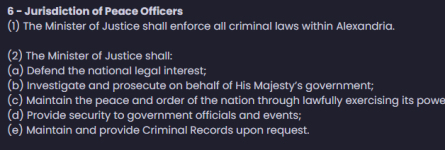
The Defense has additionally cited Section 1(a) of the Criminal Code and Procedure Act — a provision which does not exist. Assuming, charitably, they were referring instead to Section 6: this section governs peace officer jurisdiction, not criminal jurisdiction. Peace officer jurisdiction concerns who may enforce the law, not what conduct may be prosecuted. Regardless, I, as the Minister of Justice, as well as all Crown Counsel who have participated in this case thus far, meet the statutory qualifications required to prosecute on behalf of the Crown under the very law the Defense cited:

6 - Jurisdiction of Peace Officers
(1) The Minister of Justice shall enforce all criminal laws within Alexandria.

(2) The Minister of Justice shall:
(a) Defend the national legal interest;
(b) Investigate and prosecute on behalf of His Majesty’s government;
(c) Maintain the peace and order of the nation through lawfully exercising its power to enforce the laws of His Majesty’s government;
(d) Provide security to government officials and events;
(e) Maintain and provide Criminal Records upon request.

(3) The Minister may hire deputies as they determine necessary.

(4) The deputies shall have jurisdiction to carry out the duties of the Minister of Justice as the Minister of Justice shall prescribe under their lawful authority. These deputies, as well as the Minister of Justice, shall be Peace Officers for the purposes of this act.

CCPA Sec. 21(3)(b) and CCPA Sec. 20(6)(d) are Alexandrian criminal laws. If ever the Crown is provided the opportunity to address evidentiary concerns under the Rules of Evidence Act, we will do so promptly. We request, however, that the Defense identify the specific provision they believe disqualifies the evidence in question, rather than cite irrelevant or nonexistent laws.

Respectfully Submitted,

Soggeh T. Oast
Minister of Justice
Kingdom of Alexandria
 

IN THE MAGISTRATE’S COURT OF THE KINGDOM OF ALEXANDRIA


RESPONSE OF THE DEFENDANT 12700K TO CROWN’S SUBMISSION ON JURISDICTION AND EVIDENTIARY ADMISSIBILITY

TO THE HONORABLE MAGISTRATE:

The Defendant, 12700K, through undersigned counsel, respectfully submits this response to the Crown’s submission regarding the Defense’s Entreaty to Dismiss and Entreaty to Suppress. The Crown’s submission mischaracterizes the Defense’s arguments, misstates the applicable law, and fails to address the core legal deficiencies in the prosecution’s case.

I. THE DEFENSE'S POSITION IS CLEAR AND LEGALLY FOUNDED.

Contrary to the Crown’s assertion, the Defense has not “confused” jurisdiction with admissibility. The Defense has raised two distinct, legally meritorious grounds for dismissal, both rooted in statute:

1. Insufficiency of Evidence (A Challenge to the Prima Facie Case): As outlined in CCPA Sec. 10(3)(e), a case may be dismissed for "such a lack of evidence that a reasonable magistrate could never find the player guilty." The Defense’s argument that the evidence (Exhibits P-013 to P-016) fails to establish the essential elements of the charged crimes—specifically the quid pro quo for bribery—is a direct challenge to the legal sufficiency of the complaint under this provision.

2. Improper Admission of Extra-Jurisdictional Evidence (A Challenge to Admissibility): The Defense’s argument concerning evidence sourced from DemocracyCraft (Redmont) is grounded in the Rules of Evidence Act, Sec. 2(1), which explicitly states: “This act shall apply to all cases where a Court examines a case under their original jurisdiction” This clause inherently limits the Court’s fact-finding to matters and evidence arising within its jurisdictional purview—the Kingdom of Alexandria. Evidence drawn from a wholly separate and sovereign jurisdiction (DemocracyCraft) is not “drawn from” Alexandria and is therefore inadmissible under a plain reading of the Act’s foundational scope. This is a proper objection under Rules of Evidence Act, Sec. 4(1) and forms the basis for an Entreaty to Suppress under CCPA Sec. 10(3)(b).

The Crown’s attempt to reduce this to a simple “relevance” argument under Sec. 8(1) of the Rules of Evidence Act ignores the preliminary, threshold question of whether the Court may even consider such foreign-sourced material. Jurisdiction defines the Court’s authority; the Rules of Evidence govern how that authority is exercised within its proper bounds. The Defense argues the evidence falls outside those bounds entirely.

II. THE CROWN'S JURISDICTIONAL ARGUMENT IS CIRCULAR AND NON-RESPONSIVE.

The Crown states jurisdiction exists “because the Defendant has been charged with multiple violations of Alexandrian law.” This is a tautology. The very question before the Court is whether the conduct alleged and the evidence presented legitimately support those charges under Alexandrian law.

The Defense does not dispute that if the alleged conduct occurred within Alexandria, jurisdiction would attach. The core of the jurisdictional challenge is that the proof offered by the Crown—the evidence itself—originates from outside Alexandria, thereby failing to demonstrate that the Court’s original jurisdiction has been properly invoked over the actionable conduct. The Crown cannot bootstrap jurisdiction by merely filing a charge; it must be established through admissible evidence tied to the jurisdiction.

III. THE CROWN MISSTATES THE DEFENSE'S CITATION AND FAILS TO REBUT THE BURDEN OF PROOF ISSUE.

The Defense acknowledges the clerical error in its prior filing regarding a “Section 1(a)” citation. The intended reference was to the burden of proof principles enshrined throughout the CCPA, particularly CCPA Sec. 16, which unequivocally states: “The Crown may never shift the burden of proof onto the player.”

The Crown’s entire case, as presented in Exhibits P-013 to P-016, lacks direct evidence of the criminal actus reus (e.g., financial transactions). By proceeding on purely circumstantial evidence from an extra-jurisdictional source, the Crown is effectively demanding the Defendant prove a negative—that no transaction occurred. This inverts the burden of proof, requiring the Defense to disprove an element the Crown has failed to substantiate, a clear violation of CCPA Sec. 16.

IV. CONCLUSION AND PRAYER FOR RELIEF


The Crown’s response does not remedy the fatal flaws in its case. It has:
1. Failed to identify admissible evidence placing the alleged criminal conduct within Alexandria’s jurisdiction.
2. Failed to present evidence satisfying the essential elements of the charged offenses.
3. Relied on evidence that is statutorily inadmissible for proceedings within this Court’s original jurisdiction.

Therefore, the Defense respectfully renews its requests for the following relief:
1. GRANT the Entreaty to Suppress all evidence originating from DemocracyCraft (Redmont).
2. GRANT the Entreaty to Dismiss all charges against 12700K pursuant to CCPA Sec. 10(3)(e), due to the insufficiency of the remaining, admissible evidence.

Respectfully submitted,

SrICEKING
Legal Representative for Defendant 12700K
 
IN THE MAGISTRATE COURT OF ALEXANDRIA

ENTREATY TO RECONSIDER SANCTION


Your Honor,

Counsel for the Defendant, 12700K, hereby submits this formal entreaty for the reconsideration and vacatur of the fine recently levied against my client. The imposition of this sanction is inappropriate and unjust under the circumstances, as it penalizes the Defendant for a systemic failure beyond his control.

The Criminal Code and Procedure Act guarantees the right to timely legal representation. The statute’s intent is clear: the state assumes the obligation to ensure that every accused individual is afforded a meaningful opportunity to mount a defense.

The factual record will demonstrate that the Ministry of Justice was not in a state of operational readiness to fulfill this statutory duty at the material time. Due to this administrative failure, my client was not provided with a public defender within the period prescribed by law.

A fundamental principle of justice holds that an accused cannot be penalized for the state's failure to uphold its own legal obligations. The delay in assigning counsel was not attributable to any action or omission by 12700K, but rather to a deficiency in the ministerial apparatus. To impose a fine under these conditions violates principles of due process and fairness, effectively punishing the Defendant for the government's lapse.

PRAYER FOR RELIEF

Wherefore, the Defense respectfully PRAYS that this Honorable Court:

  1. Recognize that the fine was imposed under circumstances where the state failed to meet its prerequisite statutory duty.
  2. Find that holding the Defendant accountable for this systemic failure is contrary to justice.
  3. Reconsider and vacate the fine against 12700K.
Respectfully submitted,

SrICEKING
Legal Representative for Defendant 12700K


SUPPORT TO THIS SUBMISSION:
View attachment 1272
Denied. The defendant was perfectly capable of asking for an extension to the initial deadline. The sanction remains in effect.

IN THE MAGISTRATE COURT OF ALEXANDRIA

ENTREATY FOR DISMISS

Your Honor,

Counsel for the Defendant, 12700K, respectfully submits this entreaty for the dismissal of all charges presently before this Court. My client reaffirms his plea of NOT GUILTY to each count in the indictment.

The grounds for this motion are rooted in a fatal legal and evidentiary deficiency that voids the prosecution’s case in its entirety.

I. THE PROSECUTION’S CASE IS LEGALLY INSUSTAINABLE

The charges hinge upon evidence which this Court is statutorily barred from considering. Section 1(a) of the Criminal Code and Procedure Act explicitly mandates that “The Minister of Justice shall enforce all criminal law within the jurisdiction of Alexandria.”

A principled interpretation of this statute establishes a clear jurisdictional boundary: the enforcement authority—and by necessary extension, the adjudicative authority of this Court—is confined to criminal matters arising from and substantiated by evidence within the sovereign jurisdiction of StateCraft (Alexandria). Consequently, evidence procured from the foreign jurisdiction of DemocracyCraft (Redmont) is inadmissible perses.

The prosecution’s reliance on such extra-jurisdictional material constitutes a fundamental legal error. To permit its use would contravene the express territorial limits of this Court’s authority and the enforcement framework established by Parliament.

II. RESULTANT ABSENCE OF PRIMA FACIE EVIDENCE

With the extra-jurisdictional evidence deemed void and inadmissible, the prosecution’s case collapses. No competent or admissible evidence remains to establish a prima facie case against the accused for the alleged violations of CCPA Sec. 21(3)(b) and Sec. 20(6)(d). The prosecution cannot meet its burden of proof where the foundational evidence is legally null.

PRAYER FOR RELIEF

Wherefore, for the reasons stated herein, the Defense respectfully PRAYS that this Honorable Court:
1. Sustain our objection to all evidence originating from DemocracyCraft (Redmont).
2. Find that the prosecution has failed to present a legally sufficient, admissible case.
3. Dismiss all charges against the Defendant, 12700K, with prejudice.

Respectfully submitted,

SrICEKING
Legal Representative for Defendant 12700K


Support Material
View attachment 1264


Below is the legal evidence provided by the prosecution. in support of the present charges against my client
View attachment 1269

View attachment 1268


View attachment 1267

p-013-png.1265

Denied. The argument presented that evidence collected in DemocracyCraft should not be useful in StateCraft is an intriguing one, but it is one I shall rule on during the verdict of this case.
 
IN THE MAGISTRATE’S COURT OF THE KINGDOM OF ALEXANDRIA


DEFENDANT’S RESPONSE TO THE COURT’S PRELIMINARY RULING ON THE ENTREATY TO SUPPRESS & NOTICE OF OBJECTION

TO THE HONORABLE MAGISTRATE
:

The Defendant, 12700K, through undersigned counsel, acknowledges the Court’s preliminary ruling to reserve judgment on the Defense’s Entreaty to Suppress evidence originating from DemocracyCraft (Redmont). However, the Defense must formally object to this procedural course of action on grounds of fundamental fairness, due process, and the statutory framework governing trials, and requests the Court reconsider its decision to defer the ruling.

I. DEFERRING A RULING ON ADMISSIBILITY TO VERDICT CONSTITUTES REVERSIBLE ERROR AND PREJUDICE.

The purpose of a pre-trial Entreaty to Suppress, as codified in CCPA Sec. 10(3)(b), is to resolve questions of admissibility before evidence is presented to the trier of fact. The Rules of Evidence Act, Sec. 4(4), is unequivocal: “The court shall not consider evidence which has been excluded for the merits of the case.”

By postponing a ruling until verdict, the Court creates an untenable and prejudicial situation:
1. Prejudice to the Defendant: The Crown will present the disputed evidence during its case-in-chief. Regardless of any later ruling, its impact—the very “unfair prejudice” contemplated by Rules of Evidence Act Sec. 8(3)—cannot be un-heard by the Court acting as the trier of fact. This violates the core principle behind suppression motions.
2. Procedural Impropriety: It effectively requires the Defendant to stand trial based on evidence that may be fundamentally inadmissible. This contravenes the statutory sequence established in the CCPA, where evidentiary disputes are to be resolved during the pre-trial discovery and entreaty phase (CCPA Sec. 10(3)).
3. Burden and Confusion: It forces the Defense to simultaneously argue the *weight* of the evidence (during trial) and its *admissibility* (at verdict), conflating two distinct legal analyses and prejudicing the Defense’s ability to present a clear case.

II. THE ADMISSIBILITY OF EVIDENCE IS A THRESHOLD LEGAL QUESTION, NOT A FACTUAL ONE FOR VERDICT.

The question presented is not whether the DemocracyCraft evidence is persuasive, but whether this Court, under the Rules of Evidence Act Sec. 2(1), is legally permitted to consider it at all. This is a pure question of law regarding the scope of the Court’s original jurisdiction and the applicable rules of evidence.

Deciding this legal question after the trial’s conclusion turns the proper procedure on its head. The verdict stage (CCPA Sec. 10(6)) is for determining guilt based solely on admissible evidence. To first consider the evidence, then decide if it was permissible to consider it, is logically and legally flawed.

III. REQUEST FOR RECONSIDERATION & ALTERNATIVE RELIEF

In the interest of judicial economy and to prevent a potential mistrial or reversible error on appeal, the Defense respectfully requests the Court to:

1. Reconsider and rule on the Entreaty to Suppress prior to the commencement of the Crown’s case-in-chief, as contemplated by statute; or, in the alternative,
2. Issue a binding preliminary finding under Rules of Evidence Act Sec. 5(1) that the evidence is conditionally admitted, subject to a final ruling on its admissibility as a matter of law at the close of the Crown’s case, but before the Defense is required to present its case. This would at least allow the Defense to know the evidentiary landscape before deciding on trial strategy.

A deferral to verdict deprives the Defense of a fair opportunity to respond to the case actually presented and is inconsistent with the procedural safeguards of the CCPA and Rules of Evidence Act.

CONCLUSION

The Defense maintains that the evidence from DemocracyCraft is inadmissible. Postponing a ruling on this critical issue risks trying the Defendant with evidence that may be statutorily barred, undermining the integrity of the proceedings. The Court has the authority and duty to rule on this entreaty now.

Respectfully submitted,

SrICEKING
Legal Representative for Defendant 12700K
 
Back
Top