Lawsuit: Pending IGNITE v. Crown, Case 3 (Ch. 2026)

ConsequencesInc

Member
Finance Secretary
ConsequencesInc
ConsequencesInc
Executive Staff
Joined
Apr 12, 2025
Messages
145
IN THE HONOURABLE CHANCERY
OF THE SOVEREIGN KINGDOM OF ALEXANDRIA
Case No.:
3

BETWEEN:

IGNITE Party

Plaintiff

v.

Crown
Defendant


I. JURISTICATIONAL STATEMENT.

This case relates to the application of the Constitution as it relates to the nomination of the Speaker of Parliament. The Constitution of Alexandria vests in the Chancery Court “exclusive jurisdiction over constitutional questions, including the interpretation and application of the Constitution”. K.A. Const. § III Art. 15.


II. PARTIES.
IGNITE, a political party in the State of Alexandria (Plaintiff)
The Crown, as the rightful representative of the Office of the Speaker and the Government for violations of the Constitution. See RealImza v. Crown, Case 1 (Ch. 2025) (Respondent).


III. FACTS
(All in UTC)

1. On May 27th, 2026 at 7:48AM UTC, Leader of the political party IGNITE and the Scarlet Flame Alliance McBrittle419 nominated particular individual ConsequencesInc as Speaker of Parliament.

2. At 8:00AM UTC, Former Speaker of Parliament ItsStormcraft called the speaker election for the 5th Parliament and called upon Rubilubi55 as leader of the largest faction to nominate a Speaker of Parliament

3. At 8:01AM UTC, Former Speaker of Parliament ItsStormcraft did not acknowledge McBrittle419’s nomination.

4. At 8:03AM UTC, MP PhillinDeBlanc brought a Point of Order clarifying that the constitution noted the largest party may nominate a candidate for speaker.

5. At 8:04AM UTC, Former Speaker ItsStormcraft overruled PhillinDeBlanc’s point noting that Scarlet Flame was the second largest coalition in parliament, and therefore was supposedly a party.

6. At 8:05AM UTC, MP PhillinDeBlanc brought another Point of Order clarifying that coalitions and factions were not parties, and that IGNITE had the most seats and therefore could nominated a Speaker.

7. At 8:08AM UTC, the Former Speaker acknowledged PhillinDeBlanc’s second Point of Order and the Former Speaker noted he would discuss the Appeal with the Parlimentarians.

8. At 8:42AM UTC, MP PhillinDeBlanc of the IGNITE again nominated the particular individual ConsequencesInc to the office of Speaker.

9. At 8:48AM UTC, the Former Speaker ItsStormcraft denied MP PhillinDeBlanc’s nomination of ConsequencesInc and stated that “party of Parliament” in the Constitution did not mean a singular party, and that the “largest party in parliament” meant the largest faction or coalition of parties.

10. By denying IGNITE’s nomination of ConsequencesInc as Speaker, the Office of the Speaker as represented by ItsStormcraft violated IGNITE's Constitution right to nominate a Speaker of Parliament. K.A. Const. § I Art. 4.


IV. CLAIMS FOR RELIEF.

The Office of the Speaker and Former Speaker of Parliament through their actions as described above have violated IGNITE's Constitutional right to nominate a Speaker of Parliament.

The Constitution of Alexandria is clear in its differentiation of party singular, versus a coalition of parties plural:
  • For the Election of the Prime Minister, the Constitution differentiates between a ruling majority party electing the Prime Minister and a coalition of parties. K.A. Const. § II Art. 8.
  • The Opposition is defined and differentiated as either a political party or a coalition of parties that holds the second largest number of seats in Parliament. K.A. Const. § II Art. 11.
  • The Leader of the Opposition is defined as the head of the largest party in the Opposition. K.A. Const. § II Art. 11.
  • In the absence of a clear majority, a minority government can be formed by the largest coalition. K.A. Const. § II Art. 13.
  • The Constitution in the definition of a Hung Parliament notes that when no single political party wins an outright majority, this means no single party can independently form government. K.A. Const. § VIII Art. 33.

Time and time again in the Constitution, there is a clear difference that was noted by the Framers: Between a singular party, and a coalition of smaller parties. By applying that same understanding of the Framers, we come to the Constitutional section in dispute:

"The largest party of Parliament may nominate a candidate for speaker. Parliament may elect them by a majority." K.A. Const. § I Art. 4

The Framers and Founder of Alexandria were not confused with their language and were particular with it. They differentiated between a singular party versus a coalition of parties, and they used that language on purpose.

As it is laid out in the definition of Leader of the Opposition, it notes that:

"The Leader of the Opposition is the head of the largest party in the Opposition" K.A. Const. § II Art. 11.

And furthermore, when the Constitution describes the Deputy Speaker:

"After the Speaker is elected, the second largest party of Parliament may nominate a Deputy Speaker." K.A. Const. § I Art. 4

This means that the Framers not only differentiated between one and multiple parties, but also how large a party is by their specific language.

With all this information, there is but one logical set of conclusions to be drawn:

1. The Constitution differentiates between a single Party, and a Coalition of Parties or "faction".
2. IGNITE is the largest party in parliament with 3 elected members
3. The Constitution states that the largest party in Parliament may nominate a candidate for Speaker. K.A. Const. § I Art. 4
4. Therefore, IGNITE may nominate a candidate for Speaker.

This makes the actions of the Office of the Speaker and Former Speaker of Parliament ItsStormcraft Unconstitutional in denying IGNITE as the largest party in Parliament its guaranteed constitutional right and ability to nominate a Speaker of Parliament.


V. PRAYER FOR RELIEF
IGNITE now politely asks that the Chancery as parental adjudicators in this debate to settle whether the Office of the Speaker is applying the Constitution correctly or not. If the Speaker is not, IGNITE requests the Court to direct the Speaker to allow IGNITE’s nomination to proceed in Parliament.


Submitted Respectfully,

∴ ⨿🝛
The Artist Formerly Known as ConsequencesInc
5/27/2026

 
  • Wow
Reactions: Nim
IN THE HONOURABLE CHANCERY
OF THE SOVEREIGN KINGDOM OF ALEXANDRIA
Case No.:
3
ENTREATY FOR EMERGENCY INJUNCTION

Your Honor,


It is with a heavy heart and much meditation that I request the Court to issue an Emergency Injunction to order the Government and the Office of Speaker to pause and withhold on moving forward with any nomination of the Speaker of Parliament.

The Office of the Speaker of Parliament and the Speakership holds incredible power. This includes prescinding over parliament, maintaining order, and being an impartial enforcer of the rules. K.A. Const. § I Art. 4. If the acting Speaker of Parliament and the Officer of the Speaker are quite potentially improperly interpreting and executing the Constitution without proper consultation or oversight, then the will of the People is being denied. The Office of the Speaker is not properly presiding, maintaining order or being an impartial enforcer of rules at all.

That impartiality of the Speaker is possibly compromised today by the rash rulings made in less than an hour by a Speaker who's party directly gains great benefit from nominating a new Speaker of Parliament.

This is especially so if the largest party in Parliament who received the most seats elected by the People is denied the opportunity to nominate a representative to speak for the People. That, I believe, is the importance of granting this injunction to maintain the sanctity of the will of the People and of the Speakership.

The Preamble of the Constitution is clear: the People established the Constitution through Parliament. K.A. Const. Preambe. If Parliament itself cannot follow the rules setforth for it in the Constitution and attempts to violate it, action must be taken by the Courts to ensure the integrity of the elected body and the Constitution of Alexandria maintains.

The Claims of Relief mentioned above in the original filing outline just how egredious these interpretations by the Office of the Speaker can be. Under normal or less dire circumstances, an injunction would be unnecessary. In this case, unfortunately, I believe it is.


Submitted Respectfully,

∴ ⨿🝛
The Artist Formerly Known as ConsequencesInc
5/27/2026
 
Last edited:
IN THE HONOURABLE CHANCERY
OF THE SOVEREIGN KINGDOM OF ALEXANDRIA
Case No.:
3
NOTICE OF NO ARBITRATION OR MEDIATION


Your Honor,

Pursuant to the Actual Judicial Reform Act, we will not be seeking mediation or arbitration in this civil dispute. See §3 (1) A.P. 04-13.


Iacta alea esto,

∴ ⨿🝛
The Artist Formerly Known as ConsequencesInc
5/27/2026
 
IN THE HONOURABLE CHANCERY
OF THE SOVEREIGN KINGDOM OF ALEXANDRIA
Case No.:
3
PROOF OF REPRESENTATION


Your Honor,

Attached is proof of my representation of IGNITE.

Submitted Respectfully,

∴ ⨿🝛
The Artist Formerly Known as ConsequencesInc
5/27/2026
 

Attachments

  • permys.png
    permys.png
    23.7 KB · Views: 12
The Crown is commanded to appear before the Chancery int he case of IGNITE v. Crown of Alexandria, Case 3 (Ch. 2026).

Failure to appear within 72 hours may result in a default judgment based on the known facts of the case. All parties will make themselves aware of the Court Rules and Procedures.


The Crown is commanded to supply an answer to the request for an Emergency Injunction within 48 hours. Further, the Court sees a potential need for clarity, and is open to scheduling an in-game hearing to assist the Court in reaching its determination.
 
IN THE HONOURABLE CHANCERY
OF THE SOVEREIGN KINGDOM OF ALEXANDRIA
Case No.:
3
RESPONSE TO IN-GAME HEARING, AND CO-COUNSEL


Your Honor,

Schedules permitting, I would be more than willing to have an in-game hearing.

Additionally, @bernard_madoff will be co-counsel.


Respectfully submitted,

∴ ⨿🝛
The Artist Formerly Known as ConsequencesInc
5/29/2026
 
Your honor,
The crown is present.
I shall be representing the crown in this case.
Proof of representation:
Acknowledged, you have seventy-two hours to post an answer. Please remember the deadline for your response to that EI. Further, do you have any thoughts on an in-game hearing? It will be a relatively quick and informal affair, for our benefit.
 
If my schedule will allow me to join, I see no problem with an in-game hearing. I do ask that @Capt11543 join me as co-counsel for such a hearing.
(As for the response to the EI, and the answer to complaint, they should be posted either later today, or tomorrow morning)
 
If my schedule will allow me to join, I see no problem with an in-game hearing. I do ask that @Capt11543 join me as co-counsel for such a hearing.
(As for the response to the EI, and the answer to complaint, they should be posted either later today, or tomorrow morning)
Granted. I ask all relevant parties please join the Alexandrian Judiciary discord as soon as possible so we can discuss in a closed court ticket. If you are not in it, DM me for a link.
 
IN THE HONOURABLE CHANCERY
OF THE SOVEREIGN KINGDOM OF ALEXANDRIA
Case No.:
3
ENTREATY FOR EMERGENCY INJUNCTION

Your Honor,


It is with a heavy heart and much meditation that I request the Court to issue an Emergency Injunction to order the Government and the Office of Speaker to pause and withhold on moving forward with any nomination of the Speaker of Parliament.

The Office of the Speaker of Parliament and the Speakership holds incredible power. This includes prescinding over parliament, maintaining order, and being an impartial enforcer of the rules. K.A. Const. § I Art. 4. If the acting Speaker of Parliament and the Officer of the Speaker are quite potentially improperly interpreting and executing the Constitution without proper consultation or oversight, then the will of the People is being denied. The Office of the Speaker is not properly presiding, maintaining order or being an impartial enforcer of rules at all.

That impartiality of the Speaker is possibly compromised today by the rash rulings made in less than an hour by a Speaker who's party directly gains great benefit from nominating a new Speaker of Parliament.

This is especially so if the largest party in Parliament who received the most seats elected by the People is denied the opportunity to nominate a representative to speak for the People. That, I believe, is the importance of granting this injunction to maintain the sanctity of the will of the People and of the Speakership.

The Preamble of the Constitution is clear: the People established the Constitution through Parliament. K.A. Const. Preambe. If Parliament itself cannot follow the rules setforth for it in the Constitution and attempts to violate it, action must be taken by the Courts to ensure the integrity of the elected body and the Constitution of Alexandria maintains.

The Claims of Relief mentioned above in the original filing outline just how egredious these interpretations by the Office of the Speaker can be. Under normal or less dire circumstances, an injunction would be unnecessary. In this case, unfortunately, I believe it is.


Submitted Respectfully,

∴ ⨿🝛
The Artist Formerly Known as ConsequencesInc
5/27/2026
IN THE HONORABLE CHANCERY
OF THE KINGDOM OF ALEXANDRIA
Case No:3
RESPONSE FOR ENTREATY FOR EMERGENCY INJUNCTION

Your Honor,

My learned friend, on behalf of the Political Party IGNITE had requested before you to issue an emergency injunction suspending the nomination of Speaker of Parliament.
I want you to notice the terms under which IGNITE is described: “Political Party.”

The Constitution clearly sets a difference between the term “political party” (which can also be referred to as “party”), and the specific term of “party of parliament”.

In K.A Const § II Art 11, it states that: “The Opposition is the Political Party or coalition of parties that holds the second-largest number of seats in Parliament, after the government.” It later goes on to state that “The Leader of the Opposition is the head of the largest party in the Opposition.” This section, as it reads, clearly establishes that the opposition is made up of political parties and that the leader of the largest party in the opposition (ergo, political party) is the Leader of the Opposition.

On the other hand, in K.A Const § I Art 4, it clearly states that “The largest party of Parliament may nominate a candidate for Speaker.” Notice that nowhere in the sections does it read “Political Party”; rather, it simply refers to “the largest party of Parliament.” This, as it reads, clearly refers to any party within Parliament, and not specifically a political party (for example, if six Independent MP’s decided to form a faction, they would become the largest party of Parliament, depicted as being independent MP’s).

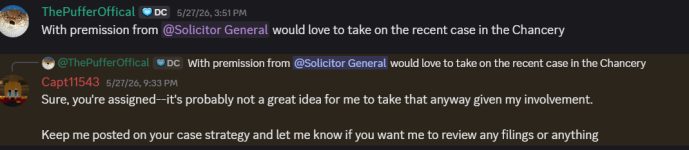
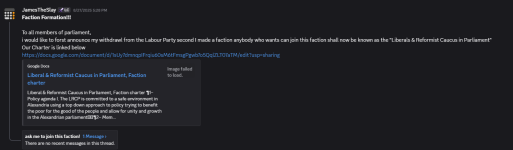
I should also note what my learned friend is requesting in his Emergency Injunction: “to order the Government and the Office of Speaker to pause and withhold on moving forward with any nomination of the Speaker of Parliament.” - With this, my learned friend is essentially claiming that the Office of the Speaker, an office required by the constitution in K.A Const § I Art 4 to “Impartilly enforce rules” has now decided to break that reuquiremnt and to collude with the government to nominate a new speaker without providing sufficient evidence to support this claim. The notion of Parliamentary “factions” has been recognized by the Office of the Speaker since the second Parliament, when MP JamesTheSlay formally left the Labour/Public Servants Party and formed an independent “faction” of one, which later joined with the Greens to form an opposition coalition (see D-001, D-002). This faction was recognized by the Office of the Speaker as separate from Labour/Public Servants in Parliament, despite MP JamesTheSlay being elected as a member of LPS (see A.P. 02-001 | Freedom of Information Act passage and amendment vote tables). In so doing, they established the precedent that political units within Parliament may be fluid, and that Members of Parliament may change their affiliation during their term. In the controversy before this Court today, the Office of the Speaker has adjudicated consistently with this precedent.

1780076350717.png
MP JamesTheSlay’s message on the Parliament floor announcing the formation of the Liberals and Reformist Caucus. Link

1780076350727.png
MP JamesTheSlay announcing the formation of the opposition coalition in the second Parliament. Link
 
IN THE HONOURABLE CHANCERY
OF THE SOVEREIGN KINGDOM OF ALEXANDRIA
Case No.:
3
ENTREATY FOR EMERGENCY INJUNCTION

Your Honor,


It is with a heavy heart and much meditation that I request the Court to issue an Emergency Injunction to order the Government and the Office of Speaker to pause and withhold on moving forward with any nomination of the Speaker of Parliament.

The Office of the Speaker of Parliament and the Speakership holds incredible power. This includes prescinding over parliament, maintaining order, and being an impartial enforcer of the rules. K.A. Const. § I Art. 4. If the acting Speaker of Parliament and the Officer of the Speaker are quite potentially improperly interpreting and executing the Constitution without proper consultation or oversight, then the will of the People is being denied. The Office of the Speaker is not properly presiding, maintaining order or being an impartial enforcer of rules at all.

That impartiality of the Speaker is possibly compromised today by the rash rulings made in less than an hour by a Speaker who's party directly gains great benefit from nominating a new Speaker of Parliament.

This is especially so if the largest party in Parliament who received the most seats elected by the People is denied the opportunity to nominate a representative to speak for the People. That, I believe, is the importance of granting this injunction to maintain the sanctity of the will of the People and of the Speakership.

The Preamble of the Constitution is clear: the People established the Constitution through Parliament. K.A. Const. Preambe. If Parliament itself cannot follow the rules setforth for it in the Constitution and attempts to violate it, action must be taken by the Courts to ensure the integrity of the elected body and the Constitution of Alexandria maintains.

The Claims of Relief mentioned above in the original filing outline just how egredious these interpretations by the Office of the Speaker can be. Under normal or less dire circumstances, an injunction would be unnecessary. In this case, unfortunately, I believe it is.


Submitted Respectfully,

∴ ⨿🝛
The Artist Formerly Known as ConsequencesInc
5/27/2026
We deny this. We will gladly produce a full explanation at a later time—for now, we are not convinced on the merits that such an emergency injunction would further justice or be for the common good of the law, equity, or the nation.
 
Your honor,
Due to me spending all of today in exams, I humbly ask for a 24 hour extension on the deadline of submission. I'm aware of the inconvenience it may cause, especially asking for an extension so close to the deadline.
I will assure the court that the crown is working tirelessly on the answer to complaint, and it may even be done by the end of the day, however I will not be able to submit it
 
IN THE CHANCERY OF THE KINGDOM OF ALEXANDRIA
RESPONSE TO COMPLAINT


Your Honor,

I have been authorized by the Minister of Justice to take this case alongside ThePuffer. I have attached proof and authorization below.

I. ANSWER TO COMPLAINT
  1. The Crown AFFIRMS the nominated ConsequencesInc as Speaker of Parliament.
  2. The Crown AFFIRMS that Rubilibu55, as leader of the largest faction and party, was called upon to nominate a Speaker of Parlimant.
  3. The Crown AFFIRMS that former Speaker of Parliament ItsStormcraft did not acknowledge McBrittle419’s nomination.
  4. The Crown AFFIRMS that PhillinDeBlanc brought a Point of Order clarifying that the constitution noted the largest party may nominate a candidate for speaker.
  5. The Crown AFFIRMS that former Speaker ItsStormcraft, in overruling a point of order raised by the Noble PhillinDeBlanc, noted that that the "largest party" as used in the Constitution refers to the largest faction rather than the largest political party.
  6. The Crown AFFIRMS that the Noble PhillinDeBlanc raised another Point of Order, arguing that the term "party" as used in the Constitution refers to political parties rather than coalitions or factions, and that IGNITE, holding the most seats, was the largest political party.
  7. The Crown AFFIRMS the Former Speaker acknowledged the Noble PhillinDeBlanc’s second Point of Order and the former Speaker stated that he would confer with the Parlimentarians.
  8. The Crown AFFIRMS that PhillinDeBlanc, a member of IGNITE, attempted once again to nominate ConsequencesInc to the office of Speaker.
  9. The Crown AFFIRMS that the former Speaker ItsStormcraft denied the Noble PhillinDeBlanc’s nomination of ConsequencesInc, once again contending that the "largest party" as used in the Constitution refers to the largest faction, rather than the largest political party.
  10. The Crown DENIES that any constitutional rights were violated, and DENIES that IGNITE has a constitutional prerogative the nominate the Speaker.

I. DEFENSES
The Plaintiff's interpretation, while perhaps appearing clear to the lay reader, does not withstand scrutiny when examined in context of the Constitution as a whole. The same language provided in K.A. Const. § I Art. 4. recurs throughout the Constitution and informs with clarity how the term "largest party" under Article 4 should be understood.

To begin with, the Crown will first establish why the Plaintiff's interpretation, which appears at first sight to have some teeth to it, demands further examination and scrutiny. The Plaintiff has read Article 4 in isolation, divorced from Articles 4a, 8, 11, 12, and 34, and has derived from that isolated reading a conclusion the Constitution as a whole cannot support. In a parliamentary context, the term "party" is used numerous times throughout the Constitution. Crucially, the Crown does not argue that every usage of the term "party" should be understood to mean "faction" rather than "political party." There are, however, various instances within the Constitution in which the only plausible interpretation is to take "party" to mean "faction," or "grouping." The Crown will even submit that in many cases, due to very poor drafting, it is difficult to ascertain which sense of the word "party" is used. We will argue, however, that there is reason for the Court to approach the Plaintiff's interpretation with a great deal of skepticism. While the Crown understands how they have arrived there, any appearance of legitimacy to their interpretation is superficial. We respectfully request the patience of the Court while we unpack the full picture.

TEXTUAL AMBIGUITY
The Crown further observes that "largest party" does not specify by what metric. The meaning here is not abundantly clear. Largest by membership? Largest by votes? Largest by seats in Parliament? Under the Plaintiff's interpretation, largest is taken to mean by seats in Parliament, which is awfully convenient. If we take it to mean by vote, it is impossible to ascertain who is entitled to the nomination, because four of the five parties in the May 2026 Election ran under an electoral alliance, rather than as individual parties. Under this interpretation, the only party clearly entitled to a nomination of either the Speaker or Deputy Speaker would be the Alexandrian National Party, which ran alone. Presumably, the Order of the Scarlet Rose, IGNITE, Labour/Public Servants, and Alliance 25/The Greens would be out of luck.

If we interpret "largest party" to mean largest by membership, the Greens would be entitled to the nomination, who, according to their latest party registration upkeep, hold 17 members. It is only when we interpret, arbitrarily, "largest" to mean highest number of seats, and "party" to mean "political party," that the Plaintiff's interpretation carries any weight. If by "largest" the Constitution refers to the greatest number of seats, and by "party" it means "political party," it is curious why the authors of A.P. 01-019 would deny clarification.

The Crown does not wish to belabor this point any further. The point is that the Plaintiff's reading requires an additional assumption that the text does not provide. The Crown contends that when we scrutinize the term "party" alone, the meaning of "largest party" becomes abundantly clear. While the Crown will soon argue that "party" read as "faction" or "grouping" is the most rational interpretation, it is worth noting that if we assume the Crown's interpretation to be correct, this ambiguity dissolves. If "largest party" is read as "largest faction" rather than "largest political party," the word "largest" can only have one meaning. "Largest faction of Parliament" in a parliamentary context has only one plausible interpretation - it refers to the faction holding the greatest number of seats. Factions do not have members, besides those in Parliament, nor do they receive votes.

STRUCTURAL INTERPRETATION
The Crown submits that these observations are not entirely convincing in isolation. It is when they are taken into the context of the Crown's broader position, however, that the picture becomes clear. K.A. Const. § I Art. 4. provides that the largest party of Parliament may nominate a candidate for Speaker.
The largest party of Parliament may nominate a candidate for Speaker; Parliament may elect them by a majority.

Then, K.A. Const. § I Art. 4a provides that the second largest party of Parliament may nominate a Deputy Speaker.

After the Speaker is elected, the second largest party of Parliament may nominate a Deputy Speaker.
That is, at first sight, fair enough. The largest party of Parliament shall receive the Speaker, and the second largest party, holding separate political values than the first, shall receive the Deputy Speaker. Under this system, the Constitution guarantees that opposite political sides are afforded representation, correct? These articles are clearly meant to be read in context of one another. Article 4 ensures the majority political force receives the Speakership, while Article 4a ensures the minority receives the Deputy Speakership. The function of this structure is to promote political balance. If a single, unified political interest were afforded both chairs, objective and procedural would inevitably be subjected to partisan influence. The purpose of this structure is to prevent parliamentary procedure from being weaponized by partisan interests, and to ensure that no single political force benefits from an unfair partisan advantage. The largest faction or majority coalition receives the Speakership, while the second largest faction receives the Deputy Speakership.

CONSTITUTIONAL ABSURDITY AND MATHEMATICAL DEADLOCK
The Crown now invites the Court to take the Plaintiff’s interpretation to its logical conclusion. Under the Plaintiff’s reading, if the majority is composed of a coalition of smaller political parties, the opposition would receive both the Speaker and Deputy Speaker nominations. Conversely, if the opposition were composed of several smaller parties, the majority coalition would take both positions. Such an impractical system cannot be what the authors of A.P. 01-019 envisioned for the following reasons.

First, it does not produce effective governance. The importance of the role of the Speaker cannot be overstated. The Speaker of Parliament has a constitutional responsibility to maintain order, facilitate debate, and ensure Parliamentary procedure is upheld under K.A. Const. § I Art. 4. A Speaker who does not come from the majority faction cannot plausibly manage the proceedings of Parliament effectively, when they actively oppose it.

Secondly, and much more importantly, it leads to paralysis for two distinct reasons. In order to govern, a coalition must command an absolute majority of votes within Parliament. This means that any opposing political faction, by extension, must mathematically constitute a minority. Under the Crown’s interpretation, the largest faction, provided there exists a Government, would always be the majority political party or coalition. If we take “party” to mean an individual political party, it can only be reasonably assumed that there would be, in many cases, parties which hold the same number of seats. What happens if two, or even three parties hold the same number of seats? In such a scenario, there would be no distinct “largest party” or “second largest party,” and no individual party would be entitled to a nomination. What would Parliament do under such a scenario? Be stuck without a Speaker for the entirety of their term?

Additionally, if a minority faction or party had the exclusive right to the Speakership, it would follow that Parliament would almost certainly suffer from long-term paralysis each term. It is perfectly reasonable for some offices within the government to require Parliamentary consent for appointment, but a Speaker is necessary for Parliament to conduct any business. If the Chancery has a vacancy, the appointment of a new Chancellor is rarely urgent. Without a Speaker, however, Parliament cannot pass laws, conduct appointments, or reasonably hold the Executive to account. It can only be assumed that under a system where a minority controls nominations, Parliament would frequently fail to appoint a Speaker for sustained periods of time, and therefore be paralyzed.

Thirdly, and quite perversely, this interpretation would, after a government is dissolved, deny any subsequent government formation unless a single party commands an absolute majority. See Article K.A. Const. § II Art. 12.
If confidence is not regained by any party within 72 hours, an election is immediately triggered.

This directly undermines the standard government formation process provided in K.A. Const. § I Art. 8.
The Prime Minister is the Member of Parliament who commands the confidence of the Parliament to form a government. This can either occur through a ruling majority party in the Parliament or as a result of a coalition of parties to form a minority government.

Are we to assume, under the Plaintiff’s interpretation, that “party” in Article 12 also means “political party?” The Crown argues that not only is this position contradicted by the Constitution, but that even under some interpretive negotiation taken to rectify this contradiction, it would still lead to nonsensical results. If a political party must achieve confidence alone, how can a government form through a coalition of parties?

The Plaintiff's interpretatiion would mean that the Government can be formed by a majority coalition initially, but if it is dissolved, a successor government cannot be formed unless and until there exists a majority political party that can on its own, without borrowing any votes from outside parties, form government. Under this interpretation, it is possible that parties could, after Parliament forms, coalition with one another to form a Government according to Article 8. Parliament would, however, for no rational purpose, have to dissolve after 72 hours regardless.

The Crown argues that this absurd result cannot be constitutionally correct. Under the Crown’s interpretation, where “party” should be understood to mean “faction,” the text does not contradict the Constitution, require any interpretive negotiation, or lead to nonsensical or absurd results. Parliament may dissolve the Government by a simple majority, and form the Government by establishing a majority party, which should be understood to mean “faction.”

III. SUMMARY
The Crown has demonstrated that there are numerous reasons to be skeptical of the Plaintiff's interpretation. It is rebutted by the plain text and structure of the Constitution, requires a great deal of interpretive negotiation, and, when taken to its logical extreme, yields absurd results that are constitutive of a disorderly, dysfunctional, and paralyzed government.

The Crown thanks the Court for its diligence.

Respectfully Submitted,

Soggeh T. Oast
Deputy Prime Minister
Kingdom fo Alexandria
 

Attachments

  • Proof of Authorization.png
    Proof of Authorization.png
    83.8 KB · Views: 2
Last edited:
IN THE CHANCERY OF THE KINGDOM OF ALEXANDRIA
ENTREATY OF SUMMARY JUDGEMENT


Your Honor,

No genuine dispute of material facts exists. The Crown and the Plaintiff disagree only on matters of legal and constitutional interpretation. The Kingdom should not have to wait until the conclusion of a full trial, which may takes months, to have confidence that our Speaker of Parliament is legitimate.

Respectfully Submitted,

Soggeh T. Oast
Deputy Prime Minister
Kingdom fo Alexandria
 
Back
Top