Lawsuit: In Session ItsStormcraft v. Crown of Alexandria, Case X (2026)

TheStormcrafter

Moderator
Moderator
ItsStormcraft
ItsStormcraft
Parliament Clerk
Joined
Apr 12, 2025
Messages
159
IN THE CHANCERY OF ALEXANDRIA
Civil Complaint

I. Jurisdictional Statement
This court has jurisdiction over all constitutional questions. I argue that the Constitution is nto directly applicable law and all decisions whether a law conflicts with the constitution must originate from the Chancery.

II. Parties
ItsStormcrafter, fmr. Electoral Adjudicator
The Crown, represented by the Ministry of Justice

III. Facts
(1) The Alexandrian Electoral Act §4(3) reads: "A Submission Period shall open as soon as is practicable after the dissolution of Parliament, and close after 120 hours (5 days)."
(2) The new Electoral Adjudicator posted an announcement proclaiming that a section of the Alexandrian Electoral Act would be ignored as they believe it to conflict with the constitution. (E1)
(3) Dissolution is today, on the 22nd of September at 18:51 UTC, 2160h after the announcement enacting the election results.

IV. Argument
This court has the sole authority to strike a section of the law. The Electoral Adjudicator, in her proclamation, effectively rendered a section law law void without a judicial mandate. The election is therefore conducted in violation with the law. The argument that this is to bring the act in line with the constitution is misguided, only this court can apply the constitution. Similarly, the MoIA in the past believed that the passport requirement for candidates was most likely unconstitutional (and even prior to .FreakyyyyBob158 v. Crown of Alexandria, Case 5 (Ch. 2026) believed the requirement for voting problematic) but could not act and ahd to follow the law.
The Constitution, in this sense, does not directly apply (it is not "directly applicable law") but instead is applied through the judiciary by this court. If a provision of law is believed to be unconstitutional, one has to sue, not ignore the law, thereby circumventing the powers of the judiciary.

V. Petition
(1) Order that the proclamation is unlawful as only this court can determine constitutionality, not the Electoral Adjudicator.
(2) Order that the election has to be restarted in line with the Alexandrian Electoral Act.

So petitioned before the honourable Court,
Kaladin Stormblessed

1790076759477.png
 
IN THE CHANCERY OF ALEXANDRIA
Amendment to Complaint

Your Honours,
I would like to amend my complaint, Section I, as follows:

"This court has jurisdiction over all constitutional questions. I argue that the Constitution is nto not directly applicable law and all decisions whether a law conflicts with the constitution must originate from the Chancery."​

This minor amendment is requested to fix a typo.

So petitioned before the honourable Court,
Kaladin Stormblessed
 
IN THE CHANCERY OF ALEXANDRIA
Amendment to Complaint

Your Honours,
I would like to amend my complaint, Section I, as follows:

"This court has jurisdiction over all constitutional questions. I argue that the Constitution is nto not directly applicable law and all decisions whether a law conflicts with the constitution must originate from the Chancery."​

This minor amendment is requested to fix a typo.

So petitioned before the honourable Court,
Kaladin Stormblessed
Strictly speaking, such a request is required to be done during discovery and discovery alone. Gen. Court R. & Proc. Part II, § 3. You may request then.
 
IN THE HONOURABLE CHANCERY OF THE KINGDOM OF ALEXANDRIA
CIVIL ACTION
Case No.
X
ENTREATY TO DISMISS - Lack of Claim, Failure to Include a Party, and Original Jurisdiction.


Your Honors,

The Crown requests that this case be dismissed due to Lack of Claim, Failure to Include a Party and Original Jurisdiction.


Firstly on Lack of Claim: Simply put, the Plaintiff in this case has failed to state how they, as a particular individual named ItsStormcraft, have been personally affected or damaged by the alleged actions off the Electoral Adjudicator. It is up to them to make that clear, and it is not clear how they are a valid party or affected by this decision in any way

The Plaintiff further claims that the alleged actions of the Electoral Adjudicator allegedly "rendered a section law void without a judicial mandate". They have not provided any concrete, comprehensive or coherent arguments that lay out exactly how the alleged actions of the Electoral Adjudicator did this.


Secondly on Failure to Include a Party: The Plaintiff has not properly cleared up as to whom exactly is the counterparty of this case. Is it that the Electoral Adjudicator, in their capacity as a government official who did these actions? Or is it the particular individual who just so happens to be an Electoral Adjudicator who did these actions on their own and violated the law?

That question is left unanswered in this rather sparse initial filing and brings to question the merits of this case. Because if the answer is the later instead of the former, the Crown is not the proper party to this case.


Thirdly on Original Jurisdiction: The Chancery has said before that "The mere scintilla of a constitutional violation or whiff of presence of constitutional issue does not immediately demand our attention, nor do we stake ultimate and unceasing claim over any dispute the moment a constitutional provision is thought of". See PhillinDeBlanc v. Crown, Case 10 Ch. 2025.

I believe this case falls into this category. The Plaintiff, while noting an alleged Constitutional Issue, has not directly cited the Constitution or noted for the Court what exactly the Constitutional issue is. This case should not be a fishing expedition simply to drag the Crown to the Highest Court in the land and skip over a likely alternative and more fitting original jurisdiction: The Magistrate's Court.

This case involves the application of a law, regardless of the particular individual who allegedly broke the law's original intention or their reasoning behind their action. Without a clear Constitutional Issue being stated by the Plaintiff, it's hard too see why it should continue to exist in the Chancery. And considering the Plaintiff's issue seemingly revolves around implementation of the Alexandrian Electoral Act, that seems more in line with the Magistrate's Court.


While overall, it is clear that the Plaintiff feels aggrieved in some wayy by something related to the Electoral Adjudicator's decision, the Crown believes it fails to address some fundamental questions related to any court filing:

  • How is the Plaintiff/Claimant personally injured by the action taken by the alleged other party?
  • Whom is the proper party that has caused the Plaintiff/Claimant injury?
  • What is the proper legal venue for adjudicating this grievance?

The Crown, therefore, humbly requests that the Court reviews all of three of these dismissal reasons, and dismiss this case forthwith.


Respectfully submitted,
Stephen W. Spooner Jr.
Solicitor General of Alexandria.
 
Last edited:
IN THE HONOURABLE CHANCERY OF THE KINGDOM OF ALEXANDRIA
CIVIL ACTION
Case No.
X
ENTREATY TO DISMISS - Lack of Claim, Failure to Include a Party, and Original Jurisdiction.


Your Honors,

The Crown requests that this case be dismissed due to Lack of Claim, Failure to Include a Party and Original Jurisdiction.


Firstly on Lack of Claim: Simply put, the Plaintiff in this case has failed to state how they, as a particular individual named ItsStormcraft, have been personally affected or damaged by the alleged actions off the Electoral Adjudicator. It is up to them to make that clear, and it is not clear how they are a valid party or affected by this decision in any way

The Plaintiff further claims that the alleged actions of the Electoral Adjudicator allegedly "rendered a section law void without a judicial mandate". They have not provided any concrete, comprehensive or coherent arguments that lay out exactly how the alleged actions of the Electoral Adjudicator did this.


Secondly on Failure to Include a Party: The Plaintiff has not properly cleared up as to whom exactly is the counterparty of this case. Is it that the Electoral Adjudicator, in their capacity as a government official who did these actions? Or is it the particular individual who just so happens to be an Electoral Adjudicator who did these actions on their own and violated the law?

That question is left unanswered in this rather sparse initial filing and brings to question the merits of this case. Because if the answer is the later instead of the former, the Crown is not the proper party to this case.


Thirdly on Original Jurisdiction: The Chancery has said before that "The mere scintilla of a constitutional violation or whiff of presence of constitutional issue does not immediately demand our attention, nor do we stake ultimate and unceasing claim over any dispute the moment a constitutional provision is thought of". See PhillinDeBlanc v. Crown, Case 10 Ch. 2025.

I believe this case falls into this category. The Plaintiff, while noting an alleged Constitutional Issue, has not directly cited the Constitution or noted for the Court what exactly the Constitutional issue is. This case should not be a fishing expedition simply to drag the Crown to the Highest Court in the land and skip over a likely alternative and more fitting original jurisdiction: The Magistrate's Court.

This case involves the application of a law, regardless of the particular individual who allegedly broke the law's original intention or their reasoning behind their action. Without a clear Constitutional Issue being stated by the Plaintiff, it's hard too see why it should continue to exist in the Chancery. And considering the Plaintiff's issue seemingly revolves around implementation of the Alexandrian Electoral Act, that seems more in line with the Magistrate's Court.


While overall, it is clear that the Plaintiff feels aggrieved in some wayy by something related to the Electoral Adjudicator's decision, the Crown believes it fails to address some fundamental questions related to any court filing:

  • How is the Plaintiff/Claimant personally injured by the action taken by the alleged other party?
  • Whom is the proper party that has caused the Plaintiff/Claimant injury?
  • What is the proper legal venue for adjudicating this grievance?

The Crown, therefore, humbly requests that the Court reviews all of three of these dismissal reasons, and dismiss this case forthwith.


Respectfully submitted,
Stephen W. Spooner Jr.
Solicitor General of Alexandria.
IN THE CHANCERY OF ALEXANDRIA
Re: Motion to Dismiss

Your Honours,
I oppose the Motion to Dismiss on the following grounds:

One: I, as a citizen of this nation, have a right to vote and to run for office and also a right to be represented as a constituent in Parliament. The actions of the Crown, in improperly handling this election by not faithfully executing the law, directly affect me by denying proper and lawful representation.

Two: The Crown is the proper opposing party to this case. Yes, one individual, Electoral Adjudicator McBrittle419, has taken the improper and, in Plaintiffs opinion, unconstitutional decision, but this individual acted on behalf of the government—the Crown. The Crown, represented through the Ministry of Justice, is the proper party to represent its interests in this forum of disputes.

Three: This is very much a constitutional issue. The law was broken by the Crown under the pretence to follow the Constitution, therefore usurping the powers of the Judiciary. A lawfully passed Act of Parliament was rendered in parts void because the Electoral Adjudicator believed it to conflict the constitution. But the Electoral Adjudicator simply put does not decide this. It remains a belief only and no basis to void a law. Under Con. Art. 15, this Court has "exclusive jurisdiction over constitutional questions, including the interpretation and application of the Constitution". The Judiciary interprets the law, only this court interprets the constitution. Another entity under the Crown proclaiming something unconstitutional and refusing to comply with the law usurps this power.
This case does not concern whether or not the provision of the law is actually constitutional, it concerns one very fine detail but non the less foundational constitutional question: Is the Constitution directly applicable law? If it is, the Electoral Adjudicator was right to apply the constitution instead of the Electoral Act. If it is not, it is solely this court's duty to say when a law ought to no longer be followed. I maintain that the latter option is true, the government executes the law, this court applies the constitution.

So petitioned before this honourable Court,
Kaladin Stormblessed
 
You shall have forty-eight hours to submit your answer.
IN THE HONOURABLE CHANCERY OF THE KINGDOM OF ALEXANDRIA
CIVIL ACTION
Case No.
X
ENTREATY OF CLARIFICATION AND CONTINUANCE.

Your Honors,

The Crown puts forth two requests: One for clarification, and one for a continuance.


For the Writ of Clarification: The Crown inquires: Is the Court currently waiting for the Crown's answer before ruling on the previously submitted Writ of Dismissal?


For the Writ of Continuance: The Crown requests a Continuance based on the decision of this court regarding the pending Entreaties, including this one.

The Crown requests there be a continuance until the Court's final ruling on the Writ of Dismissal and that the 48 hour deadline on the Crown's answer be tolled, as the Crown believes it would be grossly unfair for the Crown to respond to the Plaintiff's filing with the Writ of Dismissal currently pending.

The Chancery has previously stated: "In this court, we will not construct a party’s argument for them. We can, and will, dismiss a point or entire case simply because they are improperly researched, explained, or briefed. Filings must have all points clearly discussed and explained. Even if we do not dismiss an issue or case, we still may improperly understand it due to imperfect construction." See ColonelKai v. Crown, Case 8 Ch. 2025.

The Defense believes that by providing it's official response to the Plaintiff's case in its current form, it would be directly assisting in constructing the Plaintiff's case for them. As of right now, the Defense believes there are serious concerns with the Plaintiff's formatting, research, explanations and briefings to the Court in this case and in fact, many points are not clearly discussed or explained. The Defense also believes any good faith response to the Plaintiff's filing would be akin to doing the Plaintiff's research and job for them.


Given that Discovery opens after the Defense's response to the initial filing, this would give the Plaintiff a chance to amend their Complaint based on any work that the Defense did during the discoverry period. Normally, this would not be an issue with a well-researched, explained and written complaint. However, given the severe concerns with the Plaintiff's initial complaint, the Defense in this case believes that if the Crown is forced to respond to the complaint, the Crown's response will then be used to heavily amend the initial complaint using the Crown's research and work to essentially make the Plaintiff's argument for them. This is an unfair and unjust burden to put on the Defense.

To summarize the Crown's position: It would be grossly unfair for the Defense to putforth a good-faith effort to responding to this Complaint given the severe questions about its validity. This is because the Crown believes responding to the Complaint would equate to the Crown doing all the heavy lifting for the Plaintiff. It is the Crown's position that it is not the Defense's job to do all the research and pull all the relevant statutes and constitutional quotations for the Complainant when they couldn't even be bothered in the first place to provide those in a citable and legible format to the Court. We therefore request a continuance in the form of the 48 hours to respond to the complaint being tolled until after a ruling from the Court on the previously submitted Entreaty to Dismiss.


If the Court feels otherwise that the Crown's earlier arguments in this submission are not persuasive in this Writ of Continuance, we humbly request a 48 hour continuance be tolled from the ruling on this Entreaty. We are not doing this to delay or waste the Court's time. Rather, we doing this because the Crown is currently personally baffled at the incomprehensibility of the filling in which it is being asked to respond to.


Respectfully submitted,
Stephen W. Spooner Jr.
Solicitor General of Alexandria.
 
Last edited:
IN THE HONOURABLE CHANCERY OF THE KINGDOM OF ALEXANDRIA
CIVIL ACTION
Case No.
X
Answer to Complaint

Under threat of Default Judgement and without any further clarification from the Courts, the Crown submits the following answer to be amended at a later date:


I. ANSWER TO COMPLAINT
1. The Crown AFFIRMS that §4(3) of A.P. 00-018 reads: "A Submission Period shall open as soon as is practicable after the dissolution of Parliament, and close after 120 hours (5 days)."
2. The Crown NEITHER AFFIRMS NOR DENIES that the newly appointed Electoral Adjudicator posted an announcement proclaiming that a section of the Alexandrian Electoral Act would be ignored as they believe it to conflict with the constitution.
3. The Crown AFFIRMS that Parliament disolved on the 22nd of September at 18:51 UTC, 2160h after previous election announcements.


II. DEFENSES
The Crown takes the following Affirmative Defenses pending the Court's response to it's motion to dismiss.:

1. Lack of Claim. The Crown continues to hold that the Plaintiff has failed to establish in their initial response how they were affected by the claim and how exactly the Electoral Adjudicator's action nullified the law. Only in a Response to the Crown's Entreaty to Dismiss did the Plaintiff attempt to expound their Claim, using a response in the Crown's opinion to improperly testify and try to add information to their filing that was not properly stated before.

2. Failure to Include a Party. The Crown holds that the Plaintiff in their original filing did not properly establish The Crown as the proper party to this suit as
the Plaintiff hasn't established that the Office of Electoral Adjudicator itself isn't the proper party of this suit. Again, only in a Response to the Crown's Entreaty to Dismiss did the Plaintiff attempt to use the response as a chance to add testimonial to compensate for a lackluster complaint.

3. Original Jurisdiction. The Crown still holds that this case revolves more around the application of a law than a purely constitutional issue.


Additionally, the Crown takes the following Defense to the Plaintiff's overall argument:

The Constitution is supreme to Laws of Parliament, and when there is a Law that conflicts with the Constitution, any Citizen, whether they are a particular individual or a governmental employee, may defer to following the Constitution.

This is exactly what happens in this case: The Constitution mandates that "Elections must be conducted no more than 2 days prior to the end of the term, and if not called before the 80th day, elections will take place on the 88th day." See K. A. Const. Part I, §5(3). The fact of the matter is that the Plaintiff when they were electoral adjudicator, consulted with the Prime Minister and called an election on 8/31/2026.

Then, when they were still an Electoral Adjudicator, instead of following what was outlined in the Constitution, the Plaintiff instead decided to instead delay elections passed the Constitutionally mandated 88th day. Parliament then removed the Plaintiff and replaced them with McBrittle419 as Electoral Adjudicator, and the new Electoral Adjudicator decided to follow the Constitution. No law was struck, rather something more powerful and overarching than a law was defered to.

The claim that "If a provision of law is believed to be unconstitutional, one has to sue, not ignore the law, thereby circumventing the powers of the judiciary" is quite farfetched in the Crown's opinion. This leads to a lot of issues the Crown can see, as Parliament often makes mistakes and issues that do not line up with the Constitution like in this case.

If a law or policy codifies the ability for a Constable to violate someone's Constitutional rights, I think many would argue that any member of the Justice ministry, from an individual Constable or the Minister of Justice, has the ability and the duty to uphold the Constitution. The fact that the Plaintiff believes that it is only the Chancery has the power to uphold the Constitution and while doing that deviate from an law is scary.

The fact remains that any citizen of Alexandria can follow and look to the Constitution when something seems amiss.


Respectfully submitted,
Stephen W. Spooner Jr.
Solicitor General of Alexandria.
 
For the Writ of Clarification: The Crown inquires: Is the Court currently waiting for the Crown's answer before ruling on the previously submitted Writ of Dismissal?
Unless explicitly stated otherwise, parties are expected to always meet stated deadlines regardless of any other outstanding business or pending decisions in the court. See Ayatha v. Rex, Case 6 (Ch. 2025) (Post # 11) ("We re-iterate and affirm this point; All parties must continue on with their work regardless of any outstanding business solely within the discretion of the Court at hand. It does not do to sit idly by while a motion or Entreaty is pending. You are only delaying the case further if you sit and wait for the presiding Judge(s) to rule on a motion or Entreaty while there is still work you could be doing.").


For the Writ of Continuance: The Crown requests a Continuance based on the decision of this court regarding the pending Entreaties, including this one.
Denied, as the answer was already posted (I would have denied regardless, see above) and it does not make sense to give a continuance as to the decision of that very same writ for continuance.


IN THE HONOURABLE CHANCERY OF THE KINGDOM OF ALEXANDRIA
CIVIL ACTION
Case No.
X
Answer to Complaint

Under threat of Default Judgement and without any further clarification from the Courts, the Crown submits the following answer to be amended at a later date:


I. ANSWER TO COMPLAINT
1. The Crown AFFIRMS that §4(3) of A.P. 00-018 reads: "A Submission Period shall open as soon as is practicable after the dissolution of Parliament, and close after 120 hours (5 days)."
2. The Crown NEITHER AFFIRMS NOR DENIES that the newly appointed Electoral Adjudicator posted an announcement proclaiming that a section of the Alexandrian Electoral Act would be ignored as they believe it to conflict with the constitution.
3. The Crown AFFIRMS that Parliament disolved on the 22nd of September at 18:51 UTC, 2160h after previous election announcements.


II. DEFENSES
The Crown takes the following Affirmative Defenses pending the Court's response to it's motion to dismiss.:

1. Lack of Claim. The Crown continues to hold that the Plaintiff has failed to establish in their initial response how they were affected by the claim and how exactly the Electoral Adjudicator's action nullified the law. Only in a Response to the Crown's Entreaty to Dismiss did the Plaintiff attempt to expound their Claim, using a response in the Crown's opinion to improperly testify and try to add information to their filing that was not properly stated before.

2. Failure to Include a Party. The Crown holds that the Plaintiff in their original filing did not properly establish The Crown as the proper party to this suit as
the Plaintiff hasn't established that the Office of Electoral Adjudicator itself isn't the proper party of this suit. Again, only in a Response to the Crown's Entreaty to Dismiss did the Plaintiff attempt to use the response as a chance to add testimonial to compensate for a lackluster complaint.

3. Original Jurisdiction. The Crown still holds that this case revolves more around the application of a law than a purely constitutional issue.


Additionally, the Crown takes the following Defense to the Plaintiff's overall argument:

The Constitution is supreme to Laws of Parliament, and when there is a Law that conflicts with the Constitution, any Citizen, whether they are a particular individual or a governmental employee, may defer to following the Constitution.

This is exactly what happens in this case: The Constitution mandates that "Elections must be conducted no more than 2 days prior to the end of the term, and if not called before the 80th day, elections will take place on the 88th day." See K. A. Const. Part I, §5(3). The fact of the matter is that the Plaintiff when they were electoral adjudicator, consulted with the Prime Minister and called an election on 8/31/2026.

Then, when they were still an Electoral Adjudicator, instead of following what was outlined in the Constitution, the Plaintiff instead decided to instead delay elections passed the Constitutionally mandated 88th day. Parliament then removed the Plaintiff and replaced them with McBrittle419 as Electoral Adjudicator, and the new Electoral Adjudicator decided to follow the Constitution. No law was struck, rather something more powerful and overarching than a law was defered to.

The claim that "If a provision of law is believed to be unconstitutional, one has to sue, not ignore the law, thereby circumventing the powers of the judiciary" is quite farfetched in the Crown's opinion. This leads to a lot of issues the Crown can see, as Parliament often makes mistakes and issues that do not line up with the Constitution like in this case.

If a law or policy codifies the ability for a Constable to violate someone's Constitutional rights, I think many would argue that any member of the Justice ministry, from an individual Constable or the Minister of Justice, has the ability and the duty to uphold the Constitution. The fact that the Plaintiff believes that it is only the Chancery has the power to uphold the Constitution and while doing that deviate from an law is scary.

The fact remains that any citizen of Alexandria can follow and look to the Constitution when something seems amiss.


Respectfully submitted,
Stephen W. Spooner Jr.
Solicitor General of Alexandria.
Discovery shall now begin and last for seventy-two hours. Sua sponte, I will not continue proceedings beyond discovery until the Chancery rules on the entreaty for dismissal. However, it makes no sense to delay discovery itself, and so we shall proceed for the time being.
 
IN THE HONOURABLE CHANCERY OF THE KINGDOM OF ALEXANDRIA
CIVIL ACTION
Case No.
X
Offer to Mediate/Arbitrate


Your Honors,

The Crown wishes to extend to the Plaintiff the offer to settle this case in mediation/arbitration under §3 of A.P. 04-013.


Respectfully submitted,
Stephen W. Spooner Jr.
Solicitor General of Alexandria.
 
IN THE HONOURABLE CHANCERY OF THE KINGDOM OF ALEXANDRIA
CIVIL ACTION
Case No.
X
ENTREATY TO DISMISS - Lack of Claim, Failure to Include a Party, and Original Jurisdiction.


Your Honors,

The Crown requests that this case be dismissed due to Lack of Claim, Failure to Include a Party and Original Jurisdiction.


Firstly on Lack of Claim: Simply put, the Plaintiff in this case has failed to state how they, as a particular individual named ItsStormcraft, have been personally affected or damaged by the alleged actions off the Electoral Adjudicator. It is up to them to make that clear, and it is not clear how they are a valid party or affected by this decision in any way

The Plaintiff further claims that the alleged actions of the Electoral Adjudicator allegedly "rendered a section law void without a judicial mandate". They have not provided any concrete, comprehensive or coherent arguments that lay out exactly how the alleged actions of the Electoral Adjudicator did this.


Secondly on Failure to Include a Party: The Plaintiff has not properly cleared up as to whom exactly is the counterparty of this case. Is it that the Electoral Adjudicator, in their capacity as a government official who did these actions? Or is it the particular individual who just so happens to be an Electoral Adjudicator who did these actions on their own and violated the law?

That question is left unanswered in this rather sparse initial filing and brings to question the merits of this case. Because if the answer is the later instead of the former, the Crown is not the proper party to this case.


Thirdly on Original Jurisdiction: The Chancery has said before that "The mere scintilla of a constitutional violation or whiff of presence of constitutional issue does not immediately demand our attention, nor do we stake ultimate and unceasing claim over any dispute the moment a constitutional provision is thought of". See PhillinDeBlanc v. Crown, Case 10 Ch. 2025.

I believe this case falls into this category. The Plaintiff, while noting an alleged Constitutional Issue, has not directly cited the Constitution or noted for the Court what exactly the Constitutional issue is. This case should not be a fishing expedition simply to drag the Crown to the Highest Court in the land and skip over a likely alternative and more fitting original jurisdiction: The Magistrate's Court.

This case involves the application of a law, regardless of the particular individual who allegedly broke the law's original intention or their reasoning behind their action. Without a clear Constitutional Issue being stated by the Plaintiff, it's hard too see why it should continue to exist in the Chancery. And considering the Plaintiff's issue seemingly revolves around implementation of the Alexandrian Electoral Act, that seems more in line with the Magistrate's Court.


While overall, it is clear that the Plaintiff feels aggrieved in some wayy by something related to the Electoral Adjudicator's decision, the Crown believes it fails to address some fundamental questions related to any court filing:

  • How is the Plaintiff/Claimant personally injured by the action taken by the alleged other party?
  • Whom is the proper party that has caused the Plaintiff/Claimant injury?
  • What is the proper legal venue for adjudicating this grievance?

The Crown, therefore, humbly requests that the Court reviews all of three of these dismissal reasons, and dismiss this case forthwith.


Respectfully submitted,
Stephen W. Spooner Jr.
Solicitor General of Alexandria.
We deny this. As to the second issue, it is clear that Claimant is suing the government and seeks relief only from the government. The filing explicitly says the Crown. It is the whole of government being sued. As to the third issue, though the writing could be far more clear and understandable, we see that there is a clear issue within our jurisdiction being alleged. As to the first, the standing application includes a provision that allows for claims where one "has a genuine interest as a citizen and there are no reasonable and effective alternative means to challenge the laws." Though Claimant indeed has not properly alleged personal harms here and under another legal system—such as Redmont's—this action would be properly dismissed, here it may stay.
 
We deny this. As to the second issue, it is clear that Claimant is suing the government and seeks relief only from the government. The filing explicitly says the Crown. It is the whole of government being sued. As to the third issue, though the writing could be far more clear and understandable, we see that there is a clear issue within our jurisdiction being alleged. As to the first, the standing application includes a provision that allows for claims where one "has a genuine interest as a citizen and there are no reasonable and effective alternative means to challenge the laws." Though Claimant indeed has not properly alleged personal harms here and under another legal system—such as Redmont's—this action would be properly dismissed, here it may stay.
IN THE HONOURABLE CHANCERY OF THE KINGDOM OF ALEXANDRIA
CIVIL ACTION
Case No.
X
Entreaty to Reconsider and Submission of Evidence


Your Honors,

The Crown herby submits D-001 as evidence, and I request that you reconsider the Lack of Claim dismissal on the grounds that the Claimant's standing application has not met the requirement of showing a "genuine interest as a citizen", and instead the Claimant is "seeking a declaration to contest a law...that they are directly affected by it". See Gen. Court R. & Proc. Part I, § 10(d).

In the Plaintiff's response to the Crown's Entreaty to Dismiss, the Plaintiff themselves note that:

" I, as a citizen of this nation, have a right to vote and to run for office and also a right to be represented as a constituent in Parliament. The actions of the Crown, in improperly handling this election by not faithfully executing the law, directly affect me by denying proper and lawful representation". See ItsStorrmcraft v. Crown, Case X Ch. 2026. This response to the Lack of Claim dismissal is solid proof and clarification from the Claimant that his case is not out of a genuine interest or public interest, but how they themselves have been affected. Which means they failed to include this alleged personal harm in the Standing Application.

Furthermore, in the Standing Application, the Claimant never mentions that this is in the "public interest". Instead, they have filed it as a Civil Claim and in their follow up to my Entreaty to Dismiss they show how they believe this all applies to them, not to the public interest as a whole. It is the Crowns assertion that, if a case is brought to the Chancery in the name of Public Interest, one must make that clear.

And even if it was made in the "Public Interest", the Claimant has failed to show the Court that "there are no reasonable an effective alternative means to challenge the laws".

At the time this case was filed, the elections the Claimant had issues with had not yet been run. The Claimant has provided no proof that they contacted any member of the Government, including the MoIA or the Electoral Adjudicator, regarding their concerns that a law was allegedly being nullified before filing this case. You can see from the Government Announcements channel, the Claimant filed suit before the elections were even called to start and this stands true because the Crown was called here by the Court before the Elections announcement. See D-001.

In a previous dismissal of a Public Interest case, the Chancery noted among the many reasons for dismissal that the Claimant "failed to show they have a genuine interest while having no reasonable and effective means to challenge the law". See The Public Interest v. Ministry of Welfare. In this case, the Claimant had a way to "challenge the law" in a reasonable and effective way: Contact the MoIA or Electoral Adjudicator as the ones who had allegedly "effectively rendered a section law law void without a judicial mandate".

There was time to do so, as the Claimant clearly filed this case before the elections rolled out, but the Claimant has provided no proof nor can the Crown find proof of this being contested in the simplest, and most reasonable way possible: Talking directly to the people you think are doing some unconstitutional.

The Crown would have no issue with this filing if the Claimant provided proof that they attempted to contact the MoIA or the Electoral Adjudicator directly regarding this issue and still wanted to bring suit. Without that proof being present, they fail to show they have exhausted every reasonable and effective way of resolving this issue without going to Court. For that reason, along with the Claimants clear belief that this is a personal issue that wasn't explicitly shown in the Initial Complaint, and their lack of declaring this a public interest case, the Crown requests reconsideration on the Entreaty to Dismiss for Lack of Claim.


1790446822156.png


Respectfully submitted,
Stephen W. Spooner Jr.
Solicitor General of Alexandria.
 
Last edited:
IN THE HONOURABLE CHANCERY OF THE KINGDOM OF ALEXANDRIA
CIVIL ACTION
Case No.
X
Entreaty to Reconsider and Submission of Evidence


Your Honors,

The Crown herby submits D-001 as evidence, and I request that you reconsider the Lack of Claim dismissal on the grounds that the Claimant's standing application has not met the requirement of showing a "genuine interest as a citizen", and instead the Claimant is "seeking a declaration to contest a law...that they are directly affected by it". See Gen. Court R. & Proc. Part I, § 10(d).

In the Plaintiff's response to the Crown's Entreaty to Dismiss, the Plaintiff themselves note that:

" I, as a citizen of this nation, have a right to vote and to run for office and also a right to be represented as a constituent in Parliament. The actions of the Crown, in improperly handling this election by not faithfully executing the law, directly affect me by denying proper and lawful representation". See ItsStorrmcraft v. Crown, Case X Ch. 2026. This response to the Lack of Claim dismissal is solid proof and clarification from the Claimant that his case is not out of a genuine interest or public interest, but how they themselves have been affected. Which means they failed to include this alleged personal harm in the Standing Application.

Furthermore, in the Standing Application, the Claimant never mentions that this is in the "public interest". Instead, they have filed it as a Civil Claim and in their follow up to my Entreaty to Dismiss they show how they believe this all applies to them, not to the public interest as a whole. It is the Crowns assertion that, if a case is brought to the Chancery in the name of Public Interest, one must make that clear.

And even if it was made in the "Public Interest", the Claimant has failed to show the Court that "there are no reasonable an effective alternative means to challenge the laws".

At the time this case was filed, the elections the Claimant had issues with had not yet been run. The Claimant has provided no proof that they contacted any member of the Government, including the MoIA or the Electoral Adjudicator, regarding their concerns that a law was allegedly being nullified before filing this case. You can see from the Government Announcements channel, the Claimant filed suit before the elections were even called to start and this stands true because the Crown was called here by the Court before the Elections announcement. See D-001.

In a previous dismissal of a Public Interest case, the Chancery noted among the many reasons for dismissal that the Claimant "failed to show they have a genuine interest while having no reasonable and effective means to challenge the law". See The Public Interest v. Ministry of Welfare. In this case, the Claimant had a way to "challenge the law" in a reasonable and effective way: Contact the MoIA or Electoral Adjudicator as the ones who had allegedly "effectively rendered a section law law void without a judicial mandate".

There was time to do so, as the Claimant clearly filed this case before the elections rolled out, but the Claimant has provided no proof nor can the Crown find proof of this being contested in the simplest, and most reasonable way possible: Talking directly to the people you think are doing some unconstitutional.

The Crown would have no issue with this filing if the Claimant provided proof that they attempted to contact the MoIA or the Electoral Adjudicator directly regarding this issue and still wanted to bring suit. Without that proof being present, they fail to show they have exhausted every reasonable and effective way of resolving this issue without going to Court. For that reason, along with the Claimants clear belief that this is a personal issue that wasn't explicitly shown in the Initial Complaint, and their lack of declaring this a public interest case, the Crown requests reconsideration on the Entreaty to Dismiss for Lack of Claim.


Respectfully submitted,
Stephen W. Spooner Jr.
Solicitor General of Alexandria.
Did you not just ask to have us endorse mediation? Do you want that, or do you want to try to have this dismissed? Which is it?
 
Did you not just ask to have us endorse mediation? Do you want that, or do you want to try to have this dismissed? Which is it?

Your honor,

It's both. The Crown is simply keeping up with the demands off the Court to keep things moving. "All parties must continue on with their work regardless of any outstanding business solely within the discretion of the Court at hand. It does not do to sit idly by while a motion or Entreaty is pending. You are only delaying the case further if you sit and wait for the presiding Judge(s) to rule on a motion or Entreaty while there is still work you could be doing" See Ayatha v. Rex, Case 6 (Ch. 2025).

The Plaintiff is required to accept the offer for mediation/arbitration to begin, and while the Crown is waiting for them to respond, the Crown is personally dedicated to keeping up with its other filings as it is unclear as to if they will even accept the offer to begin with. If the Plaintiff accepts the offer for Mediation/Arbitration, the Crown is willing to withdraw the Entreaty to Reconsider Dismissal. The Crown does not wish to waste any more of the Court's time on delayed motions while waiting for another to be processed or ruled on.

Respectfully submitted,
Stephen W. Spooner Jr.
Solicitor General of Alexandria.
 
IN THE HONOURABLE CHANCERY OF THE KINGDOM OF ALEXANDRIA
CIVIL ACTION
Case No.
X
Offer to Mediate/Arbitrate


Your Honors,

The Crown wishes to extend to the Plaintiff the offer to settle this case in mediation/arbitration under §3 of A.P. 04-013.


Respectfully submitted,
Stephen W. Spooner Jr.
Solicitor General of Alexandria.
IN THE CHANCERY OF ALEXANDRIA
Re: Offer to Mediate/Arbitrate

Your Honours,
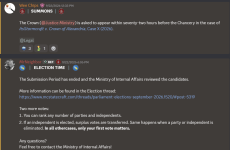
After careful consideration, Plaintiff refuses as they wish to pursue a verdict from the Court.

So filed before this honourable Court,
Kaladin Stormblessed
 
IN THE CHANCERY OF ALEXANDRIA
Entreaty to Extend Discovery

Your Honours,
I am sorry to have to ask for an extension of 72h but I am currently in discussions with a lawyer and the potential new counsel requires additional time to render a decision on whether to assist here.
I as a only private person believe that the additional help will be required to contest the government properly.

So petitioned before this honourable Court,
Kaladin Stormblessed
 
IN THE CHANCERY OF ALEXANDRIA
Entreaty to Extend Discovery

Your Honours,
I am sorry to have to ask for an extension of 72h but I am currently in discussions with a lawyer and the potential new counsel requires additional time to render a decision on whether to assist here.
I as a only private person believe that the additional help will be required to contest the government properly.

So petitioned before this honourable Court,
Kaladin Stormblessed
IN THE HONOURABLE CHANCERY OF THE KINGDOM OF ALEXANDRIA
CIVIL ACTION
Case No.
X
Response to Entreaty to Extend Discovery


Your Honors,

The Crown is opposed to such a motion to extend discovery. The Plaintiff has had ample time since they filed this case 6 days ago, as well as ample time since the start of Discovery to request this extension and in the meantime responded to the Crown's mediation/arbitration request.

While the Crown is sympathetic to having proper representation, it should come as no surprise to the Plaintiff that they would be trying to contest the Government of Alexandria. They could have made this issue known to the Court in a timely manner in the proceeding 6 days, instead of submitting this request less than 3 hours before the discovery deadline.

It would be grossly unfair to the Crown, who has made prompt and timely filings throughout this entire endeavor, for this extension to be granted.


Respectfully submitted,
Stephen W. Spooner Jr.
Solicitor General of Alexandria.
 
IN THE CHANCERY OF ALEXANDRIA
Entreaty to Extend Discovery

Your Honours,
I am sorry to have to ask for an extension of 72h but I am currently in discussions with a lawyer and the potential new counsel requires additional time to render a decision on whether to assist here.
I as a only private person believe that the additional help will be required to contest the government properly.

So petitioned before this honourable Court,
Kaladin Stormblessed
I will accept this and grant an extension to the original deadline by seventy-two hours. It should be noted that this request was made in a timely manner within the proper deadline to ask for such an extension, and this court is not in the habit of denying timely filed extension requests without good cause, especially in the first instance.
 
Back
Top