Lawsuit: In Session ItsStormcraft v. Crown of Alexandria, Case X (2026)

IN THE CHANCERY OF ALEXANDRIA
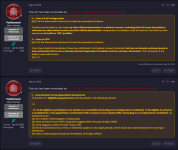
Consent to Representation and Oath

Your Honours,

I, ItsStormcraft, consent to Theory Fontaine (xXTheoryXx) representing me as counsel in ItsStormcraft v. Crown of Alexandria, Case X (2026), and to counsel making all further filings on my behalf.

I swear to the Crown to speak the truth and nothing but the truth before this Court.

So filed before this honourable Court,
Kaladin Stormblessed
 
IN THE CHANCERY OF ALEXANDRIA
Notice of Appearance​

Your Honours,

I, Theory Fontaine (xXTheoryXx), give notice that I appear as counsel for the Plaintiff, ItsStormcraft, in this matter. The Plaintiff's consent is recorded in the post above. All further filings for the Plaintiff will be made by counsel.

I swear to the Crown to speak the truth and nothing but the truth before this Court, as required by Gen. Court R. & Proc. Part I, § 5.

Respectfully submitted,
Theory Fontaine
Counsel for the Plaintiff
 
IN THE CHANCERY OF ALEXANDRIA
CIVIL ACTION
Case No. X (2026)

AMENDMENT TO COMPLAINT​

Your Honours,

Under Gen. Court R. & Proc. Part II, § 3, the Plaintiff declares and explains the following amendments to the Complaint, made during discovery. The full text of the Complaint as amended is set out below.

How to read the amendment
Red struck text is removed. Green text is added. Text in the ordinary colour is the original Complaint, unchanged.

In keeping with Part II, § 5, no information already submitted is changed. The only text removed is the misspelling "nto", corrected to "not" as the Court directed on 23 September (Post #4). Every other change is an addition.


Schedule of amendments

Heading
1. Adds the case caption (Civil Action, Case No. X (2026), the parties) and a note that the Complaint is amended under Part II, § 3.

Section I, Jurisdictional Statement
2. Corrects "nto" to "not" in the second sentence.
3. Adds paragraph (a): the text of K.A. Const. Part III, Art. 15 and Gen. Court R. & Proc. Part I, § 10(c).
4. Adds paragraph (b): the first ground of jurisdiction, a constitutional question arising solely out of the Constitution (Arts. 1, 3, 3a, 6, 14 and 15), with the Crown's own statement in its Answer and PhillinDeBlanc v. Crown, Case 10 (Ch. 2025).
5. Adds paragraph (c): the second ground of jurisdiction, a challenge to the results of the September 2026 general election, with Alliance 25 / The Greens for Alexandria v. Crown of Alexandria, Case VII (2026).
6. Adds paragraph (d): this Court's finding of 26 September that a clear issue within its jurisdiction is alleged (Post #13).
7. Adds paragraph (e): clarifies that the Plaintiff does not contend the Constitution fails to bind the Executive, only that the power to hold a statute yields to the Constitution belongs to this Court alone.

Section II, Parties
8. Adds paragraph (1): the Plaintiff's citizenship, his office as President of the Greens, his candidacy as fifth on the Greens' list (P-003), and his service as Electoral Adjudicator until his removal.
9. Adds paragraph (2): the Crown is sued for the acts of the Electoral Office (AEA § 3), as this Court held in Post #13.
10. Adds paragraph (3), standing under Part I, § 9 and Part II, § 1(a)(i):
(a) injury caused by a clear second party: the loss of the ability to stand in the election (Art. 22; P-001; P-004);
(b) affected by an application of law: P-001 was applied to the Plaintiff's candidacy;
(c) genuine interest as a citizen with no reasonable and effective alternative means: the Magistrates Court cannot hear the question, the Electoral Office had already rejected the restart argument, the action was filed before the Voting Period opened (D-001), and Parliament was dissolved the same day;
(d) Part I, § 10(d) does not govern, because no law is contested;
(e) remedy: the relief sought is within the Court's power (.FreakyyyyBob158 v. Crown of Alexandria, Case 5 (Ch. 2026); SoggehToast v. Crown, Case VI (2026)).​

Section III, Facts
11. Fact (2): adds that E1 is re-submitted in discovery as P-001.
12. Adds facts (4) to (19):
(4) the term began on 24 June 2026 at 18:51 UTC; its 80th, 88th and 90th days ended on 12, 20 and 22 September 2026;
(5) the Crown states the election was called on 31 August 2026, the 68th day;
(6) the Ministry's submission period ran from 14 September 2026 at 13:49 UTC to 19 September 2026 at 14:00 UTC, before dissolution, and was not the Submission Period prescribed by AEA § 4(3) (P-002);
(7) the Plaintiff accepts that this schedule was set while he was Electoral Adjudicator;
(8) the Greens' declaration was filed on 19 September 2026 at 16:21 UTC, listing the Plaintiff fifth; Crimson Tide (16:49 UTC) and ComplexKing (21:44 UTC) filed the same day (P-003);
(9) Parliament removed the Plaintiff and appointed McBrittle419; Case IX was dismissed without prejudice and is not relitigated;
(10) A.P.06-022 and A.P.06-020 amended the Electoral Act, recorded on 22 September 2026 at 12:59 and 13:04 UTC, and left § 4(3) unaltered (P-006);
(11) the content of the proclamation at P-001, quoted in full where relied on;
(12) the Ministry marked the three declarations "NOT ACKNOWLEDGED" on 22 September 2026 between 17:10 and 17:17 UTC (P-004);
(13) no Submission Period opened after dissolution; the Voting Period ran from 23 September 2026 at 01:07 UTC to 26 September 2026 at 01:00 UTC, and results were announced at 03:01 UTC (P-004; P-005);
(14) the Voting Period ran entirely after the term had ended;
(15) the Crown did not bring the question before this Court;
(16) under AEA § 4(3), the Greens' declaration would have been in time;
(17) this Court summoned the Crown at 19:31 UTC on 22 September 2026, before the Voting Period opened (Post #2; D-001);
(18) in September, 30 ballots were cast, the quota was 2.72727, and ANP was apportioned four seats with one candidate, leaving three of eleven seats vacant (P-005; AEA § 10(2)(a) and (3));
(19) in June 2026 the Greens received 9 of 71 first-preference votes and two seats, one later reassigned in Case VI, and ComplexKing was returned for ANP (P-007).​

Section IV, Argument
13. Adds Part A, paragraphs (1) to (5): the Constitution gives the question to this Court, not the Executive (Parliament's exclusive legislative power, Arts. 1, 3 and 3a; the Executive's duty under Art. 6; this Court's exclusive role under Arts. 14 and 15; P-001's own concession; Case 5's refusal of interim suspension; the lawful routes not used).
14. Adds Part B, paragraphs (6) to (10): the Crown's defence fails on its own terms (Art. 22 and Case 5; the conflict was not clear; setting § 4(3) aside did not secure compliance; the Constable example; the allegation of delay).
15. Adds Part C, paragraph (11): the declarations are needed in any event, because the question will recur.
16. Adds Part D, paragraphs (12) to (18): the September returns should be set aside (jurisdiction and Case VI; the exclusion changed the result; Prior Ponderance VI does not bar relief; the Crown ran the vote with notice; the Plaintiff's own part is no answer; continuity of government; declarations alone in the alternative).

Section V, Petition
17. Prayers (1) and (2) are retained unchanged.
18. Adds prayer (3): a declaration that no officer of the Executive may suspend or decline to apply an Act of Parliament because the officer believes it unconstitutional, that the question must be brought to this Court, and that the Act must be administered as written until this Court rules.
19. Adds prayer (4): a declaration that P-001 was made without lawful authority.
20. Adds prayer (5): a declaration that the disqualifications of the Greens, Crimson Tide and ComplexKing had no lawful basis.
21. Adds prayer (6): in support of prayer (2), an order setting aside the September 2026 returns and directing a new general election on the schedule in AEA § 4, with the Members returned in September remaining in office until the new results are announced.
22. Adds prayer (7): the declarations alone, in the alternative to prayers (2) and (6).
23. Adds prayer (8): any further relief the Court considers just.

Signature
24. Adds counsel's name to the signature.

Reason for the amendment
The Plaintiff has retained counsel. The amendment sets out the constitutional principle the Plaintiff asks the Court to declare, the grounds on which the returns should be set aside, and alternative relief should the Court prefer declarations alone. It states the case with the clarity this Court requires (ColonelKai v. Crown, Case 8 (Ch. 2025)). The amended Section II also sets out the standing facts relevant to the Crown's pending Entreaty to Reconsider (Post #14).

As this amendment is made within 72 hours of the close of discovery, the Crown will have 72 hours after discovery closes to amend its Answer (Part II, § 7). The amended text will be edited into the original Complaint (Post #1) immediately after this declaration.


Text of the Complaint as amended

IN THE CHANCERY OF ALEXANDRIA
CIVIL ACTION
Case No. X (2026)

ItsStormcraft
Plaintiff

v.

The Crown of the Kingdom of Alexandria
Defendant


Civil Complaint
As amended on 30 September 2026 under Gen. Court R. & Proc. Part II, § 3.​


I. Jurisdictional Statement

This court has jurisdiction over all constitutional questions. I argue that the Constitution is nto not directly applicable law and all decisions whether a law conflicts with the constitution must originate from the Chancery.

Added by amendment, 30 September 2026:

(a) The Constitution gives this Court "exclusive jurisdiction over constitutional questions, including the interpretation and application of the Constitution, as well as disputed returns arising from elections, including challenges to election results" (K.A. Const. Part III, Art. 15). Constitutional matters must be heard by the Chancery (Gen. Court R. & Proc. Part I, § 10(c)).

(b) Constitutional question. The question in this case arises directly and solely out of the Constitution: whether Articles 1, 3, 3a, 6, 14 and 15 allow an officer of the Executive to set aside a provision of an Act of Parliament because that officer believes it conflicts with the Constitution. It does not turn on the meaning of any Act. The Crown affirms the text of A.P.00-018 Alexandrian Electoral Act ("AEA") § 4(3) and states that "the new Electoral Adjudicator decided to follow the Constitution" instead (Answer, Post #10). The issue is therefore "born solely or almost entirely out of the Constitution itself" (PhillinDeBlanc v. Crown, Case 10 (Ch. 2025)).

(c) Disputed return. This action is also a challenge to the results of the September 2026 general election. That is the second of the two matters this Court hears at first instance (Alliance 25 / The Greens for Alexandria v. Crown of Alexandria, Case VII (2026)).

(d) This Court has already found that "there is a clear issue within our jurisdiction being alleged" (Post #13).

(e) Clarification of the second sentence above. The Plaintiff does not contend that the Constitution fails to bind the Executive; it binds every officer. The Plaintiff contends that where an officer believes an Act of Parliament conflicts with the Constitution, the officer must continue to administer the Act as written and bring the question to this Court. The power to hold that a statute yields to the Constitution belongs to this Court alone.


II. Parties

ItsStormcrafter, fmr. Electoral Adjudicator
The Crown, represented by the Ministry of Justice

Added by amendment, 30 September 2026:

(1) The Plaintiff, ItsStormcraft (forum: TheStormcrafter), is a citizen of the Kingdom of Alexandria and President of Alliance 25 / The Greens for Alexandria ("the Greens"). He stood as the fifth candidate on the Greens' list for the September 2026 general election (P-003). He served as Electoral Adjudicator until his removal by Parliament on or about 22 September 2026.

(2) The Crown is sued for the acts of the Electoral Office of the Ministry of Internal Affairs (AEA § 3). This Court has held: "It is the whole of government being sued" (Post #13).

(3) Standing (Gen. Court R. & Proc. Part I, § 9; Part II, § 1(a)(i)). The Plaintiff meets each limb, although one suffices.
(a) Injury caused by a clear second party. The Crown refused to apply AEA § 4(3) (P-001) and, on that basis, disqualified the Greens' declaration on which the Plaintiff stood as a candidate (P-004). The Plaintiff lost the ability to stand in the September 2026 general election, a right guaranteed to every citizen by K.A. Const. Part V, Art. 22.

(b) Affected by an application of law. The proclamation at P-001 was applied to the Plaintiff's candidacy.

(c) Genuine interest as a citizen, with no reasonable and effective alternative means. Every citizen has the right to run for office and to vote (Art. 22). A constitutional question cannot be heard by the Magistrates Court (Art. 15 and 16; Part I, § 10(c)). The Electoral Office had already considered the argument that the Submission Period must be restarted and publicly rejected it (P-001). The Plaintiff filed this action at 11:41 UTC on 22 September 2026, before the Voting Period opened (D-001). Parliament stood dissolved at 18:51 UTC that same day, so no legislative correction was available.

(d) No law is contested. The Plaintiff asks that an Act of Parliament be applied as written. Part I, § 10(d), which concerns a plaintiff "seeking a declaration to contest a law", therefore does not govern this action. If it did, (a) to (c) above satisfy it.

(e) Remedy. The relief sought in Section V is within this Court's power. It has granted declarations striking provisions of the Electoral Act (.FreakyyyyBob158 v. Crown of Alexandria, Case 5 (Ch. 2026)), and it has corrected an election return by removing a sitting Member (SoggehToast v. Crown, Case VI (2026), Post #11).
​


III. Facts

(1) The Alexandrian Electoral Act §4(3) reads: "A Submission Period shall open as soon as is practicable after the dissolution of Parliament, and close after 120 hours (5 days)."

(2) The new Electoral Adjudicator posted an announcement proclaiming that a section of the Alexandrian Electoral Act would be ignored as they believe it to conflict with the constitution. (E1) (re-submitted in discovery as P-001)

(3) Dissolution is today, on the 22nd of September at 18:51 UTC, 2160h after the announcement enacting the election results.

Added by amendment, 30 September 2026:

The term

(4) The term of the Parliament dissolved on 22 September 2026 began 2160 hours (90 days) earlier, on 24 June 2026 at 18:51 UTC (Answer, Post #10, ¶ 3). Its 80th day ended on 12 September, its 88th day on 20 September and its 90th day on 22 September 2026.

(5) The Crown states that the general election was called on 31 August 2026 (Answer, Post #10, Defences), the 68th day of the term.

The submission period and the Greens' declaration

(6) On 14 September 2026 at 13:49 UTC, the Ministry of Internal Affairs opened a submission period in the election thread and stated that it would close on 19 September 2026 at 14:00 UTC (P-002). That period opened and closed while Parliament was still in session. It was not the Submission Period prescribed by AEA § 4(3), which opens only "after the dissolution of Parliament".

(7) The Plaintiff accepts that this schedule was set by the Electoral Office while he held the office of Electoral Adjudicator.

(8) On 19 September 2026 at 16:21 UTC, the Plaintiff filed the Greens' declaration, listing five candidates with himself fifth (P-003). Crimson Tide (16:49 UTC) and the independent candidate ComplexKing (21:44 UTC) filed on the same day.

22 September 2026

(9) Parliament then removed the Plaintiff as Electoral Adjudicator and appointed McBrittle419 (Answer, Post #10, Defences). The Plaintiff challenged those motions in ItsStormcraft v. The Crown of Alexandria, Case IX (2026), which this Court dismissed without prejudice for want of jurisdiction. The Plaintiff does not relitigate those motions here.

(10) On 22 September 2026, Parliament's amendments to the Electoral Act by A.P.06-022 (Independent Candidates Fixes Act) and A.P.06-020 (The Let Only Eligible Players Be Appointed To Parliament Act) were recorded on the Act at 12:59 and 13:04 UTC. Both amended the Act's election rules. Neither altered AEA § 4(3) (P-006).

(11) Before this Complaint was filed at 11:41 UTC on 22 September 2026, and so before dissolution, the new Electoral Adjudicator published the proclamation at P-001 (E1 above). It quotes AEA § 4(3) and K.A. Const. Part I, Art. 5(3) and records that "The argument is being made that the elections to include the entire submission period should be restarted". It reasons that "the Constitution clearly states that elections must begin no later than the 88th day of Parliament. Which would bring us to assume that the submission period of elections should begin prior to that." It then states: "It is clear that the law conflicts with the Constitution. While it is not our job to make a legally binding interpretation of the Constitution, it is our job to uphold it in our work to the best of our ability." It adds: "According to the Constitution, we are already late on elections" and "This election will proceed as quickly as possible."

(12) On 22 September 2026, between 17:10 and 17:17 UTC, the Ministry of Internal Affairs marked the declarations of the Greens, Crimson Tide and ComplexKing "NOT ACKNOWLEDGED", on the ground that each declaration was made after the Submission Period closed (P-004).

The election

(13) No Submission Period opened after dissolution. The Voting Period opened on 23 September 2026 at 01:07 UTC and listed the Greens as disqualified because their "Declaration was made after Submission Period had ended" (P-004). It closed on 26 September 2026 at 01:00 UTC, and results were announced at 03:01 UTC that day (P-005).

(14) The Voting Period therefore ran entirely after the 90-day term had ended.

(15) To the Plaintiff's knowledge, the Crown did not bring the question of AEA § 4(3) before this Court, whether by action, entreaty for emergency relief or Writ of Prior Ponderance, before or after publishing P-001.

(16) Had AEA § 4(3) been applied, the Submission Period would have opened after 18:51 UTC on 22 September 2026 and closed 120 hours later. The Greens' declaration would have been in time, or could have been filed again in time (AEA § 5, which allows a declaration to be edited until the Submission Period closes).

(17) This Court summoned the Crown in this action at 19:31 UTC on 22 September 2026 (Post #2), before the Voting Period opened (D-001).

The result

(18) In the September 2026 general election, 30 ballots were cast and the quota was 2.72727 votes. The Alexandria National Party ("ANP"), which stood a single candidate, was apportioned four seats. Three of the eleven seats of Parliament are therefore vacant (P-005). Under AEA § 10(2)(a) and (3), those seats are held under ANP's control and are to be filled by appointment, failing which by special election.

(19) In the June 2026 general election, the Greens received 9 of 71 first-preference votes and were returned to Parliament with two seats, one of which this Court later reassigned in SoggehToast v. Crown, Case VI (2026). ComplexKing was returned in the same election as a Member for ANP (P-007).


IV. Argument

This court has the sole authority to strike a section of the law. The Electoral Adjudicator, in her proclamation, effectively rendered a section law law void without a judicial mandate. The election is therefore conducted in violation with the law. The argument that this is to bring the act in line with the constitution is misguided, only this court can apply the constitution. Similarly, the MoIA in the past believed that the passport requirement for candidates was most likely unconstitutional (and even prior to .FreakyyyyBob158 v. Crown of Alexandria, Case 5 (Ch. 2026) believed the requirement for voting problematic) but could not act and ahd to follow the law.
The Constitution, in this sense, does not directly apply (it is not "directly applicable law") but instead is applied through the judiciary by this court. If a provision of law is believed to be unconstitutional, one has to sue, not ignore the law, thereby circumventing the powers of the judiciary.

Added by amendment, 30 September 2026:

A. The Constitution gives this question to the Court, not to the Executive

(1) Legislative power is vested in Parliament, which holds "the exclusive authority" to "create, amend, and repeal laws" (K.A. Const. Part I, Art. 1 and 3). Parliament may not even delegate that power (Art. 3a(1)). Suspending AEA § 4(3) for a whole general election changed the law for that election. No officer of the Executive holds that power. Parliament's will on § 4(3) was also current: the two amendments to the Electoral Act recorded on the day of dissolution left § 4(3) as it stood (Fact 10).

(2) The Executive exists to "administer and enforce the law, as written by the legislature and interpreted by the judiciary" (Part II, Art. 6). The courts interpret the law (Part III, Art. 14), and this Court alone interprets and applies the Constitution (Art. 15). An officer who holds that a statute gives way to the Constitution is applying the Constitution against the statute. That is the function Art. 15 makes exclusive to this Court.

(3) P-001 concedes as much: "it is not our job to make a legally binding interpretation of the Constitution". Yet P-001 bound everyone it touched. Three contenders were struck from the ballot because of it (Facts 12 and 13). An interpretation that disqualifies candidates is binding in every sense that matters.

(4) This Court will not suspend an Act of Parliament even before its own judgment. In Case 5 it refused interim relief against the passport requirement, preferring "to uphold that status quo and later overturn the statute rather than radically suspend it" (Case 5, Post #5). If this Court will not suspend an Act pending judgment, an Electoral Adjudicator cannot suspend one without any judgment at all.

(5) Lawful routes were open. The Crown could have sought emergency relief from this Court, or a Writ of Prior Ponderance (Chancery R. & Proc. § 2(a)(ii)), as was done on the timing of dissolution in Entreaty for Prior Ponderance VI (Ch. 2025). Parliament could have authorised such a question by majority vote (id.) or amended the Act. None of these routes was used (Fact 15).

B. The Crown's defence fails on its own terms

(6) The Crown says that any citizen or official "may defer to following the Constitution" (Answer, Post #10). But the Constitution that P-001 invoked also guarantees every citizen "the right to run for and hold elected offices", and allows only Parliament, by law, to limit it through "reasonable activity requirements" (Part V, Art. 22). This Court has held that "any action by the government may not limit voting rights or the right to run and hold office unless it is both passed by Parliament and is a reasonable activity requirement" (Case 5, Verdict, § III.A). P-001 did the opposite. An Executive officer kept in place a candidacy window that Parliament never enacted, refused to open the one Parliament did enact, and excluded candidates on that basis. Deference to the Constitution cannot justify an act the Constitution forbids.

(7) The conflict P-001 called "clear" was not. P-001 itself reached its conclusion by inference: it said the Constitution "clearly states that elections must begin no later than the 88th day of Parliament", and that this "would bring us to assume" the Submission Period must start earlier (Fact 11). An assumption drawn from a paraphrase is not a clear conflict. The 88th-day rule in Part I, Art. 5(3) applies only "if not called before the 80th day", and the Crown says this election was called on the 68th (Fact 5). The rest of that clause, and the moment at which Parliament dissolves, needed this Court's interpretation in Prior Ponderance VI, which did not consider AEA § 4(3). The Act can also operate alongside the Constitution: the Monarch may dissolve Parliament on the advice of the Prime Minister (Part IV, Art. 19), which allows the Act's schedule to begin before the term would otherwise expire. The Plaintiff does not ask the Court to decide whether AEA § 4(3) is constitutional. The point is that the question was open, which is exactly why it belonged to this Court.

(8) Setting § 4(3) aside did not even secure compliance with the Constitution. By P-001's own account the election was "already late", and the Voting Period ran entirely after the term had ended (Facts 13 and 14). The only practical effect of P-001 was to exclude three contenders in exchange for finishing a few days sooner. Whether that trade is permissible is a question of constitutional weight, and the Constitution gives it to this Court.

(9) The Crown's example of a Constable is different in kind. Whatever room an individual officer has to refuse to carry out an act that would itself violate a person's guaranteed rights, it cannot extend to suspending an Act of Parliament for a whole general election in a way that curtails other citizens' rights. P-001 protected no one's rights. It restricted them.

(10) The Crown alleges that the Plaintiff, while Electoral Adjudicator, "decided to instead delay elections" (Answer, Post #10). The Plaintiff denies this, and the Crown offers no evidence for it. It is also beside the point. The Plaintiff accepts that the original schedule did not follow § 4(3) (Fact 7). That error could still be corrected on 22 September by the course the Act prescribes, and P-001 shows that this course was put to the Electoral Office and refused. However the lateness arose, it gave the new Electoral Adjudicator no power to suspend an Act of Parliament.

C. The declarations are needed in any event

(11) The same question will arise at the next general election, and at every one after it in which a term runs to its end. Whatever the Court decides about the September returns, a ruling on the principle tells each future Electoral Office what to do when it believes an Act of Parliament and the Constitution collide.

D. The September returns should be set aside

(12) This Court hears "challenges to election results" at first instance (Art. 15; Case VII), and it has corrected a return where the Ministry misapplied the Electoral Act. In Case VI it removed a sitting Member and seated the claimant on the claim that a single ballot had been transferred contrary to AEA § 8(4) (Case VI, Post #1; Post #11). The defect here is graver. One misallocated ballot was enough in Case VI; here whole contenders were kept off the ballot.

(13) The exclusion changed the result. With a quota of 2.72727 votes, any contender with three first-preference votes would have reached quota and qualified for seat allocation (Fact 18). Three months earlier the Greens drew 9 of 71 first preferences, and ComplexKing was returned as a Member (Fact 19). On that share alone, the Greens would have drawn nearly four first preferences from 30 ballots. Instead three of the eleven seats now sit empty, to be filled by appointment by a party that stood one candidate (Fact 18). More than a quarter of Parliament will be chosen without any vote, while two party lists and an independent candidate were refused a place on the ballot. That is not the Parliament the Act would have produced.

(14) Prior Ponderance VI does not stand in the way. It holds that good-faith mistakes in this area of law are not automatically void, which is not the same as holding that they can never be set aside. And P-001 was not a mistake. It recorded the argument that the Submission Period must restart and rejected it (Fact 11). Whatever schedule earlier elections followed, by 22 September the Electoral Office had § 4(3) and the objection in front of it and chose to set the Act aside.

(15) The Crown ran the vote with notice. It was summoned in this action before the Voting Period opened (Fact 17), and it chose to proceed while the lawfulness of the election was before this Court. It took the risk that the Court would find the election unlawful.

(16) The Plaintiff's own part in the original schedule (Fact 7) is no answer. That error could have been cured on 22 September by the course the Act prescribes, and the Crown refused the cure. A new election does not reward the Plaintiff. It gives every party, candidate and voter the election that Parliament enacted.

(17) A new election need not leave any gap in government. The Court can provide that the Members returned in September remain in office until the results of the new election are announced.

(18) If the Court considers a new election disproportionate so close to the next general election, the Plaintiff asks in the alternative for the declarations alone. They are the minimum needed to stop this happening again.


V. Petition

(1) Order that the proclamation is unlawful as only this court can determine constitutionality, not the Electoral Adjudicator.

(2) Order that the election has to be restarted in line with the Alexandrian Electoral Act.

Added by amendment, 30 September 2026:

(3) Declare that, under Articles 1, 3, 3a, 6, 14 and 15 of the Constitution, no officer of the Executive, including an Electoral Officer, may suspend or decline to apply a provision of an Act of Parliament on the ground that the officer believes it to conflict with the Constitution; that such a question must be brought before this Court; and that until this Court rules, the Act must be administered as written.

(4) Declare that the proclamation at P-001, in so far as it set aside AEA § 4(3) for the September 2026 general election, was made without lawful authority.

(5) Declare that the disqualifications of the Greens, Crimson Tide and ComplexKing rested on that proclamation and had no lawful basis.

(6) In support of prayer (2), set aside the returns of the September 2026 general election and order the Ministry of Internal Affairs to conduct a new general election on the schedule in AEA § 4, with the Submission Period opening as soon as practicable after this Court's order; and provide that the Members returned in September remain in office until the results of the new election are announced.

(7) In the alternative to prayers (2) and (6), should the Court consider a new election disproportionate, grant prayers (1) and (3) to (5) alone.

(8) Any further relief the Court considers just.


So petitioned before the honourable Court,

Kaladin Stormblessed
Plaintiff

Theory Fontaine
Counsel for the Plaintiff (amendment of 30 September 2026)


(The E1 spoiler in the original Complaint is unchanged.)


Respectfully submitted,
Theory Fontaine
Counsel for the Plaintiff
 
IN THE CHANCERY OF ALEXANDRIA
Submission of Discovery and Witness List​

Your Honours,

The Plaintiff submits the following evidence under Gen. Court R. & Proc. Part III, § 5. Each image is uploaded directly to this post. Forum timestamps visible in the screenshots are shown in Central European Summer Time (UTC+2); times given below are in UTC.


P-001: Proclamation of the Electoral Adjudicator declining to apply AEA § 4(3) (item 1 of the Electoral Office announcement), published before this Complaint was filed at 11:41 UTC on 22 September 2026. Previously attached to the Complaint as E1, re-submitted here under the required label.
Source: Complaint, Post #1 (E1)
UPLOAD: P-001_E1-proclamation.png


P-002: Ministry of Internal Affairs, opening post of "Parliament Elections | September 2026", 14 September 2026 at 13:49 UTC, stating that the Submission Period would close on "the 19th June, 2026; at 14:00 UTC" (in context, 19 September 2026).
Source: Parliament Elections | September 2026, Post #1
UPLOAD: P-002_MoIA-opening-post.png


P-003: Declaration of Alliance 25 / The Greens for Alexandria, 19 September 2026 at 16:21 UTC, listing ItsStormcraft as the fifth candidate.
Source: Parliament Elections | September 2026, Post #6
UPLOAD: P-003_Greens-declaration.png


P-004: Ministry of Internal Affairs posts of 22 September 2026 marking the declarations of the Greens (17:10 UTC), Crimson Tide (17:16 UTC) and ComplexKing (17:17 UTC) "NOT ACKNOWLEDGED", and the Voting Period notice of 23 September 2026 at 01:07 UTC listing them as disqualified.
Sources: Post #13 (Greens), Post #14 (Crimson Tide), Post #15 (ComplexKing), Post #16 (Voting Period)
UPLOAD: P-004a_not-acknowledged.png
UPLOAD: P-004b_voting-period.png


P-005: Results announcement, 26 September 2026 at 03:01 UTC, showing 30 ballots, a quota of 2.72727, and four seats apportioned to the Alexandria National Party with three left vacant.
Source: Parliament Elections | September 2026, Post #17
UPLOAD: P-005_September-results.png


P-006: Records of A.P.06-022 (Independent Candidates Fixes Act) and A.P.06-020 (The Let Only Eligible Players Be Appointed To Parliament Act) amending the Alexandrian Electoral Act, posted on the Act on 22 September 2026 at 12:59 and 13:04 UTC.
Sources: A.P.00-018, Post #13 (A.P.06-022), A.P.00-018, Post #14 (A.P.06-020)
UPLOAD: P-006_AEA-amendments.png


P-007: Results announcement of the June 2026 general election, 24 June 2026 at 18:04 UTC, showing the Greens with 9 of 71 first-preference votes and two seats, and ComplexKing returned for the Alexandria National Party.
Source: Parliament Elections | June 2026, Post #21
UPLOAD: P-007a_June-results.png
UPLOAD: P-007b_June-results-lists.png


Witness list (Part III, § 7(a)):
1. McBrittle419, Electoral Adjudicator and author of P-001.
2. MrNeighbor, Electoral Officer.
3. Vennefly, Electoral Officer during the Plaintiff's tenure as Electoral Adjudicator.

The Plaintiff reserves the right not to call any listed witness.

Respectfully submitted,
Theory Fontaine
Counsel for the Plaintiff
 
IN THE HONOURABLE CHANCERY OF THE KINGDOM OF ALEXANDRIA
CIVIL ACTION
Case No.
X
Entreaty to Extend Discovery


Your Honors,


The drive-by filings that the Plaintiff and their Counsel have dumped upon the Court has fundamentally changed the entirety of this case in many ways, shapes and forms. It has come to the point where I would call the Plaintiff's amended filings Theseus's Ship as so little of the original complaint remains one has to wonder if, metaphysically speaking, this new Star Wars opening scrawl of a requested amendment and evidence is even in the original spirit of the complaint brought before the Court to begin with.

The Crown requests that Discovery be extended, in total, by an additional 144 hours, given the extreme change in direction this case has taken on almost all fronts:

  • 72 hours to properly reassess the Crown's case in light of the new circumstances.

  • 48 hours to draft a proper amended response to the excessive complaint amendments to the Plaintiff's filings, if they are granted by the court.


Clearly the Plaintiff want's to go on a metaphorical and metaphysical fishing expedition into every single facet of the election on Theseus's Ship with Captain Ahab at the helm. The Crown needs a proper amount of time to chum the waters for this Moby Dick sized whale of a case it may now find itself responding to.


Respectfully submitted,
Stephen W. Spooner Jr.
Solicitor General of Alexandria.
 
IN THE CHANCERY OF ALEXANDRIA
CIVIL ACTION
Case No. X (2026)

AMENDMENT TO COMPLAINT​

Your Honours,

Under Gen. Court R. & Proc. Part II, § 3, the Plaintiff declares and explains the following amendments to the Complaint, made during discovery. The full text of the Complaint as amended is set out below.

How to read the amendment
Red struck text is removed. Green text is added. Text in the ordinary colour is the original Complaint, unchanged.

In keeping with Part II, § 5, no information already submitted is changed. The only text removed is the misspelling "nto", corrected to "not" as the Court directed on 23 September (Post #4). Every other change is an addition.


Schedule of amendments

Heading
1. Adds the case caption (Civil Action, Case No. X (2026), the parties) and a note that the Complaint is amended under Part II, § 3.

Section I, Jurisdictional Statement
2. Corrects "nto" to "not" in the second sentence.
3. Adds paragraph (a): the text of K.A. Const. Part III, Art. 15 and Gen. Court R. & Proc. Part I, § 10(c).
4. Adds paragraph (b): the first ground of jurisdiction, a constitutional question arising solely out of the Constitution (Arts. 1, 3, 3a, 6, 14 and 15), with the Crown's own statement in its Answer and PhillinDeBlanc v. Crown, Case 10 (Ch. 2025).
5. Adds paragraph (c): the second ground of jurisdiction, a challenge to the results of the September 2026 general election, with Alliance 25 / The Greens for Alexandria v. Crown of Alexandria, Case VII (2026).
6. Adds paragraph (d): this Court's finding of 26 September that a clear issue within its jurisdiction is alleged (Post #13).
7. Adds paragraph (e): clarifies that the Plaintiff does not contend the Constitution fails to bind the Executive, only that the power to hold a statute yields to the Constitution belongs to this Court alone.

Section II, Parties
8. Adds paragraph (1): the Plaintiff's citizenship, his office as President of the Greens, his candidacy as fifth on the Greens' list (P-003), and his service as Electoral Adjudicator until his removal.
9. Adds paragraph (2): the Crown is sued for the acts of the Electoral Office (AEA § 3), as this Court held in Post #13.
10. Adds paragraph (3), standing under Part I, § 9 and Part II, § 1(a)(i):
(a) injury caused by a clear second party: the loss of the ability to stand in the election (Art. 22; P-001; P-004);​
(b) affected by an application of law: P-001 was applied to the Plaintiff's candidacy;​
(c) genuine interest as a citizen with no reasonable and effective alternative means: the Magistrates Court cannot hear the question, the Electoral Office had already rejected the restart argument, the action was filed before the Voting Period opened (D-001), and Parliament was dissolved the same day;​
(d) Part I, § 10(d) does not govern, because no law is contested;​
(e) remedy: the relief sought is within the Court's power (.FreakyyyyBob158 v. Crown of Alexandria, Case 5 (Ch. 2026); SoggehToast v. Crown, Case VI (2026)).​

Section III, Facts
11. Fact (2): adds that E1 is re-submitted in discovery as P-001.
12. Adds facts (4) to (19):
(4) the term began on 24 June 2026 at 18:51 UTC; its 80th, 88th and 90th days ended on 12, 20 and 22 September 2026;​
(5) the Crown states the election was called on 31 August 2026, the 68th day;​
(6) the Ministry's submission period ran from 14 September 2026 at 13:49 UTC to 19 September 2026 at 14:00 UTC, before dissolution, and was not the Submission Period prescribed by AEA § 4(3) (P-002);​
(7) the Plaintiff accepts that this schedule was set while he was Electoral Adjudicator;​
(8) the Greens' declaration was filed on 19 September 2026 at 16:21 UTC, listing the Plaintiff fifth; Crimson Tide (16:49 UTC) and ComplexKing (21:44 UTC) filed the same day (P-003);​
(9) Parliament removed the Plaintiff and appointed McBrittle419; Case IX was dismissed without prejudice and is not relitigated;​
(10) A.P.06-022 and A.P.06-020 amended the Electoral Act, recorded on 22 September 2026 at 12:59 and 13:04 UTC, and left § 4(3) unaltered (P-006);​
(11) the content of the proclamation at P-001, quoted in full where relied on;​
(12) the Ministry marked the three declarations "NOT ACKNOWLEDGED" on 22 September 2026 between 17:10 and 17:17 UTC (P-004);​
(13) no Submission Period opened after dissolution; the Voting Period ran from 23 September 2026 at 01:07 UTC to 26 September 2026 at 01:00 UTC, and results were announced at 03:01 UTC (P-004; P-005);​
(14) the Voting Period ran entirely after the term had ended;​
(15) the Crown did not bring the question before this Court;​
(16) under AEA § 4(3), the Greens' declaration would have been in time;​
(17) this Court summoned the Crown at 19:31 UTC on 22 September 2026, before the Voting Period opened (Post #2; D-001);​
(18) in September, 30 ballots were cast, the quota was 2.72727, and ANP was apportioned four seats with one candidate, leaving three of eleven seats vacant (P-005; AEA § 10(2)(a) and (3));​
(19) in June 2026 the Greens received 9 of 71 first-preference votes and two seats, one later reassigned in Case VI, and ComplexKing was returned for ANP (P-007).​

Section IV, Argument
13. Adds Part A, paragraphs (1) to (5): the Constitution gives the question to this Court, not the Executive (Parliament's exclusive legislative power, Arts. 1, 3 and 3a; the Executive's duty under Art. 6; this Court's exclusive role under Arts. 14 and 15; P-001's own concession; Case 5's refusal of interim suspension; the lawful routes not used).
14. Adds Part B, paragraphs (6) to (10): the Crown's defence fails on its own terms (Art. 22 and Case 5; the conflict was not clear; setting § 4(3) aside did not secure compliance; the Constable example; the allegation of delay).
15. Adds Part C, paragraph (11): the declarations are needed in any event, because the question will recur.
16. Adds Part D, paragraphs (12) to (18): the September returns should be set aside (jurisdiction and Case VI; the exclusion changed the result; Prior Ponderance VI does not bar relief; the Crown ran the vote with notice; the Plaintiff's own part is no answer; continuity of government; declarations alone in the alternative).

Section V, Petition
17. Prayers (1) and (2) are retained unchanged.
18. Adds prayer (3): a declaration that no officer of the Executive may suspend or decline to apply an Act of Parliament because the officer believes it unconstitutional, that the question must be brought to this Court, and that the Act must be administered as written until this Court rules.
19. Adds prayer (4): a declaration that P-001 was made without lawful authority.
20. Adds prayer (5): a declaration that the disqualifications of the Greens, Crimson Tide and ComplexKing had no lawful basis.
21. Adds prayer (6): in support of prayer (2), an order setting aside the September 2026 returns and directing a new general election on the schedule in AEA § 4, with the Members returned in September remaining in office until the new results are announced.
22. Adds prayer (7): the declarations alone, in the alternative to prayers (2) and (6).
23. Adds prayer (8): any further relief the Court considers just.

Signature
24. Adds counsel's name to the signature.

Reason for the amendment
The Plaintiff has retained counsel. The amendment sets out the constitutional principle the Plaintiff asks the Court to declare, the grounds on which the returns should be set aside, and alternative relief should the Court prefer declarations alone. It states the case with the clarity this Court requires (ColonelKai v. Crown, Case 8 (Ch. 2025)). The amended Section II also sets out the standing facts relevant to the Crown's pending Entreaty to Reconsider (Post #14).

As this amendment is made within 72 hours of the close of discovery, the Crown will have 72 hours after discovery closes to amend its Answer (Part II, § 7). The amended text will be edited into the original Complaint (Post #1) immediately after this declaration.


Text of the Complaint as amended

IN THE CHANCERY OF ALEXANDRIA
CIVIL ACTION
Case No. X (2026)

ItsStormcraft
Plaintiff

v.

The Crown of the Kingdom of Alexandria
Defendant


Civil Complaint
As amended on 30 September 2026 under Gen. Court R. & Proc. Part II, § 3.​


I. Jurisdictional Statement

This court has jurisdiction over all constitutional questions. I argue that the Constitution is nto not directly applicable law and all decisions whether a law conflicts with the constitution must originate from the Chancery.

Added by amendment, 30 September 2026:

(a) The Constitution gives this Court "exclusive jurisdiction over constitutional questions, including the interpretation and application of the Constitution, as well as disputed returns arising from elections, including challenges to election results" (K.A. Const. Part III, Art. 15). Constitutional matters must be heard by the Chancery (Gen. Court R. & Proc. Part I, § 10(c)).

(b) Constitutional question. The question in this case arises directly and solely out of the Constitution: whether Articles 1, 3, 3a, 6, 14 and 15 allow an officer of the Executive to set aside a provision of an Act of Parliament because that officer believes it conflicts with the Constitution. It does not turn on the meaning of any Act. The Crown affirms the text of A.P.00-018 Alexandrian Electoral Act ("AEA") § 4(3) and states that "the new Electoral Adjudicator decided to follow the Constitution" instead (Answer, Post #10). The issue is therefore "born solely or almost entirely out of the Constitution itself" (PhillinDeBlanc v. Crown, Case 10 (Ch. 2025)).

(c) Disputed return. This action is also a challenge to the results of the September 2026 general election. That is the second of the two matters this Court hears at first instance (Alliance 25 / The Greens for Alexandria v. Crown of Alexandria, Case VII (2026)).

(d) This Court has already found that "there is a clear issue within our jurisdiction being alleged" (Post #13).

(e) Clarification of the second sentence above. The Plaintiff does not contend that the Constitution fails to bind the Executive; it binds every officer. The Plaintiff contends that where an officer believes an Act of Parliament conflicts with the Constitution, the officer must continue to administer the Act as written and bring the question to this Court. The power to hold that a statute yields to the Constitution belongs to this Court alone.


II. Parties

ItsStormcrafter, fmr. Electoral Adjudicator
The Crown, represented by the Ministry of Justice

Added by amendment, 30 September 2026:

(1) The Plaintiff, ItsStormcraft (forum: TheStormcrafter), is a citizen of the Kingdom of Alexandria and President of Alliance 25 / The Greens for Alexandria ("the Greens"). He stood as the fifth candidate on the Greens' list for the September 2026 general election (P-003). He served as Electoral Adjudicator until his removal by Parliament on or about 22 September 2026.

(2) The Crown is sued for the acts of the Electoral Office of the Ministry of Internal Affairs (AEA § 3). This Court has held: "It is the whole of government being sued" (Post #13).

(3) Standing (Gen. Court R. & Proc. Part I, § 9; Part II, § 1(a)(i)). The Plaintiff meets each limb, although one suffices.


(a) Injury caused by a clear second party. The Crown refused to apply AEA § 4(3) (P-001) and, on that basis, disqualified the Greens' declaration on which the Plaintiff stood as a candidate (P-004). The Plaintiff lost the ability to stand in the September 2026 general election, a right guaranteed to every citizen by K.A. Const. Part V, Art. 22.​
​
(b) Affected by an application of law. The proclamation at P-001 was applied to the Plaintiff's candidacy.​
​
(c) Genuine interest as a citizen, with no reasonable and effective alternative means. Every citizen has the right to run for office and to vote (Art. 22). A constitutional question cannot be heard by the Magistrates Court (Art. 15 and 16; Part I, § 10(c)). The Electoral Office had already considered the argument that the Submission Period must be restarted and publicly rejected it (P-001). The Plaintiff filed this action at 11:41 UTC on 22 September 2026, before the Voting Period opened (D-001). Parliament stood dissolved at 18:51 UTC that same day, so no legislative correction was available.​
​
(d) No law is contested. The Plaintiff asks that an Act of Parliament be applied as written. Part I, § 10(d), which concerns a plaintiff "seeking a declaration to contest a law", therefore does not govern this action. If it did, (a) to (c) above satisfy it.​
​
(e) Remedy. The relief sought in Section V is within this Court's power. It has granted declarations striking provisions of the Electoral Act (.FreakyyyyBob158 v. Crown of Alexandria, Case 5 (Ch. 2026)), and it has corrected an election return by removing a sitting Member (SoggehToast v. Crown, Case VI (2026), Post #11).​


III. Facts

(1) The Alexandrian Electoral Act §4(3) reads: "A Submission Period shall open as soon as is practicable after the dissolution of Parliament, and close after 120 hours (5 days)."

(2) The new Electoral Adjudicator posted an announcement proclaiming that a section of the Alexandrian Electoral Act would be ignored as they believe it to conflict with the constitution. (E1) (re-submitted in discovery as P-001)

(3) Dissolution is today, on the 22nd of September at 18:51 UTC, 2160h after the announcement enacting the election results.

Added by amendment, 30 September 2026:

The term

(4) The term of the Parliament dissolved on 22 September 2026 began 2160 hours (90 days) earlier, on 24 June 2026 at 18:51 UTC (Answer, Post #10, ¶ 3). Its 80th day ended on 12 September, its 88th day on 20 September and its 90th day on 22 September 2026.

(5) The Crown states that the general election was called on 31 August 2026 (Answer, Post #10, Defences), the 68th day of the term.

The submission period and the Greens' declaration

(6) On 14 September 2026 at 13:49 UTC, the Ministry of Internal Affairs opened a submission period in the election thread and stated that it would close on 19 September 2026 at 14:00 UTC (P-002). That period opened and closed while Parliament was still in session. It was not the Submission Period prescribed by AEA § 4(3), which opens only "after the dissolution of Parliament".

(7) The Plaintiff accepts that this schedule was set by the Electoral Office while he held the office of Electoral Adjudicator.

(8) On 19 September 2026 at 16:21 UTC, the Plaintiff filed the Greens' declaration, listing five candidates with himself fifth (P-003). Crimson Tide (16:49 UTC) and the independent candidate ComplexKing (21:44 UTC) filed on the same day.

22 September 2026

(9) Parliament then removed the Plaintiff as Electoral Adjudicator and appointed McBrittle419 (Answer, Post #10, Defences). The Plaintiff challenged those motions in ItsStormcraft v. The Crown of Alexandria, Case IX (2026), which this Court dismissed without prejudice for want of jurisdiction. The Plaintiff does not relitigate those motions here.

(10) On 22 September 2026, Parliament's amendments to the Electoral Act by A.P.06-022 (Independent Candidates Fixes Act) and A.P.06-020 (The Let Only Eligible Players Be Appointed To Parliament Act) were recorded on the Act at 12:59 and 13:04 UTC. Both amended the Act's election rules. Neither altered AEA § 4(3) (P-006).

(11) Before this Complaint was filed at 11:41 UTC on 22 September 2026, and so before dissolution, the new Electoral Adjudicator published the proclamation at P-001 (E1 above). It quotes AEA § 4(3) and K.A. Const. Part I, Art. 5(3) and records that "The argument is being made that the elections to include the entire submission period should be restarted". It reasons that "the Constitution clearly states that elections must begin no later than the 88th day of Parliament. Which would bring us to assume that the submission period of elections should begin prior to that." It then states: "It is clear that the law conflicts with the Constitution. While it is not our job to make a legally binding interpretation of the Constitution, it is our job to uphold it in our work to the best of our ability." It adds: "According to the Constitution, we are already late on elections" and "This election will proceed as quickly as possible."

(12) On 22 September 2026, between 17:10 and 17:17 UTC, the Ministry of Internal Affairs marked the declarations of the Greens, Crimson Tide and ComplexKing "NOT ACKNOWLEDGED", on the ground that each declaration was made after the Submission Period closed (P-004).

The election

(13) No Submission Period opened after dissolution. The Voting Period opened on 23 September 2026 at 01:07 UTC and listed the Greens as disqualified because their "Declaration was made after Submission Period had ended" (P-004). It closed on 26 September 2026 at 01:00 UTC, and results were announced at 03:01 UTC that day (P-005).

(14) The Voting Period therefore ran entirely after the 90-day term had ended.

(15) To the Plaintiff's knowledge, the Crown did not bring the question of AEA § 4(3) before this Court, whether by action, entreaty for emergency relief or Writ of Prior Ponderance, before or after publishing P-001.

(16) Had AEA § 4(3) been applied, the Submission Period would have opened after 18:51 UTC on 22 September 2026 and closed 120 hours later. The Greens' declaration would have been in time, or could have been filed again in time (AEA § 5, which allows a declaration to be edited until the Submission Period closes).

(17) This Court summoned the Crown in this action at 19:31 UTC on 22 September 2026 (Post #2), before the Voting Period opened (D-001).

The result

(18) In the September 2026 general election, 30 ballots were cast and the quota was 2.72727 votes. The Alexandria National Party ("ANP"), which stood a single candidate, was apportioned four seats. Three of the eleven seats of Parliament are therefore vacant (P-005). Under AEA § 10(2)(a) and (3), those seats are held under ANP's control and are to be filled by appointment, failing which by special election.

(19) In the June 2026 general election, the Greens received 9 of 71 first-preference votes and were returned to Parliament with two seats, one of which this Court later reassigned in SoggehToast v. Crown, Case VI (2026). ComplexKing was returned in the same election as a Member for ANP (P-007).


IV. Argument

This court has the sole authority to strike a section of the law. The Electoral Adjudicator, in her proclamation, effectively rendered a section law law void without a judicial mandate. The election is therefore conducted in violation with the law. The argument that this is to bring the act in line with the constitution is misguided, only this court can apply the constitution. Similarly, the MoIA in the past believed that the passport requirement for candidates was most likely unconstitutional (and even prior to .FreakyyyyBob158 v. Crown of Alexandria, Case 5 (Ch. 2026) believed the requirement for voting problematic) but could not act and ahd to follow the law.
The Constitution, in this sense, does not directly apply (it is not "directly applicable law") but instead is applied through the judiciary by this court. If a provision of law is believed to be unconstitutional, one has to sue, not ignore the law, thereby circumventing the powers of the judiciary.

Added by amendment, 30 September 2026:

A. The Constitution gives this question to the Court, not to the Executive

(1) Legislative power is vested in Parliament, which holds "the exclusive authority" to "create, amend, and repeal laws" (K.A. Const. Part I, Art. 1 and 3). Parliament may not even delegate that power (Art. 3a(1)). Suspending AEA § 4(3) for a whole general election changed the law for that election. No officer of the Executive holds that power. Parliament's will on § 4(3) was also current: the two amendments to the Electoral Act recorded on the day of dissolution left § 4(3) as it stood (Fact 10).

(2) The Executive exists to "administer and enforce the law, as written by the legislature and interpreted by the judiciary" (Part II, Art. 6). The courts interpret the law (Part III, Art. 14), and this Court alone interprets and applies the Constitution (Art. 15). An officer who holds that a statute gives way to the Constitution is applying the Constitution against the statute. That is the function Art. 15 makes exclusive to this Court.

(3) P-001 concedes as much: "it is not our job to make a legally binding interpretation of the Constitution". Yet P-001 bound everyone it touched. Three contenders were struck from the ballot because of it (Facts 12 and 13). An interpretation that disqualifies candidates is binding in every sense that matters.

(4) This Court will not suspend an Act of Parliament even before its own judgment. In Case 5 it refused interim relief against the passport requirement, preferring "to uphold that status quo and later overturn the statute rather than radically suspend it" (Case 5, Post #5). If this Court will not suspend an Act pending judgment, an Electoral Adjudicator cannot suspend one without any judgment at all.

(5) Lawful routes were open. The Crown could have sought emergency relief from this Court, or a Writ of Prior Ponderance (Chancery R. & Proc. § 2(a)(ii)), as was done on the timing of dissolution in Entreaty for Prior Ponderance VI (Ch. 2025). Parliament could have authorised such a question by majority vote (id.) or amended the Act. None of these routes was used (Fact 15).

B. The Crown's defence fails on its own terms

(6) The Crown says that any citizen or official "may defer to following the Constitution" (Answer, Post #10). But the Constitution that P-001 invoked also guarantees every citizen "the right to run for and hold elected offices", and allows only Parliament, by law, to limit it through "reasonable activity requirements" (Part V, Art. 22). This Court has held that "any action by the government may not limit voting rights or the right to run and hold office unless it is both passed by Parliament and is a reasonable activity requirement" (Case 5, Verdict, § III.A). P-001 did the opposite. An Executive officer kept in place a candidacy window that Parliament never enacted, refused to open the one Parliament did enact, and excluded candidates on that basis. Deference to the Constitution cannot justify an act the Constitution forbids.

(7) The conflict P-001 called "clear" was not. P-001 itself reached its conclusion by inference: it said the Constitution "clearly states that elections must begin no later than the 88th day of Parliament", and that this "would bring us to assume" the Submission Period must start earlier (Fact 11). An assumption drawn from a paraphrase is not a clear conflict. The 88th-day rule in Part I, Art. 5(3) applies only "if not called before the 80th day", and the Crown says this election was called on the 68th (Fact 5). The rest of that clause, and the moment at which Parliament dissolves, needed this Court's interpretation in Prior Ponderance VI, which did not consider AEA § 4(3). The Act can also operate alongside the Constitution: the Monarch may dissolve Parliament on the advice of the Prime Minister (Part IV, Art. 19), which allows the Act's schedule to begin before the term would otherwise expire. The Plaintiff does not ask the Court to decide whether AEA § 4(3) is constitutional. The point is that the question was open, which is exactly why it belonged to this Court.

(8) Setting § 4(3) aside did not even secure compliance with the Constitution. By P-001's own account the election was "already late", and the Voting Period ran entirely after the term had ended (Facts 13 and 14). The only practical effect of P-001 was to exclude three contenders in exchange for finishing a few days sooner. Whether that trade is permissible is a question of constitutional weight, and the Constitution gives it to this Court.

(9) The Crown's example of a Constable is different in kind. Whatever room an individual officer has to refuse to carry out an act that would itself violate a person's guaranteed rights, it cannot extend to suspending an Act of Parliament for a whole general election in a way that curtails other citizens' rights. P-001 protected no one's rights. It restricted them.

(10) The Crown alleges that the Plaintiff, while Electoral Adjudicator, "decided to instead delay elections" (Answer, Post #10). The Plaintiff denies this, and the Crown offers no evidence for it. It is also beside the point. The Plaintiff accepts that the original schedule did not follow § 4(3) (Fact 7). That error could still be corrected on 22 September by the course the Act prescribes, and P-001 shows that this course was put to the Electoral Office and refused. However the lateness arose, it gave the new Electoral Adjudicator no power to suspend an Act of Parliament.

C. The declarations are needed in any event

(11) The same question will arise at the next general election, and at every one after it in which a term runs to its end. Whatever the Court decides about the September returns, a ruling on the principle tells each future Electoral Office what to do when it believes an Act of Parliament and the Constitution collide.

D. The September returns should be set aside

(12) This Court hears "challenges to election results" at first instance (Art. 15; Case VII), and it has corrected a return where the Ministry misapplied the Electoral Act. In Case VI it removed a sitting Member and seated the claimant on the claim that a single ballot had been transferred contrary to AEA § 8(4) (Case VI, Post #1; Post #11). The defect here is graver. One misallocated ballot was enough in Case VI; here whole contenders were kept off the ballot.

(13) The exclusion changed the result. With a quota of 2.72727 votes, any contender with three first-preference votes would have reached quota and qualified for seat allocation (Fact 18). Three months earlier the Greens drew 9 of 71 first preferences, and ComplexKing was returned as a Member (Fact 19). On that share alone, the Greens would have drawn nearly four first preferences from 30 ballots. Instead three of the eleven seats now sit empty, to be filled by appointment by a party that stood one candidate (Fact 18). More than a quarter of Parliament will be chosen without any vote, while two party lists and an independent candidate were refused a place on the ballot. That is not the Parliament the Act would have produced.

(14) Prior Ponderance VI does not stand in the way. It holds that good-faith mistakes in this area of law are not automatically void, which is not the same as holding that they can never be set aside. And P-001 was not a mistake. It recorded the argument that the Submission Period must restart and rejected it (Fact 11). Whatever schedule earlier elections followed, by 22 September the Electoral Office had § 4(3) and the objection in front of it and chose to set the Act aside.

(15) The Crown ran the vote with notice. It was summoned in this action before the Voting Period opened (Fact 17), and it chose to proceed while the lawfulness of the election was before this Court. It took the risk that the Court would find the election unlawful.

(16) The Plaintiff's own part in the original schedule (Fact 7) is no answer. That error could have been cured on 22 September by the course the Act prescribes, and the Crown refused the cure. A new election does not reward the Plaintiff. It gives every party, candidate and voter the election that Parliament enacted.

(17) A new election need not leave any gap in government. The Court can provide that the Members returned in September remain in office until the results of the new election are announced.

(18) If the Court considers a new election disproportionate so close to the next general election, the Plaintiff asks in the alternative for the declarations alone. They are the minimum needed to stop this happening again.


V. Petition

(1) Order that the proclamation is unlawful as only this court can determine constitutionality, not the Electoral Adjudicator.

(2) Order that the election has to be restarted in line with the Alexandrian Electoral Act.

Added by amendment, 30 September 2026:

(3) Declare that, under Articles 1, 3, 3a, 6, 14 and 15 of the Constitution, no officer of the Executive, including an Electoral Officer, may suspend or decline to apply a provision of an Act of Parliament on the ground that the officer believes it to conflict with the Constitution; that such a question must be brought before this Court; and that until this Court rules, the Act must be administered as written.

(4) Declare that the proclamation at P-001, in so far as it set aside AEA § 4(3) for the September 2026 general election, was made without lawful authority.

(5) Declare that the disqualifications of the Greens, Crimson Tide and ComplexKing rested on that proclamation and had no lawful basis.

(6) In support of prayer (2), set aside the returns of the September 2026 general election and order the Ministry of Internal Affairs to conduct a new general election on the schedule in AEA § 4, with the Submission Period opening as soon as practicable after this Court's order; and provide that the Members returned in September remain in office until the results of the new election are announced.

(7) In the alternative to prayers (2) and (6), should the Court consider a new election disproportionate, grant prayers (1) and (3) to (5) alone.

(8) Any further relief the Court considers just.


So petitioned before the honourable Court,

Kaladin Stormblessed

Plaintiff

Theory Fontaine
Counsel for the Plaintiff (amendment of 30 September 2026)


(The E1 spoiler in the original Complaint is unchanged.)


Respectfully submitted,
Theory Fontaine
Counsel for the Plaintiff
IN THE HONOURABLE CHANCERY OF THE KINGDOM OF ALEXANDRIA
CIVIL ACTION
Case No.
X
Objection - Procedural Breach


Your Honors,

I object to this to amendment to the original complaint, on the grounds that this amendment should be a case filling in its own right and that the Plaintiff's Counsel has seemingly made the mistake of submitting their entire opening statement in the amended argument's section out of turn.

This new filing, if it is allowed to go forward, fundamentally changes the original complaint to the point where this is no longer an "amendment" to the complaint, rather it is a whole new case and direction to begin with.

The proposed amendment adds:
  • 5 New Jurisdictional Justifications
  • 3 New Paragraphs to Parties
  • 15 New Facts of Evidence
  • 18 New Argumentative Points, divided in 4 new subsections that makes up the early submitted opening statement
  • 6 New Prayers/Claims for Relief (I cannot tell which as of all things clarified, that was not one off them in this proposed "amendment")

To the honorable Chancery Court of Alexandria, I beseech thee: Do not accept this amended filing.

Accepting this filing will set the precedent that any Court case that happens to be accepted by a judge on any Court, can be amended to the point where it is nearly unrecognizable from the original in any way, shape or form.

I am not against lengthy filings, having admittedly created and produced many of my own before the Court, but this is a whole new level of absurdity. This is almost an entirely a whole new case, and this goes to give creedence to the Crown's standing Entreaty to Reconsider before the Court.

The fact of the matter is that this amendment is so substantial that it needs to be a new filing. This is no longer the same case, this is an entirely new beast and it either needs to be resubmitted before the Court as a new case or this "amendment" needs to be denied.


Respectfully submitted,
Stephen W. Spooner Jr.
Solicitor General of Alexandria.
 
IN THE HONOURABLE CHANCERY OF THE KINGDOM OF ALEXANDRIA
CIVIL ACTION
Case No.
X
Objection - Procedural Breach


Your Honors,

I object to this to amendment to the original complaint, on the grounds that this amendment should be a case filling in its own right and that the Plaintiff's Counsel has seemingly made the mistake of submitting their entire opening statement in the amended argument's section out of turn.

This new filing, if it is allowed to go forward, fundamentally changes the original complaint to the point where this is no longer an "amendment" to the complaint, rather it is a whole new case and direction to begin with.

The proposed amendment adds:
  • 5 New Jurisdictional Justifications
  • 3 New Paragraphs to Parties
  • 15 New Facts of Evidence
  • 18 New Argumentative Points, divided in 4 new subsections that makes up the early submitted opening statement
  • 6 New Prayers/Claims for Relief (I cannot tell which as of all things clarified, that was not one off them in this proposed "amendment")

To the honorable Chancery Court of Alexandria, I beseech thee: Do not accept this amended filing.

Accepting this filing will set the precedent that any Court case that happens to be accepted by a judge on any Court, can be amended to the point where it is nearly unrecognizable from the original in any way, shape or form.

I am not against lengthy filings, having admittedly created and produced many of my own before the Court, but this is a whole new level of absurdity. This is almost an entirely a whole new case, and this goes to give creedence to the Crown's standing Entreaty to Reconsider before the Court.

The fact of the matter is that this amendment is so substantial that it needs to be a new filing. This is no longer the same case, this is an entirely new beast and it either needs to be resubmitted before the Court as a new case or this "amendment" needs to be denied.


Respectfully submitted,
Stephen W. Spooner Jr.
Solicitor General of Alexandria.


IN THE CHANCERY OF ALEXANDRIA
CIVIL ACTION
Case No. X (2026)

RESPONSE TO OBJECTION: PROCEDURAL BREACH​

Your Honours,

The Crown's objection to the Amendment to Complaint (Post #26) names no rule that the amendment breaches. The Plaintiff asks the Court to overrule it.

1. The Rules permit the amendment.
"At anytime during the course of discovery, the plaintiff or the Crown may amend their Complaint" as to its parties, facts, claims for relief and prayer for relief (Gen. Court R. & Proc. Part II, § 3). The amendment was made during discovery, and it was declared and explained to the Court as § 3 requires (Post #23). It changes nothing already submitted (Part II, § 5); the only text removed is the misspelling the Court itself directed be corrected in discovery (Post #4). The Rules set no limit on how much may be added. The Crown relied on this same rule in Alliance 25 / The Greens for Alexandria v. Crown of Alexandria, Case VII (2026), Post #23, calling it "quite clear" and objecting there only because discovery had already closed. Here it had not.

2. It is the same case.
The parties are the same. The act complained of is the same: the proclamation (E1, now P-001) that set aside AEA § 4(3) for the September 2026 general election. Every word of the original Complaint remains, and both original prayers stand: prayer (1), that the proclamation is unlawful, and prayer (2), that the election be restarted. The added prayers only spell those out. Prayers (3) to (5) are the declarations behind prayer (1); prayer (6) is the order needed to give effect to prayer (2); and prayer (7) narrows the case by offering declarations alone in the alternative. Nothing is sought that the original prayers did not already seek.

3. This Court has allowed the same kind of amendment.
In Ameslap v. Crown, Case 12 (Ch. 2025), the claimant amended his claims for relief during discovery to replace damages with a rerun of the August 2025 general election (Case 12, Post #6), and the Court granted the request (Case 12, Post #14). Here a rerun was sought from the first day.

4. The amendment answers the Crown's own complaints.
The Crown sought dismissal because the Complaint lacked "concrete, comprehensive or coherent arguments" and "has not directly cited the Constitution" (Post #6). The Court observed that "the writing could be far more clear and understandable" (Post #13). The Crown itself foresaw that discovery "would give the Plaintiff a chance to amend their Complaint" (Post #9). The Plaintiff has supplied what the Crown said was missing, by the route the Crown said was open. The Crown cannot object both that the Complaint said too little and that the amendment says too much.

5. Argument in a complaint is not an opening statement out of turn.
The original Complaint already contained an Argument section (Section IV), and the Crown's Answer argued the merits at length (Post #10). No rule forbids a complaint from explaining why its claims for relief are well founded. Opening statements remain to be given in their turn.

6. The Crown suffers no prejudice.
The Crown has 72 hours after discovery closes to amend its Answer (Part II, § 7), and the Plaintiff does not oppose a reasonable extension of discovery (Response to Entreaty to Extend Discovery, below).

7. Leave, and one correction.
In keeping with the Court's practice in Case 12, Post #14, the Plaintiff has not edited the original Complaint (Post #1) and will do so only once the Court grants leave. One correction to the declared text: Fact (6) paraphrases the close of the submission period as 19 September 2026. The Ministry's post reads "the 19th June, 2026; at 14:00 UTC" (P-002), which in context meant 19 September 2026. The text edited into Post #1 will quote it exactly.

Request
The Plaintiff asks the Court to overrule the objection and grant leave to edit the original Complaint as declared in Post #23.

Respectfully submitted,
Theory Fontaine
Counsel for the Plaintiff
 
IN THE HONOURABLE CHANCERY OF THE KINGDOM OF ALEXANDRIA
CIVIL ACTION
Case No.
X
Entreaty to Extend Discovery


Your Honors,


The drive-by filings that the Plaintiff and their Counsel have dumped upon the Court has fundamentally changed the entirety of this case in many ways, shapes and forms. It has come to the point where I would call the Plaintiff's amended filings Theseus's Ship as so little of the original complaint remains one has to wonder if, metaphysically speaking, this new Star Wars opening scrawl of a requested amendment and evidence is even in the original spirit of the complaint brought before the Court to begin with.

The Crown requests that Discovery be extended, in total, by an additional 144 hours, given the extreme change in direction this case has taken on almost all fronts:

  • 72 hours to properly reassess the Crown's case in light of the new circumstances.

  • 48 hours to draft a proper amended response to the excessive complaint amendments to the Plaintiff's filings, if they are granted by the court.


Clearly the Plaintiff want's to go on a metaphorical and metaphysical fishing expedition into every single facet of the election on Theseus's Ship with Captain Ahab at the helm. The Crown needs a proper amount of time to chum the waters for this Moby Dick sized whale of a case it may now find itself responding to.


Respectfully submitted,
Stephen W. Spooner Jr.
Solicitor General of Alexandria.


IN THE CHANCERY OF ALEXANDRIA
CIVIL ACTION
Case No. X (2026)

RESPONSE TO ENTREATY TO EXTEND DISCOVERY​

Your Honours,

Under Gen. Court R. & Proc. Part III, § 3, the Plaintiff opposes the Crown's Entreaty to Extend Discovery (Post #25) in part.

1. A reasonable extension is not opposed.
This Court granted the Plaintiff 72 hours (Post #20), and the Plaintiff does not ask the Court to treat the Crown less generously.

2. The Crown's own reasons do not support 144 hours.
The Crown itemises 72 hours to reassess its case and 48 hours to draft an amended Answer, which is 120 hours, not 144. Both needs are already met by the Rules. Where an amended complaint is submitted within the last 72 hours of discovery, the defendant has 72 hours after discovery ends to amend its Answer (Part II, § 7). That is the time the Rules consider enough to reassess and respond to a late amendment, and the Crown has it without any extension.

3. Time matters in this case.
The Plaintiff challenges the returns of a general election and asks for a new one. Every week of delay brings the next general election closer and weighs against that relief. When the Plaintiff sought 72 hours, the Crown called it "grossly unfair" (Post #19).

Request
If the Court grants an extension, the Plaintiff asks that it not exceed 72 hours, and that the Crown's amended Answer be due by the end of discovery as extended (Part II, § 4), in place of a further 72 hours under Part II, § 7. That gives the Crown the 72 hours the Rules guarantee for answering the amendment, without adding a second 72 hours on top of the first.

Respectfully submitted,
Theory Fontaine
Counsel for the Plaintiff
 
CIVIL ACTION
Case No. X (2026)

AMENDMENT TO COMPLAINT​

Your Honours,

Under Gen. Court R. & Proc. Part II, § 3, the Plaintiff declares and explains the following amendments to the Complaint, made during discovery. The full text of the Complaint as amended is set out below.

How to read the amendment
Red struck text is removed. Green text is added. Text in the ordinary colour is the original Complaint, unchanged.

In keeping with Part II, § 5, no information already submitted is changed. The only text removed is the misspelling "nto", corrected to "not" as the Court directed on 23 September (Post #4). Every other change is an addition.


Schedule of amendments

Heading
1. Adds the case caption (Civil Action, Case No. X (2026), the parties) and a note that the Complaint is amended under Part II, § 3.

Section I, Jurisdictional Statement
2. Corrects "nto" to "not" in the second sentence.
3. Adds paragraph (a): the text of K.A. Const. Part III, Art. 15 and Gen. Court R. & Proc. Part I, § 10(c).
4. Adds paragraph (b): the first ground of jurisdiction, a constitutional question arising solely out of the Constitution (Arts. 1, 3, 3a, 6, 14 and 15), with the Crown's own statement in its Answer and PhillinDeBlanc v. Crown, Case 10 (Ch. 2025).
5. Adds paragraph (c): the second ground of jurisdiction, a challenge to the results of the September 2026 general election, with Alliance 25 / The Greens for Alexandria v. Crown of Alexandria, Case VII (2026).
6. Adds paragraph (d): this Court's finding of 26 September that a clear issue within its jurisdiction is alleged (Post #13).
7. Adds paragraph (e): clarifies that the Plaintiff does not contend the Constitution fails to bind the Executive, only that the power to hold a statute yields to the Constitution belongs to this Court alone.

Section II, Parties
8. Adds paragraph (1): the Plaintiff's citizenship, his office as President of the Greens, his candidacy as fifth on the Greens' list (P-003), and his service as Electoral Adjudicator until his removal.
9. Adds paragraph (2): the Crown is sued for the acts of the Electoral Office (AEA § 3), as this Court held in Post #13.
10. Adds paragraph (3), standing under Part I, § 9 and Part II, § 1(a)(i):
(a) injury caused by a clear second party: the loss of the ability to stand in the election (Art. 22; P-001; P-004);​
(b) affected by an application of law: P-001 was applied to the Plaintiff's candidacy;​
(c) genuine interest as a citizen with no reasonable and effective alternative means: the Magistrates Court cannot hear the question, the Electoral Office had already rejected the restart argument, the action was filed before the Voting Period opened (D-001), and Parliament was dissolved the same day;​
(d) Part I, § 10(d) does not govern, because no law is contested;​
(e) remedy: the relief sought is within the Court's power (.FreakyyyyBob158 v. Crown of Alexandria, Case 5 (Ch. 2026); SoggehToast v. Crown, Case VI (2026)).​

Section III, Facts
11. Fact (2): adds that E1 is re-submitted in discovery as P-001.
12. Adds facts (4) to (19):
(4) the term began on 24 June 2026 at 18:51 UTC; its 80th, 88th and 90th days ended on 12, 20 and 22 September 2026;​
(5) the Crown states the election was called on 31 August 2026, the 68th day;​
(6) the Ministry's submission period ran from 14 September 2026 at 13:49 UTC to 19 September 2026 at 14:00 UTC, before dissolution, and was not the Submission Period prescribed by AEA § 4(3) (P-002);​
(7) the Plaintiff accepts that this schedule was set while he was Electoral Adjudicator;​
(8) the Greens' declaration was filed on 19 September 2026 at 16:21 UTC, listing the Plaintiff fifth; Crimson Tide (16:49 UTC) and ComplexKing (21:44 UTC) filed the same day (P-003);​
(9) Parliament removed the Plaintiff and appointed McBrittle419; Case IX was dismissed without prejudice and is not relitigated;​
(10) A.P.06-022 and A.P.06-020 amended the Electoral Act, recorded on 22 September 2026 at 12:59 and 13:04 UTC, and left § 4(3) unaltered (P-006);​
(11) the content of the proclamation at P-001, quoted in full where relied on;​
(12) the Ministry marked the three declarations "NOT ACKNOWLEDGED" on 22 September 2026 between 17:10 and 17:17 UTC (P-004);​
(13) no Submission Period opened after dissolution; the Voting Period ran from 23 September 2026 at 01:07 UTC to 26 September 2026 at 01:00 UTC, and results were announced at 03:01 UTC (P-004; P-005);​
(14) the Voting Period ran entirely after the term had ended;​
(15) the Crown did not bring the question before this Court;​
(16) under AEA § 4(3), the Greens' declaration would have been in time;​
(17) this Court summoned the Crown at 19:31 UTC on 22 September 2026, before the Voting Period opened (Post #2; D-001);​
(18) in September, 30 ballots were cast, the quota was 2.72727, and ANP was apportioned four seats with one candidate, leaving three of eleven seats vacant (P-005; AEA § 10(2)(a) and (3));​
(19) in June 2026 the Greens received 9 of 71 first-preference votes and two seats, one later reassigned in Case VI, and ComplexKing was returned for ANP (P-007).​

Section IV, Argument
13. Adds Part A, paragraphs (1) to (5): the Constitution gives the question to this Court, not the Executive (Parliament's exclusive legislative power, Arts. 1, 3 and 3a; the Executive's duty under Art. 6; this Court's exclusive role under Arts. 14 and 15; P-001's own concession; Case 5's refusal of interim suspension; the lawful routes not used).
14. Adds Part B, paragraphs (6) to (10): the Crown's defence fails on its own terms (Art. 22 and Case 5; the conflict was not clear; setting § 4(3) aside did not secure compliance; the Constable example; the allegation of delay).
15. Adds Part C, paragraph (11): the declarations are needed in any event, because the question will recur.
16. Adds Part D, paragraphs (12) to (18): the September returns should be set aside (jurisdiction and Case VI; the exclusion changed the result; Prior Ponderance VI does not bar relief; the Crown ran the vote with notice; the Plaintiff's own part is no answer; continuity of government; declarations alone in the alternative).

Section V, Petition
17. Prayers (1) and (2) are retained unchanged.
18. Adds prayer (3): a declaration that no officer of the Executive may suspend or decline to apply an Act of Parliament because the officer believes it unconstitutional, that the question must be brought to this Court, and that the Act must be administered as written until this Court rules.
19. Adds prayer (4): a declaration that P-001 was made without lawful authority.
20. Adds prayer (5): a declaration that the disqualifications of the Greens, Crimson Tide and ComplexKing had no lawful basis.
21. Adds prayer (6): in support of prayer (2), an order setting aside the September 2026 returns and directing a new general election on the schedule in AEA § 4, with the Members returned in September remaining in office until the new results are announced.
22. Adds prayer (7): the declarations alone, in the alternative to prayers (2) and (6).
23. Adds prayer (8): any further relief the Court considers just.

Signature
24. Adds counsel's name to the signature.

Reason for the amendment
The Plaintiff has retained counsel. The amendment sets out the constitutional principle the Plaintiff asks the Court to declare, the grounds on which the returns should be set aside, and alternative relief should the Court prefer declarations alone. It states the case with the clarity this Court requires (ColonelKai v. Crown, Case 8 (Ch. 2025)). The amended Section II also sets out the standing facts relevant to the Crown's pending Entreaty to Reconsider (Post #14).

As this amendment is made within 72 hours of the close of discovery, the Crown will have 72 hours after discovery closes to amend its Answer (Part II, § 7). The amended text will be edited into the original Complaint (Post #1) immediately after this declaration.


Text of the Complaint as amended

IN THE CHANCERY OF ALEXANDRIA
CIVIL ACTION
Case No. X (2026)

ItsStormcraft
Plaintiff

v.

The Crown of the Kingdom of Alexandria
Defendant


Civil Complaint
As amended on 30 September 2026 under Gen. Court R. & Proc. Part II, § 3.​


I. Jurisdictional Statement

This court has jurisdiction over all constitutional questions. I argue that the Constitution is nto not directly applicable law and all decisions whether a law conflicts with the constitution must originate from the Chancery.

Added by amendment, 30 September 2026:

(a) The Constitution gives this Court "exclusive jurisdiction over constitutional questions, including the interpretation and application of the Constitution, as well as disputed returns arising from elections, including challenges to election results" (K.A. Const. Part III, Art. 15). Constitutional matters must be heard by the Chancery (Gen. Court R. & Proc. Part I, § 10(c)).

(b) Constitutional question. The question in this case arises directly and solely out of the Constitution: whether Articles 1, 3, 3a, 6, 14 and 15 allow an officer of the Executive to set aside a provision of an Act of Parliament because that officer believes it conflicts with the Constitution. It does not turn on the meaning of any Act. The Crown affirms the text of A.P.00-018 Alexandrian Electoral Act ("AEA") § 4(3) and states that "the new Electoral Adjudicator decided to follow the Constitution" instead (Answer, Post #10). The issue is therefore "born solely or almost entirely out of the Constitution itself" (PhillinDeBlanc v. Crown, Case 10 (Ch. 2025)).

(c) Disputed return. This action is also a challenge to the results of the September 2026 general election. That is the second of the two matters this Court hears at first instance (Alliance 25 / The Greens for Alexandria v. Crown of Alexandria, Case VII (2026)).

(d) This Court has already found that "there is a clear issue within our jurisdiction being alleged" (Post #13).

(e) Clarification of the second sentence above. The Plaintiff does not contend that the Constitution fails to bind the Executive; it binds every officer. The Plaintiff contends that where an officer believes an Act of Parliament conflicts with the Constitution, the officer must continue to administer the Act as written and bring the question to this Court. The power to hold that a statute yields to the Constitution belongs to this Court alone.


II. Parties

ItsStormcrafter, fmr. Electoral Adjudicator
The Crown, represented by the Ministry of Justice

Added by amendment, 30 September 2026:

(1) The Plaintiff, ItsStormcraft (forum: TheStormcrafter), is a citizen of the Kingdom of Alexandria and President of Alliance 25 / The Greens for Alexandria ("the Greens"). He stood as the fifth candidate on the Greens' list for the September 2026 general election (P-003). He served as Electoral Adjudicator until his removal by Parliament on or about 22 September 2026.

(2) The Crown is sued for the acts of the Electoral Office of the Ministry of Internal Affairs (AEA § 3). This Court has held: "It is the whole of government being sued" (Post #13).

(3) Standing (Gen. Court R. & Proc. Part I, § 9; Part II, § 1(a)(i)). The Plaintiff meets each limb, although one suffices.


(a) Injury caused by a clear second party. The Crown refused to apply AEA § 4(3) (P-001) and, on that basis, disqualified the Greens' declaration on which the Plaintiff stood as a candidate (P-004). The Plaintiff lost the ability to stand in the September 2026 general election, a right guaranteed to every citizen by K.A. Const. Part V, Art. 22.​
​
(b) Affected by an application of law. The proclamation at P-001 was applied to the Plaintiff's candidacy.​
​
(c) Genuine interest as a citizen, with no reasonable and effective alternative means. Every citizen has the right to run for office and to vote (Art. 22). A constitutional question cannot be heard by the Magistrates Court (Art. 15 and 16; Part I, § 10(c)). The Electoral Office had already considered the argument that the Submission Period must be restarted and publicly rejected it (P-001). The Plaintiff filed this action at 11:41 UTC on 22 September 2026, before the Voting Period opened (D-001). Parliament stood dissolved at 18:51 UTC that same day, so no legislative correction was available.​
​
(d) No law is contested. The Plaintiff asks that an Act of Parliament be applied as written. Part I, § 10(d), which concerns a plaintiff "seeking a declaration to contest a law", therefore does not govern this action. If it did, (a) to (c) above satisfy it.​
​
(e) Remedy. The relief sought in Section V is within this Court's power. It has granted declarations striking provisions of the Electoral Act (.FreakyyyyBob158 v. Crown of Alexandria, Case 5 (Ch. 2026)), and it has corrected an election return by removing a sitting Member (SoggehToast v. Crown, Case VI (2026), Post #11).​


III. Facts

(1) The Alexandrian Electoral Act §4(3) reads: "A Submission Period shall open as soon as is practicable after the dissolution of Parliament, and close after 120 hours (5 days)."

(2) The new Electoral Adjudicator posted an announcement proclaiming that a section of the Alexandrian Electoral Act would be ignored as they believe it to conflict with the constitution. (E1) (re-submitted in discovery as P-001)

(3) Dissolution is today, on the 22nd of September at 18:51 UTC, 2160h after the announcement enacting the election results.

Added by amendment, 30 September 2026:

The term

(4) The term of the Parliament dissolved on 22 September 2026 began 2160 hours (90 days) earlier, on 24 June 2026 at 18:51 UTC (Answer, Post #10, ¶ 3). Its 80th day ended on 12 September, its 88th day on 20 September and its 90th day on 22 September 2026.

(5) The Crown states that the general election was called on 31 August 2026 (Answer, Post #10, Defences), the 68th day of the term.

The submission period and the Greens' declaration

(6) On 14 September 2026 at 13:49 UTC, the Ministry of Internal Affairs opened a submission period in the election thread and stated that it would close on 19 September 2026 at 14:00 UTC (P-002). That period opened and closed while Parliament was still in session. It was not the Submission Period prescribed by AEA § 4(3), which opens only "after the dissolution of Parliament".

(7) The Plaintiff accepts that this schedule was set by the Electoral Office while he held the office of Electoral Adjudicator.

(8) On 19 September 2026 at 16:21 UTC, the Plaintiff filed the Greens' declaration, listing five candidates with himself fifth (P-003). Crimson Tide (16:49 UTC) and the independent candidate ComplexKing (21:44 UTC) filed on the same day.

22 September 2026

(9) Parliament then removed the Plaintiff as Electoral Adjudicator and appointed McBrittle419 (Answer, Post #10, Defences). The Plaintiff challenged those motions in ItsStormcraft v. The Crown of Alexandria, Case IX (2026), which this Court dismissed without prejudice for want of jurisdiction. The Plaintiff does not relitigate those motions here.

(10) On 22 September 2026, Parliament's amendments to the Electoral Act by A.P.06-022 (Independent Candidates Fixes Act) and A.P.06-020 (The Let Only Eligible Players Be Appointed To Parliament Act) were recorded on the Act at 12:59 and 13:04 UTC. Both amended the Act's election rules. Neither altered AEA § 4(3) (P-006).

(11) Before this Complaint was filed at 11:41 UTC on 22 September 2026, and so before dissolution, the new Electoral Adjudicator published the proclamation at P-001 (E1 above). It quotes AEA § 4(3) and K.A. Const. Part I, Art. 5(3) and records that "The argument is being made that the elections to include the entire submission period should be restarted". It reasons that "the Constitution clearly states that elections must begin no later than the 88th day of Parliament. Which would bring us to assume that the submission period of elections should begin prior to that." It then states: "It is clear that the law conflicts with the Constitution. While it is not our job to make a legally binding interpretation of the Constitution, it is our job to uphold it in our work to the best of our ability." It adds: "According to the Constitution, we are already late on elections" and "This election will proceed as quickly as possible."

(12) On 22 September 2026, between 17:10 and 17:17 UTC, the Ministry of Internal Affairs marked the declarations of the Greens, Crimson Tide and ComplexKing "NOT ACKNOWLEDGED", on the ground that each declaration was made after the Submission Period closed (P-004).

The election

(13) No Submission Period opened after dissolution. The Voting Period opened on 23 September 2026 at 01:07 UTC and listed the Greens as disqualified because their "Declaration was made after Submission Period had ended" (P-004). It closed on 26 September 2026 at 01:00 UTC, and results were announced at 03:01 UTC that day (P-005).

(14) The Voting Period therefore ran entirely after the 90-day term had ended.

(15) To the Plaintiff's knowledge, the Crown did not bring the question of AEA § 4(3) before this Court, whether by action, entreaty for emergency relief or Writ of Prior Ponderance, before or after publishing P-001.

(16) Had AEA § 4(3) been applied, the Submission Period would have opened after 18:51 UTC on 22 September 2026 and closed 120 hours later. The Greens' declaration would have been in time, or could have been filed again in time (AEA § 5, which allows a declaration to be edited until the Submission Period closes).

(17) This Court summoned the Crown in this action at 19:31 UTC on 22 September 2026 (Post #2), before the Voting Period opened (D-001).

The result

(18) In the September 2026 general election, 30 ballots were cast and the quota was 2.72727 votes. The Alexandria National Party ("ANP"), which stood a single candidate, was apportioned four seats. Three of the eleven seats of Parliament are therefore vacant (P-005). Under AEA § 10(2)(a) and (3), those seats are held under ANP's control and are to be filled by appointment, failing which by special election.

(19) In the June 2026 general election, the Greens received 9 of 71 first-preference votes and were returned to Parliament with two seats, one of which this Court later reassigned in SoggehToast v. Crown, Case VI (2026). ComplexKing was returned in the same election as a Member for ANP (P-007).


IV. Argument

This court has the sole authority to strike a section of the law. The Electoral Adjudicator, in her proclamation, effectively rendered a section law law void without a judicial mandate. The election is therefore conducted in violation with the law. The argument that this is to bring the act in line with the constitution is misguided, only this court can apply the constitution. Similarly, the MoIA in the past believed that the passport requirement for candidates was most likely unconstitutional (and even prior to .FreakyyyyBob158 v. Crown of Alexandria, Case 5 (Ch. 2026) believed the requirement for voting problematic) but could not act and ahd to follow the law.
The Constitution, in this sense, does not directly apply (it is not "directly applicable law") but instead is applied through the judiciary by this court. If a provision of law is believed to be unconstitutional, one has to sue, not ignore the law, thereby circumventing the powers of the judiciary.

Added by amendment, 30 September 2026:

A. The Constitution gives this question to the Court, not to the Executive

(1) Legislative power is vested in Parliament, which holds "the exclusive authority" to "create, amend, and repeal laws" (K.A. Const. Part I, Art. 1 and 3). Parliament may not even delegate that power (Art. 3a(1)). Suspending AEA § 4(3) for a whole general election changed the law for that election. No officer of the Executive holds that power. Parliament's will on § 4(3) was also current: the two amendments to the Electoral Act recorded on the day of dissolution left § 4(3) as it stood (Fact 10).

(2) The Executive exists to "administer and enforce the law, as written by the legislature and interpreted by the judiciary" (Part II, Art. 6). The courts interpret the law (Part III, Art. 14), and this Court alone interprets and applies the Constitution (Art. 15). An officer who holds that a statute gives way to the Constitution is applying the Constitution against the statute. That is the function Art. 15 makes exclusive to this Court.

(3) P-001 concedes as much: "it is not our job to make a legally binding interpretation of the Constitution". Yet P-001 bound everyone it touched. Three contenders were struck from the ballot because of it (Facts 12 and 13). An interpretation that disqualifies candidates is binding in every sense that matters.

(4) This Court will not suspend an Act of Parliament even before its own judgment. In Case 5 it refused interim relief against the passport requirement, preferring "to uphold that status quo and later overturn the statute rather than radically suspend it" (Case 5, Post #5). If this Court will not suspend an Act pending judgment, an Electoral Adjudicator cannot suspend one without any judgment at all.

(5) Lawful routes were open. The Crown could have sought emergency relief from this Court, or a Writ of Prior Ponderance (Chancery R. & Proc. § 2(a)(ii)), as was done on the timing of dissolution in Entreaty for Prior Ponderance VI (Ch. 2025). Parliament could have authorised such a question by majority vote (id.) or amended the Act. None of these routes was used (Fact 15).

B. The Crown's defence fails on its own terms

(6) The Crown says that any citizen or official "may defer to following the Constitution" (Answer, Post #10). But the Constitution that P-001 invoked also guarantees every citizen "the right to run for and hold elected offices", and allows only Parliament, by law, to limit it through "reasonable activity requirements" (Part V, Art. 22). This Court has held that "any action by the government may not limit voting rights or the right to run and hold office unless it is both passed by Parliament and is a reasonable activity requirement" (Case 5, Verdict, § III.A). P-001 did the opposite. An Executive officer kept in place a candidacy window that Parliament never enacted, refused to open the one Parliament did enact, and excluded candidates on that basis. Deference to the Constitution cannot justify an act the Constitution forbids.

(7) The conflict P-001 called "clear" was not. P-001 itself reached its conclusion by inference: it said the Constitution "clearly states that elections must begin no later than the 88th day of Parliament", and that this "would bring us to assume" the Submission Period must start earlier (Fact 11). An assumption drawn from a paraphrase is not a clear conflict. The 88th-day rule in Part I, Art. 5(3) applies only "if not called before the 80th day", and the Crown says this election was called on the 68th (Fact 5). The rest of that clause, and the moment at which Parliament dissolves, needed this Court's interpretation in Prior Ponderance VI, which did not consider AEA § 4(3). The Act can also operate alongside the Constitution: the Monarch may dissolve Parliament on the advice of the Prime Minister (Part IV, Art. 19), which allows the Act's schedule to begin before the term would otherwise expire. The Plaintiff does not ask the Court to decide whether AEA § 4(3) is constitutional. The point is that the question was open, which is exactly why it belonged to this Court.

(8) Setting § 4(3) aside did not even secure compliance with the Constitution. By P-001's own account the election was "already late", and the Voting Period ran entirely after the term had ended (Facts 13 and 14). The only practical effect of P-001 was to exclude three contenders in exchange for finishing a few days sooner. Whether that trade is permissible is a question of constitutional weight, and the Constitution gives it to this Court.

(9) The Crown's example of a Constable is different in kind. Whatever room an individual officer has to refuse to carry out an act that would itself violate a person's guaranteed rights, it cannot extend to suspending an Act of Parliament for a whole general election in a way that curtails other citizens' rights. P-001 protected no one's rights. It restricted them.

(10) The Crown alleges that the Plaintiff, while Electoral Adjudicator, "decided to instead delay elections" (Answer, Post #10). The Plaintiff denies this, and the Crown offers no evidence for it. It is also beside the point. The Plaintiff accepts that the original schedule did not follow § 4(3) (Fact 7). That error could still be corrected on 22 September by the course the Act prescribes, and P-001 shows that this course was put to the Electoral Office and refused. However the lateness arose, it gave the new Electoral Adjudicator no power to suspend an Act of Parliament.

C. The declarations are needed in any event

(11) The same question will arise at the next general election, and at every one after it in which a term runs to its end. Whatever the Court decides about the September returns, a ruling on the principle tells each future Electoral Office what to do when it believes an Act of Parliament and the Constitution collide.

D. The September returns should be set aside

(12) This Court hears "challenges to election results" at first instance (Art. 15; Case VII), and it has corrected a return where the Ministry misapplied the Electoral Act. In Case VI it removed a sitting Member and seated the claimant on the claim that a single ballot had been transferred contrary to AEA § 8(4) (Case VI, Post #1; Post #11). The defect here is graver. One misallocated ballot was enough in Case VI; here whole contenders were kept off the ballot.

(13) The exclusion changed the result. With a quota of 2.72727 votes, any contender with three first-preference votes would have reached quota and qualified for seat allocation (Fact 18). Three months earlier the Greens drew 9 of 71 first preferences, and ComplexKing was returned as a Member (Fact 19). On that share alone, the Greens would have drawn nearly four first preferences from 30 ballots. Instead three of the eleven seats now sit empty, to be filled by appointment by a party that stood one candidate (Fact 18). More than a quarter of Parliament will be chosen without any vote, while two party lists and an independent candidate were refused a place on the ballot. That is not the Parliament the Act would have produced.

(14) Prior Ponderance VI does not stand in the way. It holds that good-faith mistakes in this area of law are not automatically void, which is not the same as holding that they can never be set aside. And P-001 was not a mistake. It recorded the argument that the Submission Period must restart and rejected it (Fact 11). Whatever schedule earlier elections followed, by 22 September the Electoral Office had § 4(3) and the objection in front of it and chose to set the Act aside.

(15) The Crown ran the vote with notice. It was summoned in this action before the Voting Period opened (Fact 17), and it chose to proceed while the lawfulness of the election was before this Court. It took the risk that the Court would find the election unlawful.

(16) The Plaintiff's own part in the original schedule (Fact 7) is no answer. That error could have been cured on 22 September by the course the Act prescribes, and the Crown refused the cure. A new election does not reward the Plaintiff. It gives every party, candidate and voter the election that Parliament enacted.

(17) A new election need not leave any gap in government. The Court can provide that the Members returned in September remain in office until the results of the new election are announced.

(18) If the Court considers a new election disproportionate so close to the next general election, the Plaintiff asks in the alternative for the declarations alone. They are the minimum needed to stop this happening again.


V. Petition

(1) Order that the proclamation is unlawful as only this court can determine constitutionality, not the Electoral Adjudicator.

(2) Order that the election has to be restarted in line with the Alexandrian Electoral Act.

Added by amendment, 30 September 2026:

(3) Declare that, under Articles 1, 3, 3a, 6, 14 and 15 of the Constitution, no officer of the Executive, including an Electoral Officer, may suspend or decline to apply a provision of an Act of Parliament on the ground that the officer believes it to conflict with the Constitution; that such a question must be brought before this Court; and that until this Court rules, the Act must be administered as written.

(4) Declare that the proclamation at P-001, in so far as it set aside AEA § 4(3) for the September 2026 general election, was made without lawful authority.

(5) Declare that the disqualifications of the Greens, Crimson Tide and ComplexKing rested on that proclamation and had no lawful basis.

(6) In support of prayer (2), set aside the returns of the September 2026 general election and order the Ministry of Internal Affairs to conduct a new general election on the schedule in AEA § 4, with the Submission Period opening as soon as practicable after this Court's order; and provide that the Members returned in September remain in office until the results of the new election are announced.

(7) In the alternative to prayers (2) and (6), should the Court consider a new election disproportionate, grant prayers (1) and (3) to (5) alone.

(8) Any further relief the Court considers just.


So petitioned before the honourable Court,

Kaladin Stormblessed

Plaintiff

Theory Fontaine
Counsel for the Plaintiff (amendment of 30 September 2026)


(The E1 spoiler in the original Complaint is unchanged.)


Respectfully submitted,
Theory Fontaine
Counsel for the Plaintiff
Being timely submitted and explained, this is granted. Please amend the original complaint as laid out here.

I will further dispose of all outstanding entreaties and motions with this following disposition: As previously stated, the amended complaint shall stand. It is clearly cut from the same cloth as the original complaint, and is not necessarily an untoward breach of this Court's leniency or patience. Though it does add quite a bit of new information, including several new arguments (and ostensibly, claims for relief, through the structure of the writing does not make it easy to read), I do not find that Claimant here has impermissibly "jerked the lead" so to speak as to this amendment.

Circumstances have changed since the case was filed, it is understandable that the situation regarding Claimant's key arguments changing should result in new arguments and different allegations. Further, with the change in counsel, it is no wonder that a change in strategy can be expected. These factors, combined with the above assessment regarding the relatedness of the amendments, lend me to find that this is acceptable. This tactic should not be used to badger the court or opposing parties, and if I see it done it will be treated most harshly. Here, however, I do not detect any abuse—at most, one could accuse counsel of over-zealous over-writing.

To that end, I will grant an extension post-hoc to the discovery period for the benefit of the Crown, given the great extension of argumentation, of forty-eight hours from this post (given the time that has already elapsed). The mandatory time for amending an answer still stands as the court rules dictate. Gen. Court R. & Proc. Part II, § 7.

So ordered. @xXTheoryXx @ConsequencesInc
 
IN THE HONOURABLE CHANCERY OF THE KINGDOM OF ALEXANDRIA
CIVIL ACTION
Case No.
X
Entreaty of Striking and Objection - Materiality and Relevance


Your Honor,

The Crown moves that the following arguments be struck from the Plaintiff's Complaint as being frivolous to the case and having no real bearing on the case at hand:

  • Argument Section C/Argument #11 "The declarations are needed in any event" - The Crown has no idea on how future election returns or how the Court needs to rule has a bearing on the questions at hand regarding how the elections were run, election law or the Constitution. The fact that we are here means a ruling will happen. What this argument seeks to argue for is unclear.

  • Argument #13 "The exclusion changed the result" - The Results of the June 2026 election has no bearing on how the Electoral Office ran the September 2026 election. The Plaintiff is trying to compare a two currently concluded elections and using guestimates and eyeballing previous results to claim that "the Greens would have drawn nearly four first preferences from 30 ballots" in this election. This is a logical fallacy of the highest degree: Previous results are not indicative of future success or performance, and one data point is not a large enough sample size to extrapolate any meaningful, persuasive or logical conclusion. None of this proves the conclusion that September's election "is not the Parliament the Act would have produced", which itself is irrelevant to the core of the Constitutional questions in this case. All it proves is that the Plaintiff is not well versed in statistics.

The Crown also objects to the following pieces of evidence being admitted on the grounds of Materiality and Relevance:

  • P-007 - As stated before, the results of the June 2026 general election do not establish whether the Electoral Office acted lawfully in administering the September 2026 election. The only facts that it does establish are irrelevant to the questions of this case.

Respectfully submitted,
Stephen W. Spooner Jr.
Solicitor General of Alexandria.
 
IN THE HONOURABLE CHANCERY OF THE KINGDOM OF ALEXANDRIA
CIVIL ACTION
Case No.
X
Discovery Submission and Witness List

Your Honors,

I submit the following evidence and Witness List for the Crown. All screenshots are in UTC-7, but will be described in UTC for clarity.

D-002 thru D-012: Screenshots of then Electoral Adjudicator ItsStormcraft and Electoral Officer Vennefly discussing how to proceed with the delayed election, from 20:15 23:45 UTC on September 21st.

D-013 thru D-014: Screenshots of the Plaintiff ItsStormcraft's messages in #politics from 16:34 to 16:35 on September 19th.

D-015: Screenshot of the Motion in Parliament by then-Prime Minister and current Electoral Adjudicator McBrittle419 to remove ItsStormcraft as Electoral Adjudicator at 16:13 on September 21st.


Witness List:
ItsStormcraft, former Electoral Adjudicator.

The Crown reserves the right to not call its witness at it's discretion.

D-002D-002.png


D-003D-003.png


D-004D-004.png


D-005D-005.png


D-006D-006.png


D-007D-007.png


D-008D-008.png


D-009D-009.png


D-010D-010.png


D-011D-011.png


D-012D-012.png


D-013D-013.png


D-014D-014.png


D-015D-015.png


Respectfully submitted,
Stephen W. Spooner Jr.
Solicitor General of Alexandria.
 
IN THE HONOURABLE CHANCERY OF THE KINGDOM OF ALEXANDRIA
CIVIL ACTION
Case No.
X
Entreaty of Striking and Objection - Materiality and Relevance


Your Honor,

The Crown moves that the following arguments be struck from the Plaintiff's Complaint as being frivolous to the case and having no real bearing on the case at hand:

  • Argument Section C/Argument #11 "The declarations are needed in any event" - The Crown has no idea on how future election returns or how the Court needs to rule has a bearing on the questions at hand regarding how the elections were run, election law or the Constitution. The fact that we are here means a ruling will happen. What this argument seeks to argue for is unclear.

  • Argument #13 "The exclusion changed the result" - The Results of the June 2026 election has no bearing on how the Electoral Office ran the September 2026 election. The Plaintiff is trying to compare a two currently concluded elections and using guestimates and eyeballing previous results to claim that "the Greens would have drawn nearly four first preferences from 30 ballots" in this election. This is a logical fallacy of the highest degree: Previous results are not indicative of future success or performance, and one data point is not a large enough sample size to extrapolate any meaningful, persuasive or logical conclusion. None of this proves the conclusion that September's election "is not the Parliament the Act would have produced", which itself is irrelevant to the core of the Constitutional questions in this case. All it proves is that the Plaintiff is not well versed in statistics.

The Crown also objects to the following pieces of evidence being admitted on the grounds of Materiality and Relevance:

  • P-007 - As stated before, the results of the June 2026 general election do not establish whether the Electoral Office acted lawfully in administering the September 2026 election. The only facts that it does establish are irrelevant to the questions of this case.
Respectfully submitted,
Stephen W. Spooner Jr.
Solicitor General of Alexandria.


IN THE CHANCERY OF ALEXANDRIA
CIVIL ACTION
Case No. X (2026)

ENTREATY OF LEAVE TO RESPOND OUT OF TIME​

Your Honours,

Under Gen. Court R. & Proc. Part V and Part VI, § 5, the Plaintiff asks the Court to extend the time to respond to the Crown's Entreaty of Striking and Objection (Post #30), and to accept the response set out below.

1. The time has run, and the fault is counsel's.
Post #30 was filed on 5 October 2026 at 10:10 UTC, and the time to respond ran out 24 hours later. Counsel did not respond in that time. The omission is counsel's alone, not the Plaintiff's, and counsel apologises to the Court.

2. The Rules let the Court extend the time.
The time to respond to an entreaty is twenty-four hours, "extendable at the court's discretion" (Part V). The time to respond to an objection is "extendable if an extension is granted at the presiding judicial officer's discretion" (Part VI, § 5). The bar on late responses runs from "the formal expiration date" (Part V), which is the date as the Court sets it. The Court has already extended a period after it had run in this case, granting "an extension post-hoc to the discovery period for the benefit of the Crown" (Post #29).

3. No one is prejudiced.
The Court has not yet ruled on Post #30. The Crown's amended Answer is not due until 01:15 UTC on 9 October 2026 (Post #29; Part II, § 7), and opening statements have not begun. The response below is short, and the Plaintiff has no objection to the Crown replying to it if the Court wishes.

4. Post #30 goes to the heart of the relief sought.
Post #30 asks the Court to strike the argument on which prayer (6), the Plaintiff's principal claim for relief, depends, and to exclude evidence offered in support of it. The first of this Court's guiding principles is "a fair trial under which as much truth shall be exposed" to the parties as possible (Part I, § 1(b)(i)). Deciding that question on the submissions of one party alone would not serve it.

Request
(1) Extend the time to respond to Post #30 to the time of this filing, and accept the response below.
(2) In the alternative, confirm that whatever the ruling on Post #30, the Plaintiff may still address at trial whether the exclusion of the three contenders affected the result, as that question bears on prayers (6) and (7).
 
RESPONSE TO ENTREATY OF STRIKING AND OBJECTION - MATERIALITY AND RELEVANCE
(Tendered for the Court's consideration if leave is granted.)​

A. Neither argument is frivolous.
(1) A Writ of Striking removes "frivolous or scandalous portions of a pleading" (Part V, § 5). The Crown does not say either argument is scandalous. It says it disagrees with them. Disagreement is answered by argument at trial, not by striking.
(2) The Court has already reviewed the amended Complaint, including both arguments, and allowed it as "clearly cut from the same cloth as the original complaint", finding at most "over-zealous over-writing" (Post #29).

B. Argument C(11) gives the reason for the declarations.
(3) The Crown says it is unclear what C(11) "seeks to argue for". It supports prayers (3) to (5), and prayer (7), which asks for the declarations alone if the Court declines to order a new election (Complaint as amended, Post #23, Section V). The September election has concluded. C(11) explains why a declaration still serves a purpose: the question raised by P-001, how AEA § 4(3) sits with the timetable in K.A. Const. Part I, Art. 5(3), will arise again at every general election in which a term runs to its end.
(4) The Crown observes: "The fact that we are here means a ruling will happen." C(11) addresses what that ruling should contain. This Court has held that "where ambiguity exists in how electoral systems accommodate that right, governments have a responsibility to explore lawful options" (ColonelKai v. Crown, Case 8 (Ch. 2025)). The declarations ask the Court to say what the lawful option is when an Electoral Office believes an Act of Parliament and the Constitution collide.

C. Argument D(13) and P-007 go to the remedy.
(5) This action is also a challenge to the results of the September 2026 general election, which this Court hears at first instance (K.A. Const. Part III, Art. 15). The Crown says the June results do not show whether the Electoral Office acted lawfully. They are not offered for that. They are offered on a separate question: whether the returns should be set aside. Whether the exclusion could have changed the result is material to that question. This Court has corrected a return on a claim that a single ballot was transferred contrary to the Act (SoggehToast v. Crown, Case VI (2026)).
(6) D(13) does not rest on June alone. Its first and last points come from the September results (P-005), to which the Crown does not object. With a quota of 2.72727, any contender with three first-preference votes would have reached quota. Three of the eleven seats are now vacant, to be filled by appointment.
(7) P-007 is the evidence for Fact (19) of the amended Complaint, which the Court has allowed to stand (Post #29). Evidence that proves a pleaded fact is material to it. It is also the Ministry's own published result, and the Crown does not question its accuracy. It shows that the contenders struck from the ballot were not hypothetical: three months earlier the Greens held two seats in Parliament, and ComplexKing was a sitting Member.
(8) The Crown's remaining point, that one election is too small a sample, goes to weight, not admissibility. The Plaintiff does not claim to know how many votes the excluded contenders would have received. No one can know, because they were kept off the ballot. His point is that the exclusion was capable of changing the result. How much weight P-007 deserves on that question is for the Court to decide at trial, after hearing both parties.

Request
The Plaintiff asks the Court to deny the Entreaty of Striking and to overrule the Objection to P-007.

Respectfully submitted,
Theory Fontaine
Counsel for the Plaintiff
 
IN THE HONOURABLE CHANCERY OF THE KINGDOM OF ALEXANDRIA
CIVIL ACTION
Case No.
X
Amendments to Answer to Complaint

Your Honor,

I submit the following amendments to the Crown's Answer to the Complaint:


1. The following is to be added in after the 3rd Complaint listed in Section I: ANSWER TO COMPLAINT:

" 4. The Crown AFFIRMS the term of the Parliament dissolved on 22 September 2026 after 90 days, and that its 80th day ended on 12 September, its 88th day on 20 September and its 90th day on 22 September 2026.

5. The Crown AFFIRMS that the Crown did, in fact, state the election was called on 31 August 2026, the 68th day of the term.

6. The Crown:
  • AFFIRMS the Ministry of Internal Affairs opened a submission period from the 14th to 19th of September
  • AFFIRMS the period opened and closed while parliament was in session.
  • DENIES that it was not the Submission Period prescribed by AEA § 4(3).

7. The Crown AFFIRMS that the Plaintiff accepts that this schedule was set by the Electoral Office while he held the office of Electoral Adjudicator.

8. The Crown AFFIRMS that the Plaintiff’s Green party, along with others, filed late for the Election.

9. The Crown AFFIRMS that Parliament removed the Plaintiff and replaced them with McBrittle419, and that the Plaintiff’s other cases and motions have limited bearing on this case.

10. The Crown AFFIRMS the amendments made to the electoral act didn’t alter the AEA’s 4th section.

11. The Crown AFFIRMS the statement made by McBrittle419 does include the giant paraphrased quotes included by Plaintiff's council.

12. The Crown AFFIRMS that the late declarations were not acknowledged.

13. The Crown AFFIRMS that a submission period did not open after dissolution, and that voting proceeded and yes, we can affirm that like in fact 12, the Greens were among those not acknowledged.

14. The Crown AFFIRMS that the Voting Period “therefore ran entirely after the 90-day term had ended”

15. The Crown AFFIRMS that it did not bring any questions regarding AEA § 4(3) before the Court.

16. The Crown DENIES that “Had AEA § 4(3) been applied, the Submission Period would have opened after 18:51 UTC on 22 September 2026 and closed 120 hours later. The Greens' declaration would have been in time, or could have been filed again in time”

17.The Crown AFFIRMS that the Crown was called to this Court case before the Election began.

18. The Crown AFFIRMS the results of the elections, including ANP’s seats.

19. The Crown AFFIRMS the Green’s previous election results. ”


2. The following is to be added in at the start of Section II: DEFENSES:

" 1. The Constitution may be interpreted by Government Officials in their official duties:

The Constitution is not some piece of paper, kept within a crypt that only the Highest of Judges may unroll upon a blue moon to interpret and apply. The Constitution lives and it touches every day of our lives in Alexandria, including our Elections.

The Crown and the Plaintiff do agree on something important: Legislative power is vested in Parliament. And with that power, they vested within the Electoral Adjudicator the power over elections. Both the Alexandrian Electoral Act (AEA) and Government Organization Act (GOA) say the same thing: “The Electoral Adjudicator shall have full authority and oversight over election data, setup, management, and employees”. See A.P. 00-018 §3(3) & A.P. 01-044 §14(2)(c).

Where the Crown and Plaintiff disagree is on what a “Binding Constitutional Interpretation” is. The Plaintiff contends that the decision, informed by the Constitution and the Laws that discuss elections and made by the Electoral Adjudicator given by the Law the power to manage and oversee elections, was a Constitutionally Binding One. The Crown doesn’t believe so. Legally binding or binding, sure. That is why we are here. But Constitutionally? No.

The Electoral Adjudicator, with their electoral authority and oversight as given by the Law, made a lawful judgement based on the situation they were in based on the Law and the Constitution. The submission period that was held was valid as it was, despite it possibly deviating from the law, it was a “Good faith, bona-fide mistake” that was committed “in the pursuant of good governance” as defined by Prior Ponderance VI. See Prior Ponderance VI, Ch. 2025.

Some of the actions taken after the submission period ended by the Electoral Office, however, do not lend themselves to Good faith mistakes in the pursuit of good governance.


2. A Rebuttal to the Crown’s “failed” Defense

The Plaintiff attempts to claim that P-001 violated the right to run for office, when that is not the case. P-001 was made under a unique set of circumstances. It was made by an Executive officer who was quickly nominated to replace another Executive officer, the latter of which Parliament had no faith in to do their job and thus removed them with a Supermajority (See D-015).

The conflict that the Plaintiff mis-proscribes was also clear. The election was delayed greatly from the 3-day voting period that was to start shortly after candidate verifications September 19th (See P-002). The Crown has provided evidence that show, it wasn’t until late in the evening on September 21st that the Plaintiff, as then Electoral Adjudicator, was deliberating what to actually do and that the Plaintiff hadn't yet decided on when to open polling by that point (See D-002 thru D-012). To the Crown’s knowledge, the Plaintiff did not seek the guidance of the MoJ or the Courts during the two days between declarations closing and finally deliberating what to do while actively delaying the elections.

If Plaintiff wishes for defer to the status quo like the Courts do, let us discuss the status quo of what was already there during these elections:

The declaration period was declared for 5 days from the 82nd to 87th day of Parliament, then an election for 3 days following that to run from the 87th to 90th day of Parliament. This was decided on the 68th day of Parliament, by the Electoral Adjudicator ItsStormcraft as they interpreted the AEA.

Then the Electoral Adjudicator ItsStormcraft decided to delay the prescribed elections, even admitting that his party declaration that was submitted late shouldn’t be disqualified due to “personal issues” and showing a blatant disrespect for the rules: “Well, we can, but should we?” (See D-013 & D-014).

The only rights that were being violated by this line of thought were the rights of those who submitted their attestations in a timely manner. To allow in late submissions would have unconstitutionally prejudiced the elections towards one group of players over another. The Constitution is clear here: “Every player is equal before and under the law”. See K. A. Const. Part V, §22(10).

The Status Quo would have been for the Plaintiff to continue with the declarations and elections as they were set, and then to quote their own words “one has to sue, not ignore the law”. The Electoral Adjudicator made a binding decision when deciding the dates and planning, and once the declaration period was set and open, that ship sailed. There was no turning back.

The Plaintiff as Electoral Adjudicator, however, did try to turn back. Then, contrary to the Plaintiff’s belief that no “Lawful Route” or remedy was pursued, one was: The Plaintiff was usurped as Electoral Adjudicator by a Motion of Parliament due to perceived lackluster performance and a question of if they were still even still legally the Electoral Adjudicator (See D–015).

Because the Plaintiff, in their capacity as then Electoral Adjudicator, deviated so far from the prescribed starting voting day and sat on their hands, they caused the “lateness” that occurred. That is why the error couldn’t have been corrected in time.


3. The September Results Should Stand

The Court should not require a re-run of the September 2026 elections. The Plaintiff accepts that the schedule was made during their tenure as Electoral Adjudicator, and that elections proceeded on that schedule. The Plaintiff thus was, unintentionally, deviating from Law and Constitutional requirements. However, this is where despite the Plaintiff’s assertion that Prior Ponderance VI doesn’t stand in the way, it does play a key role.

The unintentional deviation from the AEA was not on purpose, and in the crown’s opinion is not an issue as it a bona-fide, good faith mistake as described in Prior Ponderance VI. What was an issue was the Plaintiff’s own bias as Electoral Adjudicator.

Instead of continuing with the status quo of the election at hand to cause the least controversy and harm, with declarations everyone was clearly informed and notified of, with deadlines everybody knew of and was notified of, and with an election time everybody knew of and notified of, there were actions taken that left questions as to the integrity of the election at hand that lead to the removal of the Plaintiff as an Electoral Adjudicator.

The New Electoral Adjudicator, with what they inherited, decided to take one of the four Options the Plaintiff themselves gave as resolutions to the issue of the Election deviation: Electoral Adjudicator McBrittle419 chose Option 2 of 4 as the one to continue in good faith in line with being fair to all the parties who submitted on time, and as close to the Law and the Constitution as possible (See D-011). The 88th day outlined in the Constitution is truly the latest an election should be started, so the Electoral Adjudicator made the call they were legally allowed to make that made the most sense within the Law and Constitution at that time.

Option 1 of Restarting the Whole Election After Dissolution would violate the 88th day rule of the Constitution, as it would mean the entire election would be called again after the 80th day and could not take place on the 88th day as prescribed in Part I, §5(3) of the Constitution.

Option 3 of Retroactively Extending declarations by 24 hours would have violated the AEA’s 5 day declaration period provision by making it 6 days, and violate Part V, §22(10) of the Constitution which states everyone is equal before the law by unfairly giving an advantage to those who submitted outside of the original 5 day declaration period.

Option 4 of Reopening Declarations for 24 Hours would have violated the AEA’s 5 day declaration period and Part V, §22(10) of the Constitution as stated in option 3, as well as delaying election voting further from the 88th day as prescribed in Part I, §5(3) of the Constitution.

When this election was first planned and set up, it was done so in bonnafide good faith. When the Plaintiff's party missed the deadline they themselves had set and managed as the were lawfully allowed to do as Electoral Adjudicator, and the Plaintiff decided to stall and take questionable action in light of their own party missing the deadline he set instead of moving forward with what was planned, the bonnafide good faith stopped. Parliament then appointed a new Electoral Adjudicator to replace the Plaintiff to make a new good faith judgement.

This election shouldn't be thrown out just because the particular individual who was in charge of setting the deadlines missed their own, and now they are mad and want a do-over. That is not how this works.


Summary: "


3. While the Crown knows that removal of information is normally not allowed, the Crown requests the removal of the information in the Answer to the Complaint in Section II: DEFENSES regarding the now-moot Entreaty to Dismiss, given the Plaintiff's amendment to their entire complaint and the Court's denial of that entreaty. If not permitted to do so, the Crown requests that the following section be left in and this specific request not invalidate the other requested amendments :

"The Crown takes the following Affirmative Defenses pending the Court's response to it's motion to dismiss.:

1. Lack of Claim. The Crown continues to hold that the Plaintiff has failed to establish in their initial response how they were affected by the claim and how exactly the Electoral Adjudicator's action nullified the law. Only in a Response to the Crown's Entreaty to Dismiss did the Plaintiff attempt to expound their Claim, using a response in the Crown's opinion to improperly testify and try to add information to their filing that was not properly stated before.

2. Failure to Include a Party. The Crown holds that the Plaintiff in their original filing did not properly establish The Crown as the proper party to this suit as the Plaintiff hasn't established that the Office of Electoral Adjudicator itself isn't the proper party of this suit. Again, only in a Response to the Crown's Entreaty to Dismiss did the Plaintiff attempt to use the response as a chance to add testimonial to compensate for a lackluster complaint.

3. Original Jurisdiction. The Crown still holds that this case revolves more around the application of a law than a purely constitutional issue.
"


Respectfully submitted,
Stephen W. Spooner Jr.
Solicitor General of Alexandria.
 
Back
Top