


- Joined
- Apr 18, 2025
- Messages
- 304
- Thread Author
- #1
IN THE MAGISTRATES COURT OF THE KINGDOM OF ALEXANDRIA
ENTREATY FOR EMERGENCY RELIEF
I. JURISDICTION & STANDING
This Court has the ability to hear standalone petitions for emergency relief in the first instance as the court with original jurisdiction over all civil matters arising under statutory law. See K. A. Const. Art. 16:
Petitioner has standing as the principal representative of Parliament; in particular, its administrative arm, the Office of the Speaker (see K. A. Const. Art. 4(4)). Parliament is about to be gravely affected by an application of law, because it is facing a legal obligation that it cannot hope to meet. See General Court Rules and Procedures (Judiciary of Alexandria, 2025) §1(9).
II. PARTIES
Capt B. Numbers, in his official capacity as the Speaker of Parliament, Petitioner
III. FACTS
All dates and times given are in EST unless stated otherwise.
IV. CLAIM FOR RELIEF
In 48 hours, Parliament will be legally obligated to pay £4,000. As shown in P-002, Parliament cannot currently afford this. Given that the October Budget will not pass before the second week's stipendiary remunerations are due, and even then the Monarch signs legislation at their convenience (Writ of Prior Ponderance IV (Ch. 2025) §III), it is highly unlikely that Parliament will be able to afford its payroll obligations in the near future.
The CRA was assented into law in August, thereby binding Parliament through the Office of the Speaker to comply with its terms. Since the beginning of the 7th Parliament, the Office of the Speaker has taken care to meet its payroll obligations. However, Parliament relies on the Members of Parliament--typically those representing the governing majority--to propose Appropriations Acts to provide funding for its operations. The Office of the Speaker is unable to act on its own initiative to procure more funds. Therefore, it is through no fault of Parliament that it will be unable to meet its payroll obligations, but unable it will be nonetheless.
This Court is empowered to grant emergency relief suspending certain provisions of law when there is sufficient evidence that the law cannot be followed without causing harm. (See The Crown v. Thritystone, Case 3 (Mag. Ct. 2026) #16, upheld by the Chancery in Entreaty of Removal for Case 3 (Mag. Ct., 2026).) In this case, the potential harm to the institution of Parliament would be the possibility of civil liability for failure to meet payroll, which would expose the Crown to additional civil penalties on top of restitution for the unpaid payroll. The October Budget, thankfully, will grant Parliament a significantly increased budget for payroll. Furthermore, the SALT Act will reduce Parliament's payroll obligations to approximately 25% of its current obligations by way of reducing the stipendiary remuneration frequency from weekly to monthly. This means that Parliament will eventually be able to meet its payroll obligations, and any emergency relief sought from this Court today will indeed be temporary.
V. PRAYER FOR RELIEF
In seeking just relief, Petitioner humbly beseeches this Court to issue a Writ of Emergency Relief suspending Parliament's payroll obligations until such time as it has the funds to meet them.
VI. EVIDENCE
All timestamps shown are in EST unless stated otherwise.
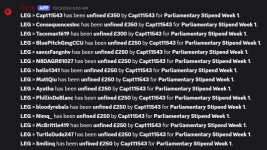
Screenshot from the #budget channel showing the Parliamentary Stipend Week 1 payouts.

Output of the /balance command showing the balance of GovLegislature at the time of filing.

Screenshot of the declaration of the vote thread on P.B. 07-006 | The SALT Act, showing the timestamp for the end of the voting period.
Respectfully submitted,
Capt B. Numbers
Speaker of Parliament
ENTREATY FOR EMERGENCY RELIEF
I. JURISDICTION & STANDING
This Court has the ability to hear standalone petitions for emergency relief in the first instance as the court with original jurisdiction over all civil matters arising under statutory law. See K. A. Const. Art. 16:
The Magistrates Court shall have jurisdiction over all criminal and civil matters, except those explicitly reserved for the Chancery by this Constitution or other specific laws. All cases shall initially be heard in the Magistrates Court, unless otherwise specified by law or granted special leave by the Chancery.
Petitioner has standing as the principal representative of Parliament; in particular, its administrative arm, the Office of the Speaker (see K. A. Const. Art. 4(4)). Parliament is about to be gravely affected by an application of law, because it is facing a legal obligation that it cannot hope to meet. See General Court Rules and Procedures (Judiciary of Alexandria, 2025) §1(9).
II. PARTIES
Capt B. Numbers, in his official capacity as the Speaker of Parliament, Petitioner
III. FACTS
All dates and times given are in EST unless stated otherwise.
- On August 16, 2026, A.P. 06-007 | Crown Remuneration Act (the "CRA") was signed into law.
- The CRA provides that Parliament is obligated to pay certain officials stipendiary remuneration on a weekly basis. (CRA §2(1)(e), §8(5)).
- Assuming one Speaker and Deputy Speaker, one Prime Minister, and 10 MPs, and further assuming that each Minister is also an MP, the weekly stipendiary remuneration required under the CRA is £3,500.
- Assuming one Speaker and Deputy Speaker, one Prime Minister, and 10 MPs, and further assuming that no Minister is also an MP, the weekly stipendiary remuneration required under the CRA is £5,000.
- The final figures provided in Facts 3 and 4 represent the range of possible total stipendiary remuneration due each week under the CRA.
- The 7th Parliament convened on Saturday, September 26, 2026.
- The first weekly stipendiary remuneration payouts under the CRA were due on Saturday, October 3, 2026, and were paid in full. The total amount paid was £4,000. (P-001)
- The second weekly stipendiary remuneration payouts will be due on Saturday, October 10, 2026.
- The current balance of Parliament's official account, GovLegislature, is £850. (P-002)
- P.B. 07-006 | The SALT Act was introduced to reduce the required frequency of statutory stipendiary remuneration under the CRA. At the time of filing, it is up for a vote on passage which will conclude on Saturday, October 10, 2026. (P-003)
- P.B. 07-007 | October 2026 Appropriations Act (the "October Budget") was introduced today, October 8, 2026. At the time of filing, this bill will pass Parliament no sooner than October 10, 2026. (Standing Orders of the 7th Parliament (Parliament of Alexandria, 2026) §5(a))
IV. CLAIM FOR RELIEF
In 48 hours, Parliament will be legally obligated to pay £4,000. As shown in P-002, Parliament cannot currently afford this. Given that the October Budget will not pass before the second week's stipendiary remunerations are due, and even then the Monarch signs legislation at their convenience (Writ of Prior Ponderance IV (Ch. 2025) §III), it is highly unlikely that Parliament will be able to afford its payroll obligations in the near future.
The CRA was assented into law in August, thereby binding Parliament through the Office of the Speaker to comply with its terms. Since the beginning of the 7th Parliament, the Office of the Speaker has taken care to meet its payroll obligations. However, Parliament relies on the Members of Parliament--typically those representing the governing majority--to propose Appropriations Acts to provide funding for its operations. The Office of the Speaker is unable to act on its own initiative to procure more funds. Therefore, it is through no fault of Parliament that it will be unable to meet its payroll obligations, but unable it will be nonetheless.
This Court is empowered to grant emergency relief suspending certain provisions of law when there is sufficient evidence that the law cannot be followed without causing harm. (See The Crown v. Thritystone, Case 3 (Mag. Ct. 2026) #16, upheld by the Chancery in Entreaty of Removal for Case 3 (Mag. Ct., 2026).) In this case, the potential harm to the institution of Parliament would be the possibility of civil liability for failure to meet payroll, which would expose the Crown to additional civil penalties on top of restitution for the unpaid payroll. The October Budget, thankfully, will grant Parliament a significantly increased budget for payroll. Furthermore, the SALT Act will reduce Parliament's payroll obligations to approximately 25% of its current obligations by way of reducing the stipendiary remuneration frequency from weekly to monthly. This means that Parliament will eventually be able to meet its payroll obligations, and any emergency relief sought from this Court today will indeed be temporary.
V. PRAYER FOR RELIEF
In seeking just relief, Petitioner humbly beseeches this Court to issue a Writ of Emergency Relief suspending Parliament's payroll obligations until such time as it has the funds to meet them.
VI. EVIDENCE
All timestamps shown are in EST unless stated otherwise.
Screenshot from the #budget channel showing the Parliamentary Stipend Week 1 payouts.
Output of the /balance command showing the balance of GovLegislature at the time of filing.
Screenshot of the declaration of the vote thread on P.B. 07-006 | The SALT Act, showing the timestamp for the end of the voting period.
Respectfully submitted,
Capt B. Numbers
Speaker of Parliament